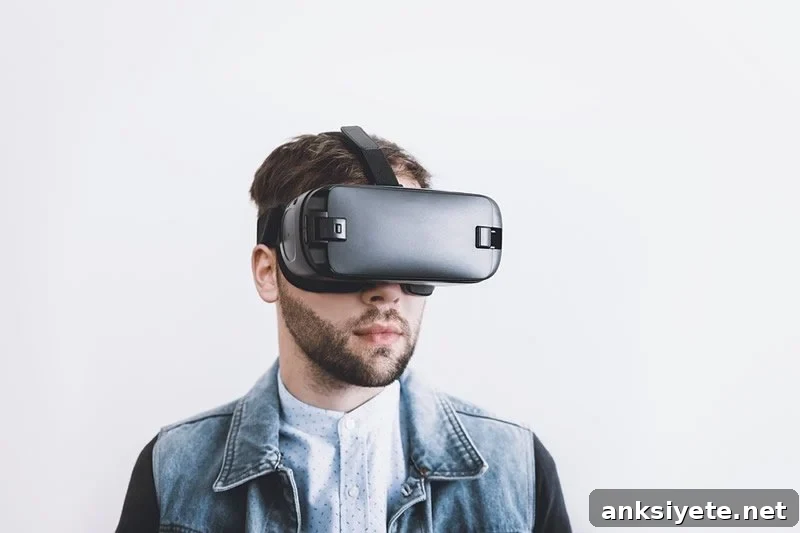
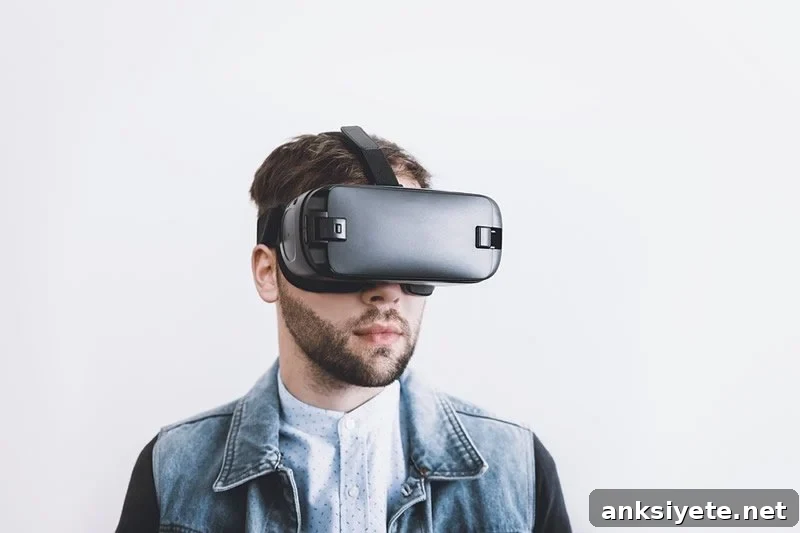
Summary: Vision appears to play a stronger role than body movements in forming memories of large-scale spaces. These findings help resolve a long-standing debate about whether physical movement enhances learning of physical environments.
Source: University of Arizona
Virtual reality is increasingly part of daily life—from virtual home tours to immersive game headsets—and its practical uses are expanding beyond entertainment.
Arne Ekstrom, director of the Human Spatial Cognition Lab in the University of Arizona Department of Psychology, studies how people navigate and remember space using virtual reality (VR). His lab explores the potential of VR for useful training applications, such as preparing first responders, medical teams, and workers who must operate in hazardous environments. To make those applications effective, researchers need a clearer picture of how people learn and remember virtual spaces.
In a study published in the journal Neuron, Ekstrom and co-author Derek Huffman, a postdoctoral researcher at the Center for Neuroscience at the University of California, Davis, tested whether physically moving through a virtual environment improves how well people learn that space.
“One concern with virtual reality is that it doesn’t always capture the real-world experience of navigation,” said Ekstrom, an associate professor of psychology and the study’s senior author. “We wanted to determine what information is sufficient for forming spatial representations that let you know where things are.”
Participants explored three different virtual cities while wearing VR headsets. Each person navigated in one of three ways:
- Walking on an omnidirectional (360-degree) treadmill while wearing the headset, allowing natural walking and head turns to steer through the environment.
- Using only a handheld joystick to move through the environment, without walking or head-based navigation.
- Combining side-to-side body shifts with joystick control—participants could move their bodies but could not walk freely.
On average, participants spent two to three hours exploring each virtual city, locating particular shops and learning the layout. After this learning phase, they answered spatial memory questions—for example, imagining standing at a coffee shop facing a bookstore and then pointing toward the grocery store.
Behavioral accuracy did not differ across the three navigation conditions: whether participants walked, used a joystick, or combined body shifts with a joystick, their pointing performance was comparable.
Participants later completed similar tasks while undergoing fMRI. The brain scans showed that the same regions were activated across all three navigation methods, and the patterns of interaction between those regions were also similar.
“The neural codes were essentially identical across conditions,” Ekstrom said. “That suggests that once people have had enough exposure to learn an environment, visual information alone in VR provides sufficient input. Additional body movement cues don’t add substantially to spatial memory performance.”
These results address a long-standing debate about the role of body-based cues—such as head turns, vestibular signals, and motor feedback—in forming spatial representations of large-scale spaces.
“Some have argued that lacking body-based cues would leave out a major component of spatial memory,” said Huffman, the study’s first author. “Our results indicate that for well-learned environments, it matters less how you originally learned the space.”
“You don’t necessarily need full body immersion or motion cues to form complex spatial maps,” Ekstrom added. “Sufficient exposure to a virtual environment— even through simple VR setups—can produce detailed spatial representations.”
Practically, the study suggests that basic VR systems could be effective for training and instruction where learning spatial layouts matters.
“Virtual reality lets us simulate situations people may never directly experience,” Ekstrom said. “For instance, VR could train first responders to navigate and locate people in a building they haven’t visited. Our findings suggest even simple VR tools—where movement is controlled with a joystick—can effectively teach complex spatial knowledge.”
Source:
University of Arizona
Media Contacts:
Alexis Blue – University of Arizona
Image Source:
The image is in the public domain.
Original Research: Closed access
“A Modality-Independent Network Underlies the Retrieval of Large-Scale Spatial Environments in the Human Brain.” Derek J. Huffman and Arne D. Ekstrom. Neuron. DOI: 10.1016/j.neuron.2019.08.012.
Abstract
A Modality-Independent Network Underlies the Retrieval of Large-Scale Spatial Environments in the Human Brain
Highlights
• What role do body-based cues, such as head turns, play in human navigation?
• This question was tested with immersive virtual reality combined with neuroimaging.
• Behavioral and brain data support the idea that human spatial memory is modality independent.
• Vision may play a dominant role in human memory for large-scale spaces.
Summary
It remains unclear how necessary body-based cues—vestibular, somatosensory, and motoric signals—are for expressing spatial representations in humans. Advances in immersive VR made it possible to manipulate the availability of body-based cues during navigation, using an omnidirectional treadmill and a head-mounted display. This study used fMRI to compare levels of activation, patterns of activity, and network interactions during spatial retrieval tasks. Behavioral and neuroimaging results point to a core, modality-independent network that supports spatial memory retrieval: for well-learned large-scale environments, primarily visual input may be sufficient to express complex spatial representations.