
“Second Brain” Neurons Coordinate Rhythmic Activity to Propel Waste Through the Colon
Summary: New research uncovers how enteric neurons synchronize their firing to generate the muscle contractions that drive fecal pellets through the colon.
Source: SfN
A study of isolated mouse colons published in the Journal of Neuroscience shows that millions of neurons in the gastrointestinal tract coordinate their activity to produce the rhythmic muscle contractions that move waste through the final section of the digestive system. The researchers identified a previously unknown pattern of neuronal firing that may reflect an evolutionarily conserved motor pattern.
The enteric nervous system (ENS), often called the “second brain” or the “brain in the gut,” can operate independently from the central nervous system (CNS). Some evidence even suggests the ENS evolved before the CNS, leading to the label “first brain.” Although the ENS’s role in controlling colonic motor patterns has long been recognized, directly observing how enteric neurons fire to generate coordinated contractions has been technically challenging.
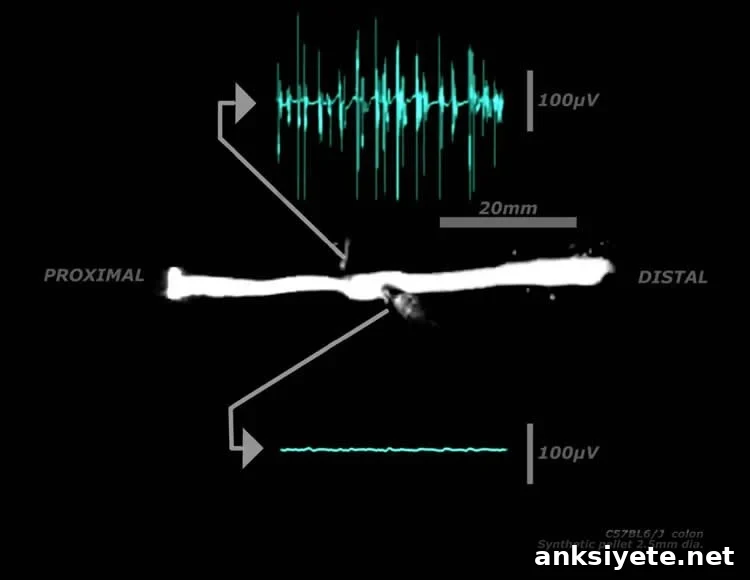
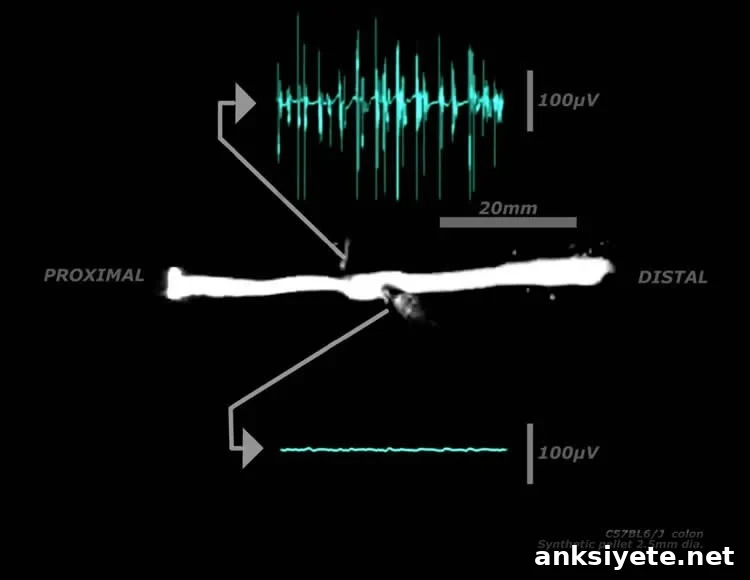
Researchers led by Nick Spencer combined a high-resolution neuronal imaging technique with electrophysiological recordings from smooth muscle to reveal how large networks of enteric neurons fire in coordinated, rhythmic bursts. These bursts involve many cell types—both excitatory and inhibitory neurons—activating together in repetitive patterns at approximately 2 Hz, and this neuronal rhythm precedes and drives the rhythmic depolarizations in smooth muscle that produce colonic migrating motor complexes (CMMCs).
By recording activity across multiple ganglia and comparing neuronal imaging with nearby muscle recordings, the team showed that the ENS generates temporally synchronized firing across several millimeters of colon tissue. During intervals between contractions, individual enteric neurons show ongoing activity. But as a neurogenic contraction begins, activity across large populations of neurons becomes temporally aligned and rhythmic, producing the smooth muscle depolarizations that result in coordinated contractions and propulsion of fecal pellets.
Funding: National Health and Medical Research Council of Australia.
Source / Publisher: David Barnstone – SfN. Article organized by NeuroscienceNews.com. Image credit: Spencer et al., JNeurosci (2018).
Original Research: Abstract for “Identification of a rhythmic firing pattern in the enteric nervous system that generates rhythmic electrical activity in smooth muscle” by Nick J. Spencer and colleagues, Journal of Neuroscience. doi: 10.1523/JNEUROSCI.3489-17.2018 (Published May 28, 2018).
- Enteric neurons fire in large, synchronized bursts at ~2 Hz that precede smooth muscle depolarizations associated with propulsion.
- Rhythmic neuronal firing spans multiple ganglia and coordinates activity across spatial fields of the colon (~7 mm longitudinally in the mouse preparation).
- The coordinated bursts include both excitatory and inhibitory neuron populations, indicating a network-driven mechanism rather than a single-cell pacemaker.
- This study provides the first direct observation of rhythmic firing in the ENS that underlies rhythmic electrical activity in smooth muscle and the generation of colonic migrating motor complexes (CMMCs).
Abstract (Condensed)
The enteric nervous system contains millions of neurons that organize intestinal motor behavior. Although the large intestine requires ENS activity to produce propulsive motor patterns, the specific ENS firing pattern behind propagating neurogenic contractions was unknown. Using high-resolution neuronal imaging alongside smooth muscle electrophysiology in mouse large intestine, researchers found that myoelectric activity during colonic migrating motor complexes consists of prolonged bursts of rhythmic depolarizations at ~2 Hz. Temporal coordination of smooth muscle activity across large spatial fields depends on the ENS. During quiet periods, many enteric neurons remain active, but the onset of neurogenic contractions is marked by widespread, temporally synchronized firing across excitatory and inhibitory neurons at ~2 Hz. ENS activation leads muscle depolarization, indicating enteric neuronal firing controls rhythmic muscle electrical activity. This cyclic, coordinated firing of large neuronal populations represents a unique peripheral neural motor pattern and explains the neural basis of CMMCs.
SIGNIFICANCE STATEMENT
While the gastrointestinal tract contains myogenic pacemakers (interstitial cells of Cajal) that produce rhythmic contractions, the neuronal mechanisms that generate rhythmic neurogenic contractions were unclear. By developing a high-resolution neuronal imaging method combined with electrophysiology, the study reveals a novel, coordinated rhythmic firing pattern in the ENS. This rhythmic neuronal activity generates neurogenic depolarizations in smooth muscle that underlie contractile behavior of the colon, clarifying how enteric networks drive gut motility.
MLA: SfN. “‘Second Brain’ Neurons Keep Colon Moving.” NeuroscienceNews. NeuroscienceNews, 29 May 2018.
APA: SfN (2018, May 29). ‘Second Brain’ Neurons Keep Colon Moving. NeuroscienceNews. Retrieved May 29, 2018.
Chicago: SfN. “‘Second Brain’ Neurons Keep Colon Moving.” NeuroscienceNews. Accessed May 29, 2018.