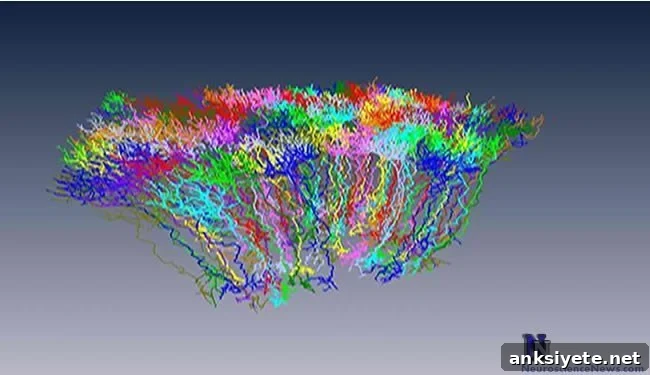
Max Planck researchers create new analytical tools for rapid, accurate neural network reconstruction
The human brain remains the most intricate organ known, composed of billions of neurons interconnected by a dense three-dimensional web of dendrites and axons. Mapping this vast network—the connectome—has long posed a formidable challenge. Researchers at the Max Planck Institute for Medical Research in Heidelberg have now developed software and a collaborative workflow that dramatically speed up and improve the accuracy of neuronal reconstruction. Using the new tools KNOSSOS and RESCOP, a team that included more than 70 students reconstructed a retinal network of over 100 neurons more quickly and reliably than previous approaches.
Each neuron in the human brain typically connects to hundreds or thousands of others through finely branched projections and synapses. These connections underlie all brain functions, so understanding the precise wiring of neural circuits is a major goal in neuroscience. Complete reconstruction of such networks requires following individual neurites through three-dimensional electron microscopy stacks. Because fully automated algorithms remain insufficiently accurate for this task, manual annotation by human experts has been necessary—but the scale of the effort has made single-lab reconstructions impractical for large volumes of tissue.
To overcome these limits, Moritz Helmstaedter, Kevin L. Briggman and Winfried Denk and their colleagues developed a two-part solution. KNOSSOS is an interactive tracing program that lets users follow neurites through serial electron microscopy images and mark branch points and paths. RESCOP aggregates the work of multiple annotators, compares redundantly traced segments and computes a consensus reconstruction. Together, these tools enable distributed, high-throughput reconstruction while reducing individual bias and error.
The practical workflow begins with tissue preparation and heavy-metal staining to enhance contrast for electron microscopy. Annotators then navigate three-dimensional image volumes from a starting cell body and trace dendritic and axonal branches across consecutive sections. KNOSSOS is designed for speed and usability: its interface and tracing tools simplify navigation through the dense neuropil and make it feasible for novices to contribute after modest training. RESCOP’s algorithms identify disagreements among annotators, weight contributions, and produce a consensus model that averages out sporadic mistakes.
These innovations yield major efficiency gains. KNOSSOS is reported to be roughly fifty times faster than previously used tracing programs, cutting the time required for manual reconstruction dramatically. By enabling many people to annotate the same volume in parallel and by using RESCOP to consolidate results, the team achieved reconstructions that matched or exceeded the accuracy of experienced neurobiologists. In the reported project, most student contributors worked remotely and submitted their tracing files by email. Analysis showed that top-performing students produced error rates comparable to trained experts, and RESCOP’s consensus approach further reduced remaining inaccuracies.
Beyond speed, the combined KNOSSOS/RESCOP pipeline improves reliability: consensus reconstructions are more robust to individual lapses in attention or ambiguous image regions. The tools therefore make it feasible to tackle larger volumes of neural tissue than was previously practical, opening the way to map circuit architecture at a scale needed to answer important questions about information flow in the brain.
Winfried Denk emphasizes the potential impact: these programs bring the field closer to unraveling neural networks on a scale that has been compared in complexity to, and in some respects surpassing, major genomic projects. The Heidelberg team plans to apply the same methodology to reconstruct fragments of the mouse cerebral cortex, an area that supports the higher-level cognitive processes central to mammalian behavior.
Notes about this brain research article
Contact: Dr. Moritz Helmstaedter – Max Planck Institute for Medical Research
Source: Max Planck Institute press release
Original research: Moritz Helmstaedter, Kevin L. Briggman, Winfried Denk – “High-accuracy neurite reconstruction for high-throughput neuroanatomy”, Nature Neuroscience, online publication 10 July 2011, doi:10.1038/nn.2868
Image source: Neuroscience image adapted from MPI for Medical Research press release image