
Summary: Connections from oxytocin-producing neurons in the hypothalamus to dopamine neurons in the brain’s reward circuitry drive parental care in both male and female mandarin voles.
Source: SfN
New research published in the Journal of Neuroscience shows that, as in females, oxytocin circuits linking the hypothalamus with reward centers promote active paternal behaviors in male mandarin voles.
Although scientific attention often focuses on motherhood, a notable minority of mammals — including humans and mandarin voles — exhibit substantial paternal care. Understanding the neural circuits that drive fathering behavior is essential for a complete view of parental brain systems.
Oxytocin, commonly called the “love hormone,” has long been associated with bonding and caregiving. Until now, however, the specific neural pathways by which oxytocin supports paternal caregiving were unclear.
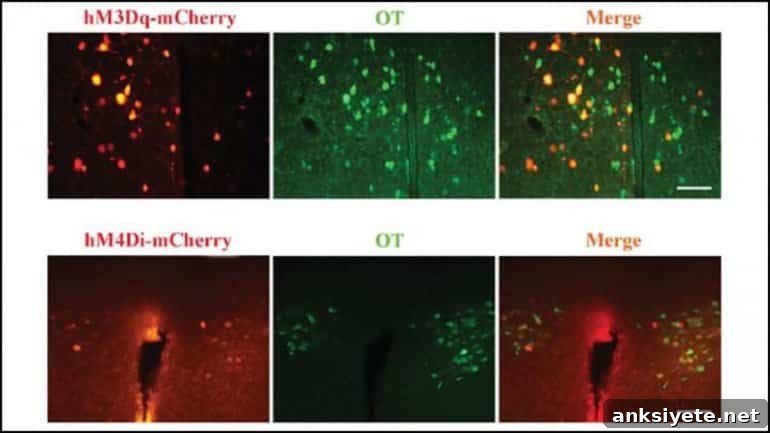
In this study, He and colleagues recorded neural activity in father mandarin voles while the males interacted with their offspring. They focused on oxytocin-producing neurons in the paraventricular nucleus (PVN) of the hypothalamus and their projections to two reward-related regions: the ventral tegmental area (VTA) and the nucleus accumbens (NAc).
The researchers found that PVN oxytocin neurons projecting to the VTA and NAc were actively engaged when fathers displayed caregiving behaviors such as pup licking and grooming. Experimental stimulation of these oxytocin pathways increased paternal behaviors, while inhibiting them reduced paternal engagement. When the PVN-to-VTA oxytocin pathway was inhibited, dopamine release in the NAc decreased during paternal interactions, indicating that oxytocin input modulates reward system activity during caregiving.
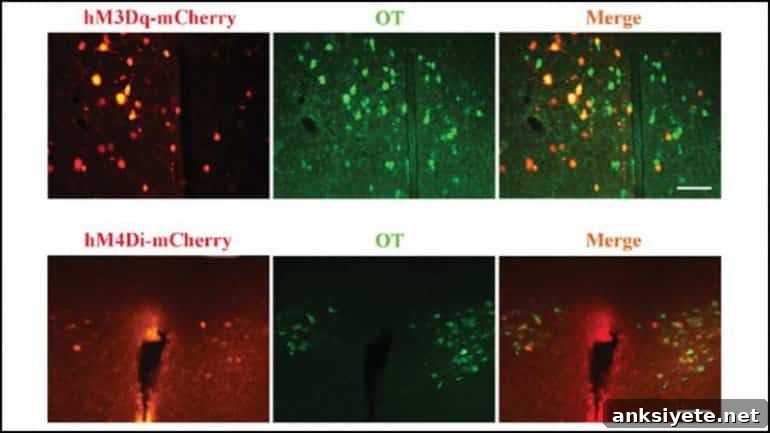
The experiments used chemogenetic and optogenetic tools to manipulate specific circuits: activating or inhibiting PVN-to-VTA oxytocin projections bidirectionally changed paternal care, while optogenetic activation or suppression of VTA-to-NAc dopamine projections also modulated caregiving behavior. Together these manipulations demonstrate a functional chain from hypothalamic oxytocin neurons through midbrain dopamine circuits to the nucleus accumbens that supports active paternal behavior.
These findings indicate that the same oxytocin–dopamine pathways known to promote maternal care also operate in males to motivate paternal behaviors. By linking oxytocin signaling in the PVN to dopamine release in reward regions during parenting, the study clarifies how hormonal and reward systems interact to produce caregiving in fathers.
Beyond basic neuroscience, mapping these circuits has potential clinical relevance. A better understanding of the neural mechanisms that foster healthy paternal caregiving could inform approaches to paternal postpartum mood disorders or interventions aimed at reducing harmful paternal behaviors.
About this neuroscience research news
Source: SfN
Contact: Calli McMurray – SfN
Image: The image is credited to He et al
Original Research: Closed access.
“Paraventricular nucleus oxytocin sub-systems promote active paternal behaviors in mandarin voles” by Zhixiong He, Lizi Zhang, Wenjuan Hou, Xin Zhang, Larry J Young, Laifu Li, Limin Liu, Huan Ma, Yufeng Xun, Zijian Lv, Yitong Li, Rui Jia, Jingang Li and Fadao Tai. Journal of Neuroscience
Abstract (paraphrased)
Paraventricular nucleus oxytocin sub-systems promote active paternal behaviors in mandarin voles
Paternal care strongly influences offspring development and behavior in species that form social bonds, but the neural circuits that support fathering are not well characterized. Using socially monogamous male mandarin voles that naturally exhibit high levels of paternal care, the authors identified oxytocin-producing neurons in the paraventricular nucleus (PVN) that project to the ventral tegmental area (VTA) and nucleus accumbens (NAc) and are selectively activated during paternal interactions.
Chemogenetic activation of PVN-to-VTA oxytocin projections enhanced paternal behaviors, while chemogenetic inhibition reduced care. Inhibiting the PVN-to-VTA oxytocin pathway lowered dopamine release in the NAc during pup-directed licking and grooming, as measured with in vivo fiber photometry. Optogenetic manipulation of the VTA-to-NAc dopamine pathway likewise influenced paternal behaviors in a direction consistent with increased or decreased reward signaling. Chemogenetic control of the PVN-to-NAc oxytocin circuit produced parallel effects on caregiving.
These results reveal two interacting neural circuits—PVN oxytocin outputs to VTA and NAc, and VTA-to-NAc dopamine projections—that together promote active paternal behavior. Identifying these pathways is a foundational step toward understanding the neural basis of paternal caregiving and may inform future research on conditions that impair paternal care, such as paternal postpartum depression or other disruptions to fathering.
SIGNIFICANCE STATEMENT:
Paternal behavior is vital for offspring survival and development in certain mammals, yet its circuit-level mechanisms remain poorly understood. This study demonstrates that PVN oxytocin projections to VTA and NAc, together with VTA-to-NAc dopamine signaling, are key modulators of paternal behavior. Inhibiting PVN-to-VTA oxytocin inputs reduces dopamine release in the NAc during caregiving, and both PVN-to-NAc and PVN-to-VTA oxytocin circuits are essential for normal paternal responses. These findings identify new neural substrates for paternal care.