
Summary: Research finds that people can consider both their own interests and the interests of others, but decisions tend to prioritize self-interest first.
Source: The Conversation
Looking out for yourself has been essential to human survival from the beginning.
Still, self-interest is not the only force shaping human behavior. Groups whose members were inclined to cooperate, care for one another, and uphold norms of fairness often outcompeted less cooperative groups. These prosocial tendencies spread across human populations, and today both self-concern and concern for others shape our sense of fairness.
Together, these motivations support cooperation among strangers—a hallmark of human social life that is rare in other species. A central question is how people balance self-interest and concern for others when making real decisions.
At the Social Cognitive Neuroscience Laboratory at the University of Chicago, we study this balance by combining behavioral economic tasks with brain imaging. Our work with children and adults shows that people are capable of caring about others—but when it comes to decisions, concern for the self tends to come first.
Learning to be equitable
Children show sensitivity to fairness at a very young age.
For example, if two siblings receive different numbers of cookies, the child who gets fewer will often protest. Young children, roughly between ages 3 and 6, strongly prefer equal distributions: giving everyone the same amount is “fair.” By about age 6, some children will even discard rewards rather than accept an unequal distribution.
As children mature, they increasingly understand other people’s minds and social norms. They grasp that fairness can mean equity—where unequal outcomes are justified by differences in need, effort, or merit. For example, a sibling who does more chores may deserve more cookies. This development toward equity appears across cultures.
Notably, children’s behavior can lag behind their understanding: they may recognize sophisticated fairness principles before consistently acting on them by sharing more rather than prioritizing their own immediate gain.
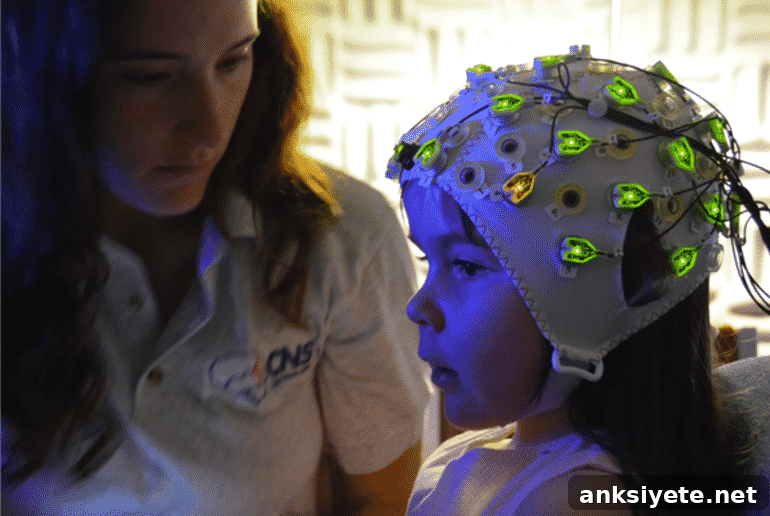
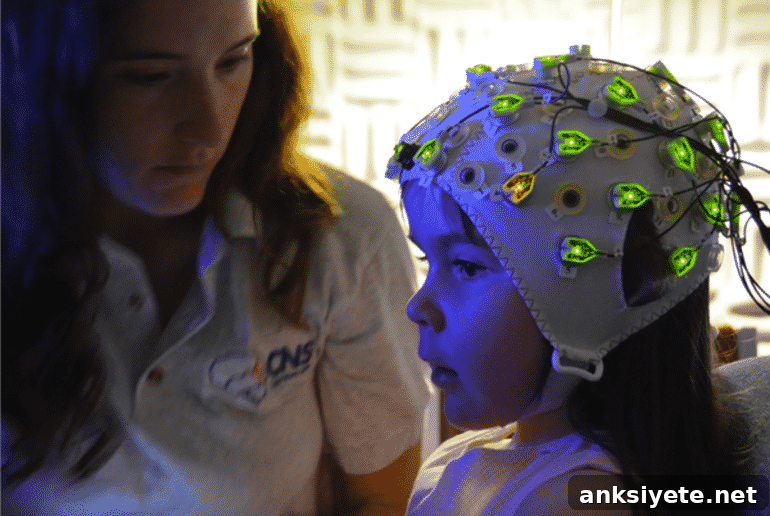
To examine how developing brains support fairness judgments, we tested children aged 4 to 8 in the lab. Each child was given four candies to divide between two other people. After making their allocation, children watched an adult distribute 10 rewards—such as candies, coins, or stickers—between two people. The adult’s distributions were either perfectly equal (5:5), slightly unequal (7:3), or completely unequal (10:0).
While children observed these distributions, we recorded their brain activity using noninvasive electroencephalography (EEG). Initially, brain responses to slightly unfair (7:3) and very unfair (10:0) splits looked similar. But after about 400 milliseconds, the brain response of children who saw a 7:3 split shifted, resembling the response to a fair 5:5 split.
We interpret that brief shift as children rapidly considering why the adult might have given more to one person—perhaps because of merit or need—and then reclassifying the slightly unfair split as acceptable. Children whose brain activity differed most when viewing fair versus unfair distributions were also the ones most likely to use merit or need when they had divided their own candies.
These EEG findings suggest that even 4-year-olds expect equal divisions by default, consistent with a natural preference for equality. By around age 5 and older, when children observe very unfair distributions, they engage cognitive processes to explain—rather than immediately accept—those outcomes.
Me first, then you
In everyday life, many choices affect both ourselves and others. Do you help someone pick up spilled belongings and risk missing your bus? Do you take the larger slice of cake, knowing a coworker will arrive soon?
More broadly, how do people weigh self-interest against fairness for others when those aims collide?
To explore this, we had adult participants play an economic game. In each round, an anonymous proposer divided US$12 among themselves, the participant, and another player. The participant could accept the distribution—so all three received the proposed shares—or reject it, so nobody received anything. While participants decided, we recorded neural activity using EEG and functional magnetic resonance imaging (fMRI).
Although the proposer was actually a computer that allowed us to control fairness, the decisions were real. We found that both fairness toward oneself and fairness toward the other person mattered. Crucially, people were more likely to tolerate offers that were unfair to someone else when their own share was unfavorable: self-interest dominated when personal payoff was threatened.
We also investigated whether thinking about fairness for oneself and for others recruits the same brain regions. One influential view in cognitive science proposes shared neural systems for self and other processing—meaning the brain uses similar mechanisms to represent our own experiences and to model other people’s minds. Instead, our data revealed distinct brain networks for fairness related to self and fairness related to others.
Using machine learning to analyze brain signals, we could reliably decode patterns corresponding to self-related fairness—essentially answering the early question, “Did I get at least one-third of the $12?” This self-focused signal emerged early in the decision process, indicating that concern for personal outcomes dominates the initial stages of evaluation.
Overall, these findings indicate that people usually ensure their own fair share before integrating concerns about others. In many situations, once someone feels secure about their personal outcome, they become more willing to act fairly toward others. That helps explain everyday choices: you may be more inclined to lend a hand if you know you won’t suffer a big personal loss.
Investigating more complicated scenarios
Real-world decisions are often more complex than the responder role in our lab game. We are interested in situations where people must allocate responsibilities within teams, or when individual influence over resource division is limited, such as in public budgeting.
One takeaway from our work is that compromise is easier when people do not feel exploited. Because people tend to look after their own interests first, reaching agreements that protect everyone’s basic share can make it easier to generate cooperative and fair outcomes.
About this psychology research news
Source: The Conversation
Contact: Keith Yoder and Jean Decety – The Conversation
Image: The image is credited to Jean Decety/University of Chicago