
When you recognize a familiar face, when a bird-watcher spots a rare species, or when an enthusiast notices a classic car on the street, a small region of the brain lights up.
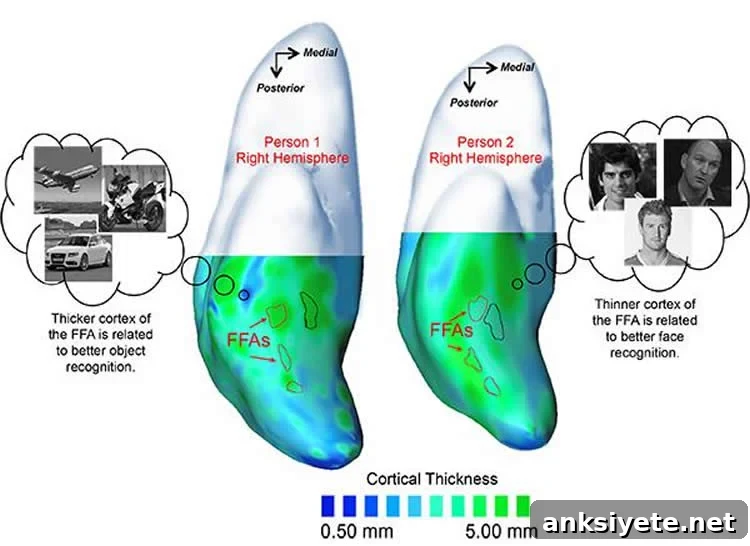
Neuroscientists have long identified this region as the fusiform face area (FFA), a specialized patch of cortex that plays a central role in recognizing faces and other categories of objects that people learn to distinguish. A recent study accepted for publication in the Journal of Cognitive Neuroscience adds a new layer to our understanding: the physical thickness of the FFA’s cortex, measured with magnetic resonance imaging (MRI), can predict an individual’s skill at recognizing faces and objects.
“It is the first time we have found a direct relationship between brain structure and visual expertise,” said Isabel Gauthier, David K. Wilson Professor of Psychology at Vanderbilt University and the senior author of the study. “This finding reinforces the importance of this region for both face recognition and object expertise.”
Unexpected pattern in cortical thickness
Previous work has linked cortical thickness to learning in a straightforward way: as people practice motor skills or musical instruments, relevant cortical regions often form new connections and appear thicker on MRI. The relationship observed in the FFA, however, revealed a surprising double dissociation.
To investigate, Gauthier and colleagues—postdoctoral fellow Rankin McGugin and Ana Van Gulick from Carnegie Mellon University—tested 27 men on their ability to recognize items from several object categories, divided into living and non-living sets, and assessed face recognition ability. Using precise, subject-specific mapping, the team identified each participant’s FFA and measured its cortical thickness.
The results showed a clear pattern: participants with a thicker cortex in the FFA generally performed better at recognizing non-living objects, especially vehicles, while those with a thinner FFA cortex were better at recognizing faces and living objects.
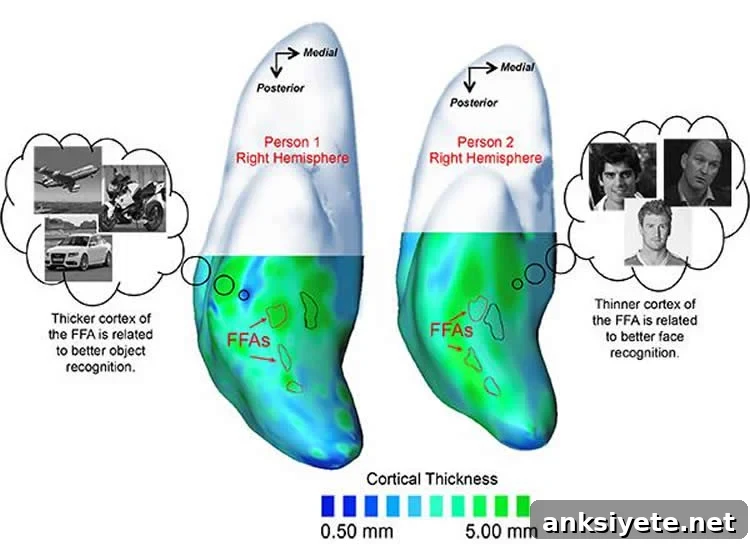
“It was really a surprise to find that the effects are in opposite directions for faces and non-living objects,” Gauthier said. One hypothesis the team is exploring is developmental timing: we typically develop expertise for faces very early in life, while expertise for man-made objects like cars is acquired later, and cortical development differs across those time windows.
The authors note that sex differences in face and object recognition are well documented. Because this initial study included only male participants, the researchers plan to repeat the experiment with women to see whether the same relationship between FFA thickness and recognition performance holds. They also aim to follow non-experts longitudinally, tracking how FFA cortical thickness changes as individuals gain expertise through training.
Funding: This research was supported by National Science Foundation grant SBE-0542013 and National Eye Institute grant R01-EY013441-06A2.
Source: David F. Salisbury – Vanderbilt University
Image Source: Image credited to Rankin McGugin, Vanderbilt University
Original Research: Abstract for “Cortical Thickness in Fusiform Face Area Predicts Face and Object Recognition Performance” by Rankin W. McGugin, Ana E. Van Gulick, Isabel Gauthier in Journal of Cognitive Neuroscience. Published online October 6, 2015.
Abstract
Cortical Thickness in Fusiform Face Area Predicts Face and Object Recognition Performance
The fusiform face area (FFA) is defined by its selective response to faces. Previous studies have shown that the FFA’s response to nonface objects can predict behavioral performance for those categories, but such effects might arise from experts paying more attention to their domain of expertise. This study investigates whether cortical thickness in functionally defined FFA regions relates to face and object recognition performance, independently of attention. Using the Cambridge Face Memory Test to assess face recognition and the Vanderbilt Expertise Test to measure object recognition, the researchers measured cortical thickness in FFA patches in a sample of men who showed functional expertise effects for cars in FFA. Face and object recognition performance together accounted for roughly 40% of the variance in cortical thickness across several FFA patches. Participants with a thicker FFA cortex performed better with vehicles, while those with a thinner FFA cortex performed better with faces and living objects. These results support a domain-general role of FFA in object perception and reveal a notable dissociation between recognition of living and nonliving categories.
“Cortical Thickness in Fusiform Face Area Predicts Face and Object Recognition Performance” by Rankin W. McGugin, Ana E. Van Gulick, and Isabel Gauthier. Journal of Cognitive Neuroscience. Published online October 6, 2015.