
How the Human Hippocampus Encodes Episodic Memories
Summary: A small, distinct subset of hippocampal neurons becomes active for each episodic memory, a new study published in PNAS reports.
Source: UCSD
Researchers at the University of California San Diego and UC San Diego School of Medicine, together with collaborators in Arizona and Louisiana, provide direct evidence that episodic memories are represented in the human hippocampus by sparse and distinct groups of neurons.
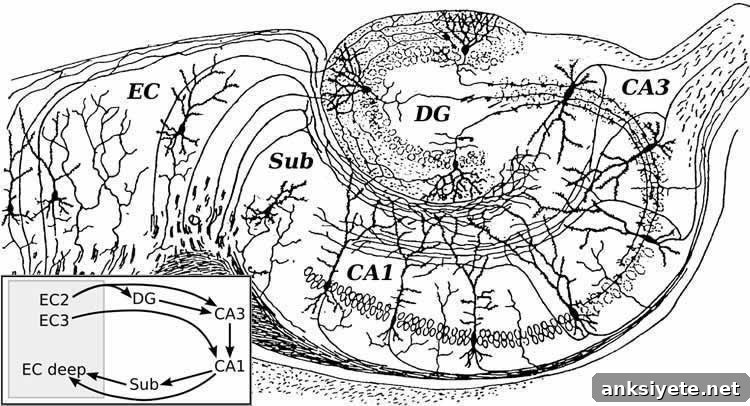
Episodic memories are our recollections of specific events situated in time and place—like remembering a birthday party or a conversation. These memories are known to be encoded in the hippocampus, the small, seahorse-shaped brain regions located deep within the medial temporal lobe. However, until now the exact neural mechanism and the number of neurons involved in encoding each memory have been unclear.
“Scientists study these mechanisms not only to refine models of memory, but also because of their clinical relevance,” said John Wixted, PhD, Distinguished Professor in the Department of Psychology at UC San Diego and the study’s first author. “Early degeneration of the hippocampus is a key factor in memory loss associated with Alzheimer’s disease, so understanding how memories are normally encoded is crucial.”
Wixted and coauthor Larry Squire, PhD, Distinguished Professor of Psychiatry, Neurosciences and Psychology at UC San Diego School of Medicine, led a study that recorded single-neuron activity from 20 patients with epilepsy who were undergoing intracranial monitoring for clinical care. Monitoring electrodes placed in the medial temporal lobe permitted researchers to observe how individual neurons responded during a memory task.
Participants performed a continuous recognition memory task in which they read a stream of words, some of which repeated. For each word they indicated whether it was “new” or “old” (i.e., seen earlier in the list). The team identified hippocampal activity associated with successful recognition of repeated words as neural signals related to episodic memory.
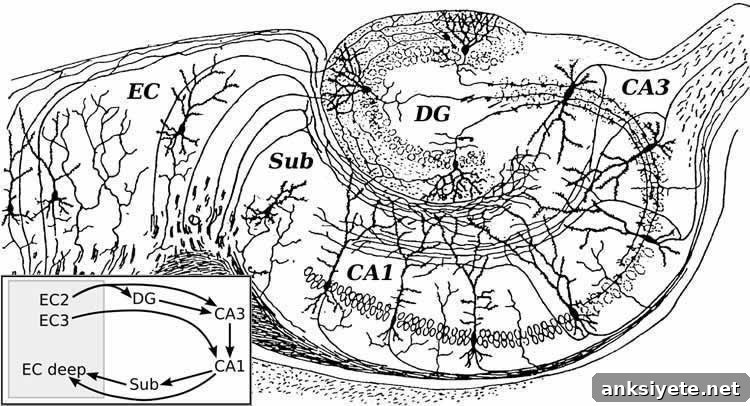
The results reveal a clear pattern: each episodic memory was associated with strong firing in a very small fraction of hippocampal neurons—typically fewer than 2.5 percent. These small sets of neurons were usually non-overlapping across different remembered items, supporting the idea of sparse, distributed coding for episodic memory. Simultaneously, the large remainder of hippocampal neurons (about 97.5 percent) showed reduced firing rates during retrieval of these memories, a phenomenon the researchers describe as neural sharpening.
This combination—sparse, distinct activation for each memory together with widespread suppression of other neurons—matches longstanding theoretical predictions from neurocomputational models of memory. The direct single-neuron evidence had been limited previously, which likely contributed to why this pattern was not detected in earlier studies.
The team also examined the amygdala, a nearby structure involved in emotion and emotional memory. Unlike the hippocampus, the amygdala did not show the same pattern of sparse, stimulus-specific activation associated with episodic memory in this task, consistent with model predictions that the hippocampus has a unique role in encoding episodic information.
“If we are to develop treatments and preventions for memory disorders, including diseases that produce memory loss, we must understand how learning and memory are accomplished in the brain,” said Larry Squire. “Our findings identify a coding scheme in the human hippocampus that theoretical models had predicted but that had previously received limited direct support from single-cell recordings.”
Publication: The findings were published in the online early edition of PNAS (Proceedings of the National Academy of Sciences) on January 15, 2018.
Funding: This research was supported by the McKnight Foundation, the Medical Research Service of the U.S. Department of Veterans Affairs, the National Institute of Child Health and Human Development (NIH), and the National Institute of Neurological and Communicative Disorders and Stroke (NIH).
Authors and study: The study, “Coding of episodic memory in the human hippocampus,” was led by John T. Wixted and includes Stephen D. Goldinger, Larry R. Squire, Joel R. Kuhn, Megan H. Papesh, Kris A. Smith, David M. Treiman, and Peter N. Steinmetz.
Neurocomputational models have long proposed that episodic memories in the human hippocampus are represented by sparse, stimulus-specific neural codes and that activation of these sparse assemblies suppresses competing neurons (neural sharpening). To test these ideas, single-neuron responses were recorded from 20 epilepsy patients performing a continuous recognition task. In the left hippocampus, only a small fraction of neurons showed strong responses to any given repeated word, with different repeated words engaging different small fractions—evidence for sparse distributed coding. The large majority of neurons exhibited reduced firing rates compared with responses to novel words, consistent with neural sharpening. These observations align with theoretical predictions that previously lacked strong single-cell support.