
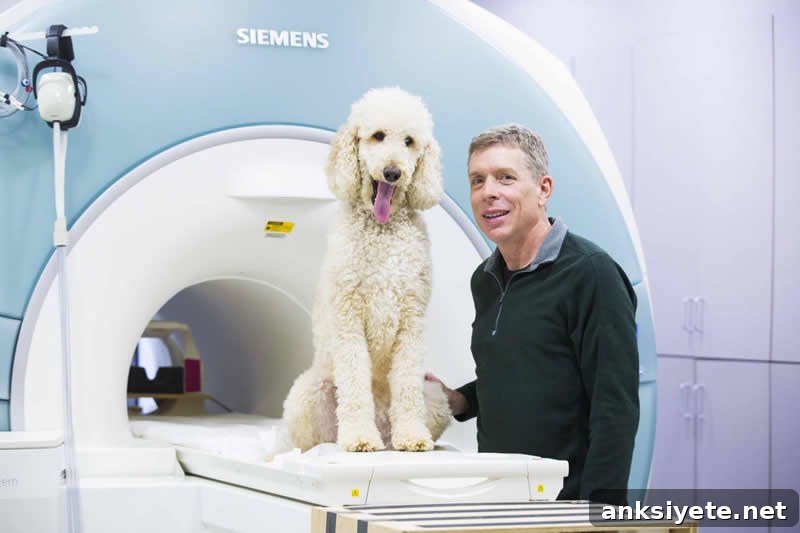
Summary: fMRI neuroimaging shows the parietotemporal cortex of dogs responds to numerical quantities. The study offers evidence that numerosity relies on a neural mechanism conserved across mammals.
Source: Emory Health Sciences
Emory University researchers find that dogs spontaneously perceive basic numerical quantities and recruit a brain region analogous to the number-responsive areas in humans.
Biology Letters published the peer-reviewed results, which suggest that a core neural mechanism for estimating number has been preserved across mammalian evolution.
“Our work not only shows that dogs use a similar part of their brain to process numbers of objects as humans do — it shows that they don’t need to be trained to do it,” says Gregory Berns, Emory professor of psychology and the study’s senior author.
“Understanding neural mechanisms — both in humans and across species — gives us insights into how brains evolved and how they function today,” says co-author Stella Lourenco, an associate professor of psychology at Emory.
Lourenco notes these insights could eventually inform approaches to treating brain disorders and improving artificial intelligence, by revealing fundamental computations shared across species. Lauren Aulet, a PhD candidate in Lourenco’s lab, is the study’s first author.
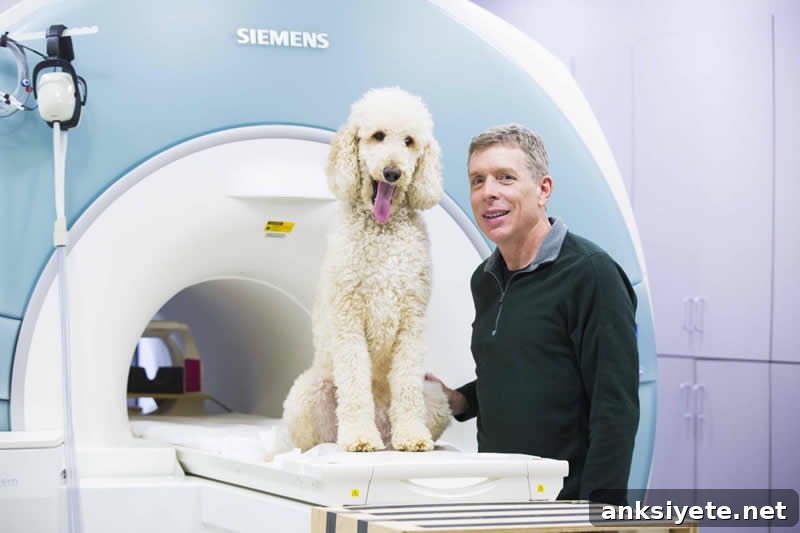
The research used awake functional magnetic resonance imaging (fMRI) to measure brain activity in dogs as they passively viewed brief displays of dots varying in number. Crucially, the total area covered by the dots was held constant so that neural responses could be attributed to the number of items rather than their cumulative size.
Results indicated ratio-dependent activation in the dogs’ parietotemporal cortex: the brain region responded more when the numerical ratio between successive dot arrays was more different than when the arrays had the same number of dots. This ratio dependency is a hallmark of the approximate number system (ANS), a nonverbal mechanism that supports rapid estimation of quantity.
The ANS helps animals and humans make quick judgments about relative quantity—estimating, for example, the number of predators, competitors or the availability of food. In humans, evidence points to the parietal cortex as a primary locus for this ability, which is present from infancy. Behavioral research has shown signs of numerosity across many species, but much prior work required extensive training or rewards, leaving uncertainty about whether number perception operates spontaneously in nonhuman animals.
By scanning untrained dogs that simply viewed dot arrays, the Emory team bypassed those training-related confounds. Eleven pet dogs of various breeds participated in the experiments. None received task-specific training beforehand; they were trained only to enter and remain still in the fMRI scanner voluntarily, a method developed by Berns’ Dog Project. During scanning, eight of the eleven dogs showed greater parietotemporal activation when alternating displays differed in numerosity compared with when the number of dots remained constant.
“We went right to the source, observing the dogs’ brains, to get a direct understanding of what their neurons were doing when the dogs viewed varying quantities of dots,” Aulet explains. “That allowed us to avoid the limitations of behavioral tasks that require training or explicit responses.”
Berns emphasizes the evolutionary significance: humans and dogs diverged roughly 80 million years ago. Finding a ratio-dependent neural response in dogs provides strong support that numerosity is a shared neural capacity that likely dates back deep into mammalian evolution.
Although many animals show a basic sensitivity to number, humans uniquely build on numerosity to develop symbolic mathematics, recruiting additional areas such as the prefrontal cortex for complex calculations. “Part of what allows humans to do algebra and calculus is an evolution from this fundamental, nonverbal numerosity,” Aulet says. “Understanding when and how that higher-level mathematical ability emerged remains a key question for cognitive and developmental science.”
Funding: The research was supported by the National Institutes of Health, the John Merck Fund, and the Office of Naval Research.
Additional authors include Veronica Chiu and Ashley Prichard, Emory graduate students in psychology, and Mark Spivak, CEO of Comprehensive Pet Therapy. Spivak and Berns co-founded Dog Star Technologies to develop methods for studying how dogs perceive the world.
Source:
Emory Health Sciences
Media Contacts:
Carol Clark – Emory Health Sciences
Image Source:
Image credited to Emory University.
Original Research: Open access
“Canine sense of quantity: evidence for numerical ratio-dependent activation in parietotemporal cortex.” Gregory Berns et al., Biology Letters. DOI: 10.1098/rsbl.2019.0666.
Abstract
Canine sense of quantity: evidence for numerical ratio-dependent activation in parietotemporal cortex
The approximate number system (ANS) enables rapid estimation of quantity and emerges early in human development. It is also widespread across species. Neural data from humans and non-human primates implicate the parietal cortex in numerical estimation, but it remains unclear whether similar neural mechanisms support number perception in non-primate species and whether such perception can occur spontaneously without training. To investigate, we recorded fMRI from awake dogs that passively viewed dot arrays varying in numerical ratio, with no task-specific training prior to testing. We observed ratio-dependent activation—a signature of the ANS—in the canine parietotemporal cortex in the majority of studied dogs. These results suggest a conserved neural mechanism for quantity perception across mammalian evolution.