
Summary: Researchers have identified a new role for bidirectional connections in accelerating communication between brain networks.
Source: University of Freiburg
Selective communication among different brain regions is essential for normal brain function, yet the brain’s inherently sparse and weak connectivity presents a major challenge. Over the past decade, neuroscientists have uncovered mechanisms that help overcome this limitation. Now, a team of researchers from Iran, Germany and Sweden reports a novel role for bidirectional (feedback) connections: they can substantially speed up and strengthen communication between neural networks. The study appears in the open-access journal PLOS Computational Biology.
Two principal strategies have been proposed to boost effective connectivity despite sparse wiring: synchrony and oscillatory modulation. In the synchrony mechanism, large groups of neurons fire together in tightly timed volleys; this simultaneous activity produces a stronger, combined impact on downstream targets than individual spikes alone. In the oscillatory mechanism, transient network oscillations periodically raise the excitability of downstream neurons, increasing the chance that incoming spikes will be effective when the receiving network is in a high-excitability phase.
Oscillatory communication requires the sender and receiver networks to be oscillating in sync. “How such synchronous oscillations arise across distinct brain areas has been an open question,” says Ad Aertsen of the Bernstein Center Freiburg at the University of Freiburg. He and colleagues previously proposed that neuronal networks can act as resonators: when stimulated at a particular frequency, a network exhibits amplified oscillations and becomes especially responsive to inputs at that frequency. This idea is known as communication through resonance (CTR).
CTR, however, has limitations. Building up resonance takes several oscillation cycles, and each downstream stage normally needs to establish its own resonant state. As a result, communication across multiple network layers can be slow. “We considered synchrony and oscillations as providing fast and slow communication modes, respectively,” explains Arvind Kumar from the Royal Institute of Technology (KTH) in Stockholm. “But the slow build-up of resonance remained a concern for efficient information transfer.”
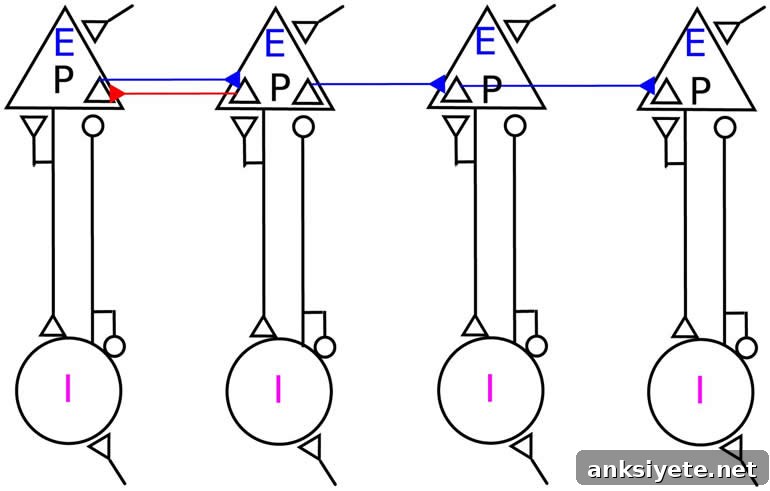
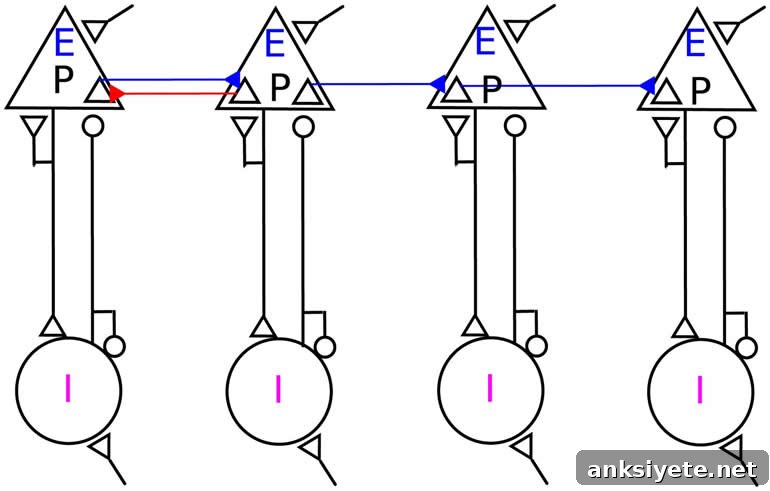
To speed up CTR, the team investigated an anatomical feature commonly observed in cortex: bidirectional connections between areas. In many cases, a subset of neurons in a receiving area projects back to the sending area, forming sparse feedback loops. “Although these bi-directional projections are few in number, they are sufficient to create a recurrent loop between sender and receiver,” explains Alireza Valizadeh from the Institute for Advanced Studies in Basic Sciences in Zanjan, Iran.
Their computational analyses and simulations show that such a feedback loop between a sender and receiver—termed a resonance pair—can dramatically reduce the number of oscillation cycles required to establish resonance. The reciprocal interaction amplifies the initial signal so that a single synchronized spike packet can trigger reliable propagation through multiple network layers, rather than requiring repeated pulse trains tuned to the resonant frequency. Hedyeh Rezaei, a PhD student at Zanjan University and visiting student at the Bernstein Center Freiburg, notes: “Remarkably, a loop connecting just one sender–receiver resonance pair can speed up communication by at least a factor of two.”
Beyond speed, the presence of bidirectional connections lowers the threshold for successful transmission by synchronous spiking in weakly coupled modular networks. The authors identify an important condition for effective transmission: the combined forward and backward delays within the resonance pair should match the network’s intrinsic resonance period. When this timing constraint is met, a single pulse packet can propagate reliably and much faster than in the original CTR scenario.
Ad Aertsen summarizes the findings: “These results support the communication-through-resonance concept and reveal a new functional role for bidirectional connectivity. Feedback loops between cortical areas can shape faster and more reliable inter-area communication.”
About this neuroscience research article
Source:
University of Freiburg
Contacts:
Ad Aertsen – University of Freiburg
Image credit:
Hedyeh Rezaei.
Original Research: Open access
“Facilitating the propagation of spiking activity in feedforward networks by including feedback” by Rezaei H, Aertsen A, Kumar A, Valizadeh A. PLOS Computational Biology.
Abstract
Facilitating the propagation of spiking activity in feedforward networks by including feedback
Transient oscillations triggered by sensory inputs are routinely observed across sensory brain areas. These evoked oscillations reflect the natural response of networks composed of excitatory and inhibitory neurons (EI-networks) to a brief external drive. Recent work has shown that the resonance property of EI-networks can be exploited to transmit sequences of synchronous spike packets (pulse packets) across modular neuronal networks despite sparse and weak intermodule connectivity. This communication-through-resonance (CTR) mechanism requires that pulse packet intervals match the modules’ resonance period. However, CTR faces three main constraints: it typically needs periodic trains of pulse packets (single packets fail to propagate), the inter-packet interval must match the resonance, and transmission is slow because each module must build resonance over multiple cycles. The present study demonstrates that adding targeted feedback connections—forming a resonance pair among upstream modules—alleviates these constraints. Appropriately timed feedback enables a single pulse packet to propagate through the entire network, speeds transmission by more than a factor of two, and reduces the threshold for successful synchronous propagation in weakly coupled networks. These findings point to a functional role for bidirectional connectivity in enabling rapid, reliable communication across cortical area networks.