
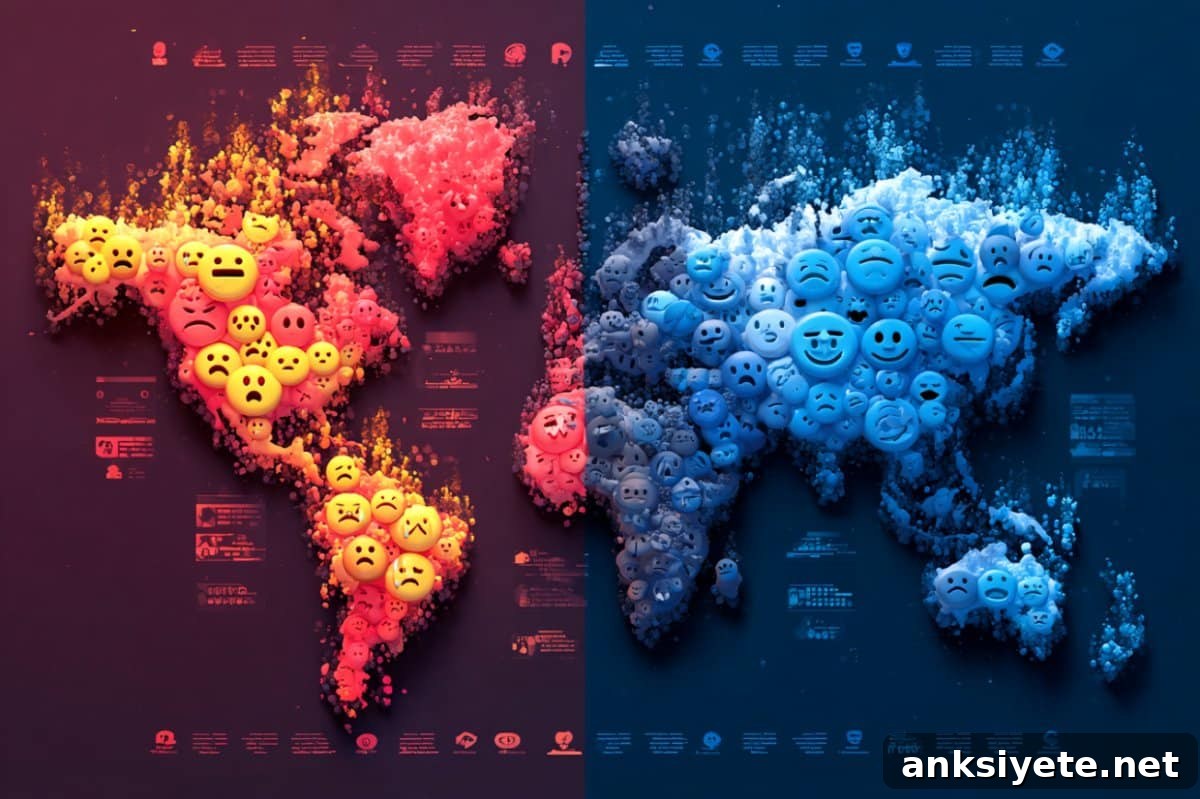
Summary: A large international study finds that extreme heat affects not only physical health and productivity but also people’s emotions. By analyzing more than 1.2 billion social media posts, researchers discovered that when daily temperatures exceed 95°F (35°C), expressed sentiment turns noticeably more negative—an effect that is substantially stronger in lower-income countries.
The study highlights how rising temperatures are changing everyday emotional experiences around the world. Using climate projections, the authors estimate that, if current trends continue, extreme heat alone could reduce global emotional well-being by about 2.3% by the year 2100.
Key Facts
- Scale of analysis: 1.2 billion social media posts in 65 languages, from 157 countries.
- Heat effect: Sentiment declines about 25% in lower-income countries versus about 8% in higher-income countries when temperatures exceed 35°C (95°F).
- Future projection: By 2100, extreme heat could reduce global emotional well-being by roughly 2.3% under the scenarios examined.
Source: MIT
Overview
Rising global temperatures influence many aspects of life. This new, large-scale analysis adds another dimension: very hot days are linked to more negative emotional expression on social media. The research draws on a global dataset to measure how temperature extremes shape sentiment across diverse regions and income levels.
The study examined posts made during 2019 on major social platforms and used advanced natural language processing to score sentiment. When local temperatures rose above 35°C (95°F), the average sentiment expressed online became substantially more negative—especially in lower-income regions, where the impact was about three times larger than in wealthier countries. These findings show that extreme heat has measurable psychological effects, not just physical or economic ones.
“Our analysis shows that rising temperatures threaten not only physical health and economic output, but also daily emotional well-being across the globe,” says Siqi Zheng, a professor in MIT’s Department of Urban Studies and Planning and Center for Real Estate, and a co-author of the paper. “This work opens a new frontier for understanding how climate stress affects human well-being at planetary scale.”
Authors and publication
The study, titled “Unequal Impacts of Rising Temperatures on Global Human Sentiment,” is published in the journal One Earth. The author team includes Jianghao Wang, Nicolas Guetta-Jeanrenaud, Juan Palacios, Yichun Fan, Devika Kakkar, Nick Obradovich, and Siqi Zheng, representing institutions such as the Chinese Academy of Sciences, MIT, Duke University, Harvard University, Maastricht University, and the Laureate Institute for Brain Research.
Using social media to measure emotions
To quantify emotional responses to temperature, researchers analyzed 1.2 billion public posts from Twitter and Weibo dated from 2019. They applied a multilingual version of BERT (Bidirectional Encoder Representations from Transformers) to classify sentiment in 65 languages. Each post received a sentiment score from 0.0 (very negative) to 1.0 (very positive). Those scores were aggregated across 2,988 geographic locations and then compared with local weather observations to identify correlations between temperature extremes and expressed sentiment.
This social media approach offers broad, near–real-time coverage that traditional surveys cannot match, enabling researchers to detect regional and socioeconomic differences in emotional responses to heat. To compare impacts across income levels, the team used a World Bank-inspired cutoff for gross national income per capita. They found that in areas below that income threshold, sentiment declines on extremely hot days were about three times greater than in higher-income areas—a pattern that highlights unequal vulnerability to climate stress.
Long-term projections and implications
Using climate model projections and allowing for partial adaptation over time, the researchers extended their empirical findings to estimate long-term effects. Their projection suggests that, even accounting for some adaptation, rising temperatures could lead to a global average decline in emotional well-being of about 2.3% by 2100 compared with 2019 levels. While such projections involve uncertainty, they indicate that the psychological costs of warming are likely to be persistent and disproportionately burden poorer populations.
“Our results, together with earlier studies, make it clear that weather and climate influence sentiment at global scale,” says Nick Obradovich. “As climates change, promoting resilience to emotional shocks will be an important component of societal adaptation.”
The authors emphasize caveats and areas for future work. Public social media users are not a perfectly representative sample of all age groups—children and the elderly are underrepresented online—but those groups may be especially vulnerable to heat, meaning the study’s estimates could understate total population impacts. The dataset and methods aim to complement other approaches so policymakers and communities can better prepare for a warming world.
The research is part of the Global Sentiment project led by the MIT Sustainable Urbanization Lab. The team hopes that this resource will support further research, inform policy choices, and help communities build adaptive capacity to protect emotional as well as physical well-being in a hotter future.
Funding: The work received support from Zheng’s chaired professorship research fund and grants awarded to Jianghao Wang from the National Natural Science Foundation of China and the Chinese Academy of Sciences.
About this temperature and mood research news
Author: Peter Dizikes
Source: MIT
Contact: Peter Dizikes – MIT
Image credit: Neuroscience News
Original Research: Closed access. “Unequal impacts of rising temperatures on global human sentiment” by Jianghao Wang et al., published in One Earth.
Abstract
Unequal impacts of rising temperatures on global human sentiment
Climate change poses growing risks to human well-being, but prior research on emotional impacts has largely focused on developed countries, leaving global inequalities in psychological vulnerability underexplored. Analyzing over 1.2 billion social media posts from 157 countries, this study documents how rising temperatures influence sentiment worldwide and projects future impacts under climate scenarios.
The analysis reveals a nonlinear pattern: moderate warming can improve sentiment in cooler regions, yet temperatures above 35°C systematically harm emotional well-being globally. The negative effect is about three times larger in low- and middle-income countries (a 25.0% decline in sentiment) than in high-income countries (an 8.1% decline). Even allowing for income growth and partial adaptation, projections indicate a roughly 2.3% global decline in average sentiment by 2100 relative to 2019, underscoring persistent psychological costs that fall disproportionately on the world’s poorest populations. These findings call for climate policies that integrate emotional impacts and prioritize equity in adaptation planning.