
Summary: A membrane protein known as TRPM8 appears to relay testosterone signals in the brain, helping limit aggression and sexual drive. New experiments in mice show that loss of TRPM8 leads to excessive aggression and persistent sexual behavior.
Source: Biophysical Society
Testosterone is commonly associated with driving sexual interest and aggressive behavior, but it also provides feedback that tells the brain when those behaviors should stop. New research from Eleonora Zakharian and colleagues at the University of Illinois College of Medicine identifies the ion channel TRPM8 as a rapid testosterone receptor on the surface of certain cells, and shows that it helps activate brain reward circuits that curb excessive sex and aggression. These findings were presented at the 63rd Biophysical Society Annual Meeting, March 2–6, 2019 in Baltimore, Maryland.
TRPM8 was originally characterized as a sensor for cool temperatures, but high levels of the protein in organs such as the prostate prompted further investigation. Zakharian’s lab discovered that TRPM8 can also bind testosterone and trigger quick cellular signaling. To understand the behavioral role of this receptor, the team studied mice genetically engineered to lack the TRPM8 gene. Male mice without TRPM8 displayed strikingly elevated aggression and markedly increased sexual activity, mounting more frequently and persisting in sexual behavior long after normal mice would stop.
“The mice without TRPM8 are so aggressive that we cannot house them together like typical male mice,” Zakharian said. The pronounced aggression made standard social housing unsafe for these males.
Female mice lacking TRPM8 also showed measurable changes. Although assessment was complicated by the males’ hyperactivity, females exhibited heightened receptivity signals and increased investigatory behaviors such as sniffing, consistent with greater sexual arousal.
These behavioral changes stand in contrast to the effects seen when classic steroid hormone receptors are disrupted. For example, loss of the androgen receptor generally reduces aggression and sexual interest in male rodents. By contrast, TRPM8 appears to be part of a different testosterone-driven pathway that signals reward in the brain: without TRPM8, mating fails to produce normal reward sensations, and mice continue the behavior in an attempt to achieve reinforcement.
Because the hypersexual pattern in TRPM8-deficient males resembled some features of Klüver-Bucy syndrome—a condition sometimes linked to damage in the amygdala, a brain region involved in emotion, social behavior and sexual drive—the researchers examined neuronal activity in the amygdala. Applying testosterone directly to the amygdala activated neurons in normal male mice, but failed to activate those same neurons in males lacking TRPM8. This indicates that TRPM8 is required for testosterone to elicit rapid neuronal responses in that region.
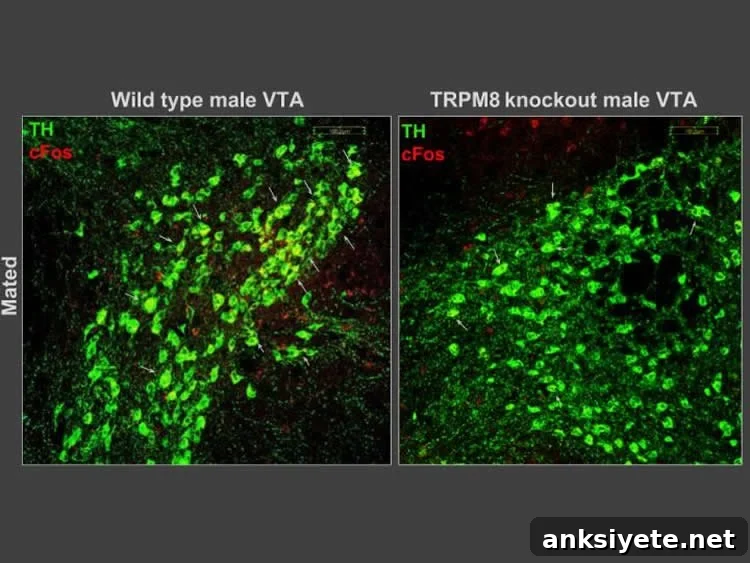
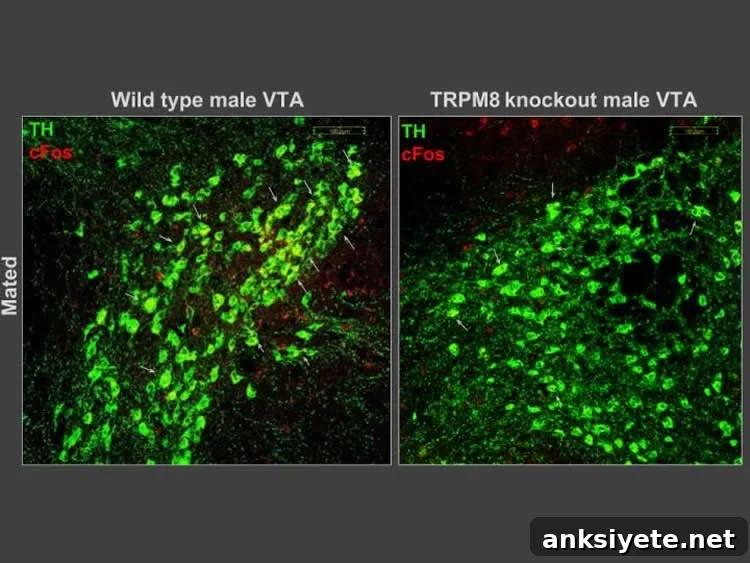
The team also evaluated neurons in the ventral tegmental area (VTA), a central component of the brain’s reward system that is important for sexual reward. After mating, activation of VTA neurons was reduced in males lacking TRPM8, suggesting that the absence of this receptor blunts the normal reward response to sexual activity. Without that reward signaling, the animals appear to persist in aggressive and sexual behaviors in an effort to receive the feedback they no longer experience.
“Without TRPM8, male mice do not experience typical testosterone-driven responses in the brain, and this leads to substantially increased aggression and sexual behavior,” Zakharian explained. The results indicate that TRPM8 may be essential for linking rapid testosterone signaling to the activation of reward circuits that normally help terminate or modulate these behaviors.
These findings provide new insight into how testosterone can both drive and regulate social and reproductive behaviors through distinct molecular mechanisms. Identifying TRPM8 as a testosterone-responsive receptor that influences amygdala and VTA activity helps clarify the neural pathways that control the balance between motivation and restraint for sex and aggression. Further research will be needed to explore how TRPM8 interacts with other hormone receptors and circuits to shape complex social behaviors.
Source: Biophysical Society
Publisher: NeuroscienceNews.com (organized coverage)
Image source: Eleonora Zakharian (credit as provided in original figure)
Original research presentation: Findings announced at the 63rd Biophysical Society Annual Meeting, March 2–6, 2019.
MLA: Biophysical Society. “Sex and Aggression Controlled by Cold Sensor in Brain: Mouse Study.” NeuroscienceNews, 1 March 2019.
APA: Biophysical Society (2019, March 1). Sex and Aggression Controlled by Cold Sensor in Brain: Mouse Study. NeuroscienceNews.
Chicago: Biophysical Society. “Sex and Aggression Controlled by Cold Sensor in Brain: Mouse Study.” NeuroscienceNews. (March 1, 2019).