
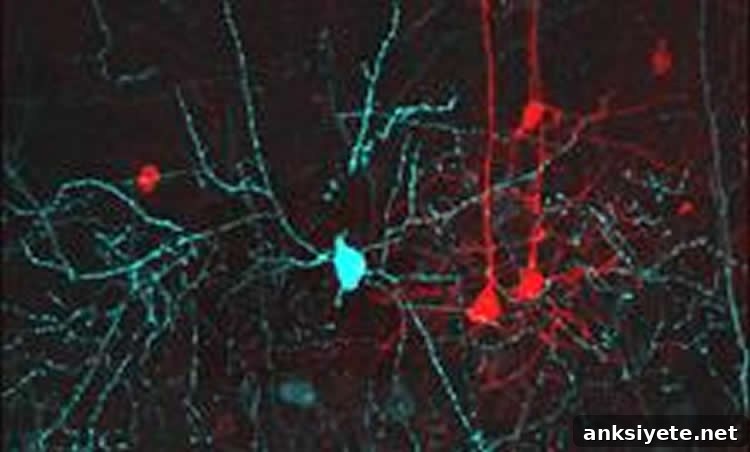
Summary: New research identifies how a class of cortical inhibitory neurons, called basket cells, contributes to spatial information coding and navigation.
Source: King’s College London.
Researchers at King’s College London have identified a specific class of cortical inhibitory neurons that is essential for how the brain encodes and remembers spatial information. Their findings, published in Nature Neuroscience, show that disruption of these basket cells during development impairs hippocampal spatial coding and leads to selective deficits in spatial learning and memory.
The cerebral cortex—the brain’s outer layer—supports complex functions including perception, movement, learning and memory. These functions rely on large, highly organized networks of neurons. Two principal groups of cortical neurons are pyramidal cells, which are generally excitatory, and interneurons, which are inhibitory. Interneurons are extremely diverse, allowing them to shape network activity in many distinct ways. Understanding the specific roles of different interneuron classes is a central challenge in modern neuroscience.
Among cortical interneurons, basket cells are known for their strong inhibitory influence on surrounding neurons, but their precise roles in cortical circuits and behavior have been unclear. The new study demonstrates that a major subclass of basket cells—those expressing the neuropeptide cholecystokinin (CCK) and the vesicular glutamate transporter VGlut3—has a critical role in maintaining accurate spatial representations in the hippocampus.
The research team, bringing together expertise from the Centre for Developmental Neurobiology and the MRC Centre for Neurodevelopmental Disorders at the Institute of Psychiatry, Psychology & Neuroscience, focused on the receptor ErbB4, a tyrosine kinase implicated in neuronal development. They found that when ErbB4 is absent from CCK+VGlut3+ basket cells, these interneurons form fewer synaptic connections and receive reduced input from other neurons. This abnormal wiring during development reduces the inhibitory synapses that these basket cells make onto pyramidal cells and weakens their overall inhibitory drive.
As a consequence of this altered connectivity, the animals exhibited changes in brain oscillatory dynamics—specifically a reduction in theta oscillation power during exploratory behavior—and impaired function of place cells. Place cells are pyramidal neurons in the hippocampus that fire when an animal is in a specific location, forming the neural basis of an internal spatial map. Disruption of CCK+ basket cell integration made these spatial maps less precise and less stable, and adult mice showed selective impairments in spatial learning and memory tasks.
Professor Oscar Marín, senior co-author and Director of the MRC CNDD and the CDN at King’s College London, commented that the work highlights the degree of functional specialization among different neuronal classes in the cortex and shows how modest developmental changes in circuit wiring can have significant effects on adult brain function and behavior.
Professor Beatriz Rico, co-author, added that while the hippocampus is well established as the region that creates detailed spatial maps, their results reveal that a subpopulation of inhibitory interneurons is essential to preserve the shape and stability of those maps. Without proper wiring of these basket cells, spatial representations become diffuse and unstable, undermining accurate navigation and spatial memory.
Funding: The study received support from Fundación Alicia Koplowitz, the European Research Council (ERC), the Spanish Government (CONSOLIDER), Lilly Research Awards Program, and French government programs (ANR and LabEX BRAIN). The senior investigators are also Wellcome Trust Investigators.
Source: King’s College London.
Image source: Image adapted from the King’s College London press materials.
Original research: “Abnormal wiring of CCK+ basket cells disrupts spatial information coding” by Isabel del Pino et al., published online April 10, 2017 in Nature Neuroscience (doi:10.1093/hmg/ddx133).
This study provides converging evidence—from anatomical, electrophysiological and behavioral experiments—that proper integration of CCK+VGlut3+ basket cells into cortical and hippocampal circuits is necessary for accurate spatial coding. Key implications include:
- Developmental disruption of interneuron wiring (via loss of ErbB4) reduces inhibitory synapses and weakens inhibition onto pyramidal neurons.
- Altered inhibitory control leads to changes in theta oscillations during exploration, a rhythm known to support spatial navigation and memory.
- Place cell responses become less precise and less stable, degrading the internal map the hippocampus generates for navigation.
- Adult animals show selective deficits in spatial learning and memory, linking early circuit wiring to later cognitive outcomes.
These results underscore the importance of interneuron diversity and precise developmental wiring for cognitive functions such as navigation. They also provide a framework for exploring how developmental disruptions in inhibitory circuits might contribute to neurodevelopmental and psychiatric disorders that affect cognition.
Abnormal wiring of CCK+ basket cells disrupts spatial information coding
The integration of cortical GABAergic interneurons into specific circuits defines their function, but the mechanisms controlling their wiring are not fully understood. This study shows that the receptor ErbB4 is required for normal integration of CCK+VGlut3+ basket cells into cortical circuits. Conditional deletion of ErbB4 reduced the number of inhibitory synapses these cells form and the inhibitory drive they provide to pyramidal neurons. Developmental disruption of CCK+ basket cell connectivity diminished theta oscillation power during exploration, impaired hippocampal place cell coding, and produced selective deficits in spatial learning and memory in adult mice. These findings indicate that correct integration of CCK+ basket cells is essential to support spatial coding in the hippocampus.