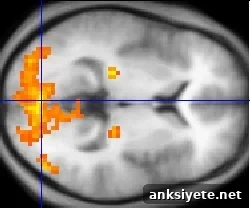
Scientists Identify Two Small Brain Areas That Separately Process Orientation and Shape
Researchers from the Universities of York and Bradford have located two neighbouring regions of the visual cortex that play distinct, causal roles in how we perceive orientation and shape.
Using high-resolution functional magnetic resonance imaging (fMRI) at the York Neuroimaging Centre (YNiC), the team mapped two neighbouring visual field areas—each roughly the size of a 5p coin—and then applied brief, targeted magnetic stimulation to these precise locations to disrupt their activity temporarily. This combination of imaging and focal stimulation allowed the researchers to move beyond correlational measures and demonstrate that the two small cortical regions make independent, specialised contributions to visual perception.
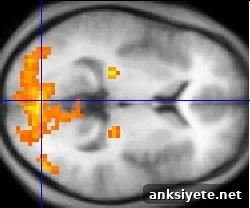
The research was led by Professor Tony Morland (Department of Psychology and Hull York Medical School, University of York) and Dr Declan McKeefry (Bradford School of Optometry & Vision Science, University of Bradford), and formed part of a PhD project by Edward Silson at York. The study identifies a clear functional distinction between two adjacent areas of the extra-striate cortex: disrupting one area selectively impaired tasks that required judging orientation, while disrupting the neighbouring area selectively impaired tasks that required discriminating shapes based on curvature.
Professor Morland explained that while fMRI reveals where activity occurs in the brain, it does not by itself demonstrate which areas are causally necessary for a given perceptual ability. “By temporarily disrupting neural activity in precise, small cortical regions, we can test whether that area is required for a particular perceptual task,” he said. The targeted stimulation approach therefore bridges the gap between brain mapping and functional causation, revealing how distinct cortical patches contribute to different visual computations.
Dr McKeefry added that combining modern brain imaging with focal magnetic neurostimulation provides a powerful way to study the living human brain. The findings illuminate how the brain separates and organises visual information: different attributes of the same object—such as its orientation and its curvature-defined shape—are processed side by side in closely positioned cortical modules. Understanding these modular specialisations is an important step toward explaining how the brain integrates diverse signals to achieve robust object recognition.
The study also points the way for further work. Attention now turns to four additional areas of the extra-striate cortex that are known to be involved in visual processing but whose specific roles remain unclear. Mapping the functional specialisation and interactions among these neighbouring visual field maps will help build a more complete picture of how the human visual system analyses complex scenes and recognises objects.
Why this matters for vision science and object recognition
Establishing causal roles for small, neighbouring cortical regions strengthens our mechanistic understanding of visual perception. The results show that the brain does not rely on a single, widely distributed network to perform basic visual tasks; instead, finely organised cortical maps handle different computations in parallel. This insight refines models of early visual processing and guides future experiments aimed at tracing how information flows from these specialised maps into downstream systems that support memory, decision-making and recognition.
Notes about this neuroscience research article
Contact: David Garner – University of York
Source: University of York press release
Image credit: fMRI image credited to Washington Irving (Wikimedia Commons). The image is reported as public domain.
Original research: The findings are reported in the paper titled “Specialized and independent processing of orientation and shape in visual field maps LO1 and LO2” by Edward H. Silson, Declan J. McKeefry, Jessica Rodgers, Andre D. Gouws, Mark Hymers and Antony B. Morland, published in Nature Neuroscience. The research demonstrates that adjacent visual field maps can have specialised, causal roles in processing distinct visual attributes, an advance for understanding cortical organisation of visual perception.