
Summary: Findings could lead to new treatments to help regeneration following trauma.
Source: Kobe University.
A research team led by Associate Professor Mitsuharu Endo and Professor Yasuhiro Minami has identified a key mechanism by which astrocytes drive the restoration of brain tissue after injury. These results point toward therapeutic strategies that could limit neuronal damage and promote tissue regeneration following ischemia or traumatic injury. The study was published online October 11 in GLIA and appears in print January 2017.
When the brain is damaged by trauma or ischemia—reduced blood flow—immune cells such as macrophages and lymphocytes remove damaged neurons through an inflammatory response. While inflammation clears debris and supports repair, an excessive inflammatory reaction can further injure healthy neurons and worsen outcomes.
Astrocytes are glial cells and the most abundant cell type in the human cerebral cortex. Beyond their traditional supportive roles—providing metabolic support, maintaining the extracellular environment and modulating blood flow—astrocytes actively regulate neuronal activity and participate in tissue repair. After injury, some astrocytes proliferate and form a dense barrier around damaged tissue. This reactive response helps confine inflammation and protect surviving neurons, but until now the molecular triggers that cause astrocytes to re-enter the cell cycle were not well understood.
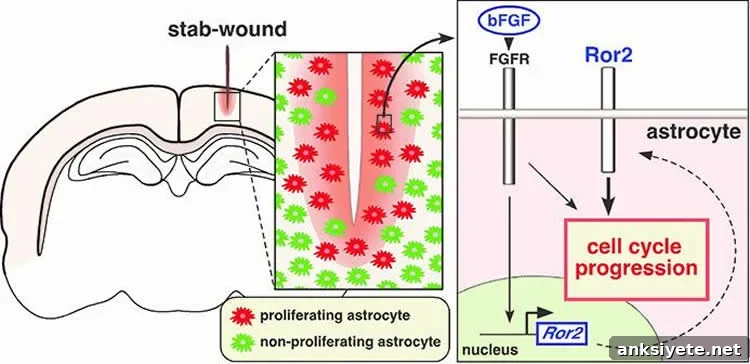
The research team investigated a subpopulation of reactive astrocytes that acquire neural stem cell–like properties near injury sites. They focused on the receptor tyrosine kinase Ror2, a cell-surface protein highly expressed in neural stem/progenitor cells during development. In the healthy adult brain Ror2 is largely silent, but the investigators found that brain injury induces Ror2 expression in a subset of astrocytes localized around the lesion.
Because Ror2 regulates proliferation in neural progenitors, the authors hypothesized that Ror2 drives astrocyte proliferation in injured cortex. To test this, they generated mice with astrocyte-specific loss of Ror2. In those animals, the number of proliferating astrocytes after injury was markedly reduced and the density of astrocytes around the lesion was lower than in control animals. Complementary experiments with cultured astrocytes showed that basic fibroblast growth factor (bFGF), a growth factor up-regulated after injury, can induce Ror2 expression in some quiescent astrocytes and restart their cell cycle.
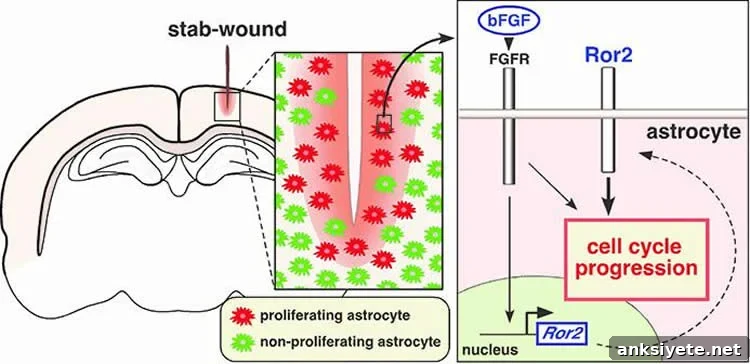
The study indicates that bFGF, produced by several cell types in the injury zone including surviving neurons and astrocytes, provides the signal that induces Ror2 expression in a distinct subset of astrocytes. Only the astrocytes that express Ror2 respond to bFGF by accelerating cell cycle progression and proliferating. The researchers note that the proportion of astrocytes capable of expressing Ror2 may decline with age, which could help explain reduced repair capacity in aging brains and the possible link to cognitive decline. Ongoing work aims to identify how these astrocyte subpopulations are specified and why their proportions change over time.
By understanding and eventually controlling the signals that trigger astrocyte proliferation—particularly the bFGF→Ror2 pathway—future therapies may be able to limit secondary neuronal damage after injury and promote regeneration of damaged cortical tissue.
Funding: Supported by the Japan Society for the Promotion of Science, the Ministry of Education, Culture, Sports, Science and Technology of Japan, and the Takeda Science Foundation.
Source: Eleanor Wyllie – Kobe University
Image Source: NeuroscienceNews.com image credited to Kobe University.
Original Research: Article titled “Critical role of Ror2 receptor tyrosine kinase in regulating cell cycle progression of reactive astrocytes following brain injury” by Mitsuharu Endo, Guljahan Ubulkasim, Chiho Kobayashi, Reiko Onishi, Atsu Aiba, and Yasuhiro Minami. Published online October 11, 2016. doi:10.1002/glia.23086
MLA: Kobe University. “How Brain Tissue Recovers Following an Injury.” NeuroscienceNews. NeuroscienceNews, 16 December 2016.
APA: Kobe University. (2016, December 16). How Brain Tissue Recovers Following an Injury. NeuroscienceNews.
Chicago: Kobe University. “How Brain Tissue Recovers Following an Injury.” NeuroscienceNews, December 16, 2016.
Abstract
Critical role of Ror2 receptor tyrosine kinase in regulating cell cycle progression of reactive astrocytes following brain injury
Ror2, a receptor tyrosine kinase known for roles in development and organogenesis, is typically expressed in neural stem/progenitor cells in the developing brain but is low in the adult cortex. This study demonstrates that Ror2 becomes up-regulated in reactive astrocytes within three days after a cortical stab-wound injury. Ror2-expressing astrocytes concentrate around the lesion and overlap with cells that express Nestin, a neural progenitor marker, and that proliferate after injury. Using astrocyte-specific Ror2 knockout mice, the authors show that loss of Ror2 substantially reduces injury-induced astrocyte proliferation. They also report that bFGF is rapidly up-regulated after injury and that bFGF stimulation of cultured quiescent astrocytes drives their re-entry into the cell cycle and induces Ror2 expression predominantly in cells that progress through G1. Histone deacetylase inhibitors increased the fraction of Ror2-expressing astrocytes in culture, and manipulating Ror2 levels altered bFGF-driven S phase entry. Together, these results identify Ror2 as a critical regulator of cell cycle progression in reactive astrocytes following brain injury.
“Critical role of Ror2 receptor tyrosine kinase in regulating cell cycle progression of reactive astrocytes following brain injury” by Mitsuharu Endo, Guljahan Ubulkasim, Chiho Kobayashi, Reiko Onishi, Atsu Aiba, and Yasuhiro Minami. Glia. Published online October 11, 2016. doi:10.1002/glia.23086