
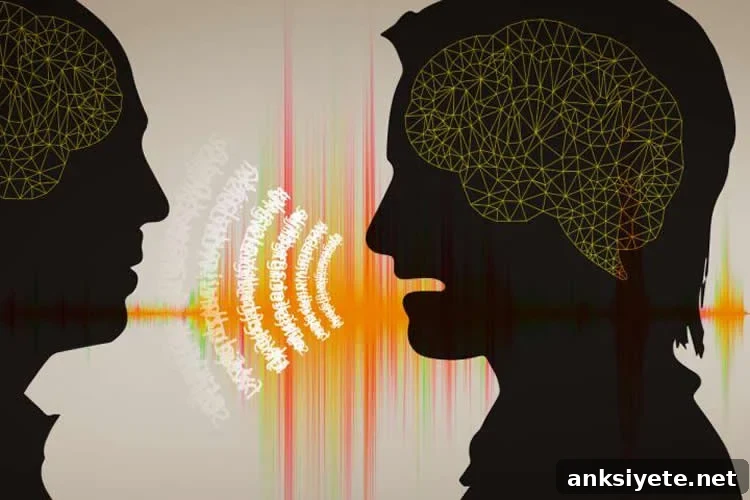
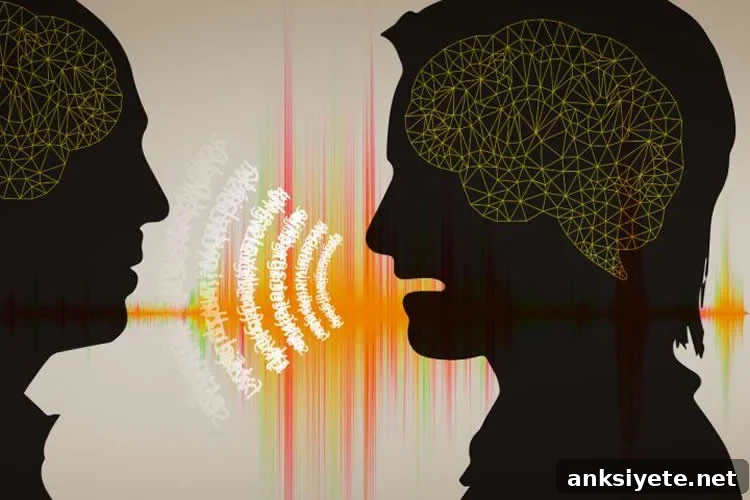
Repeating words aloud improves verbal memory, and the effect is strongest when you speak as if communicating with another person, according to Professor Victor Boucher of the University of Montreal’s Department of Linguistics and Translation. His team’s study, to be published in Consciousness and Cognition, demonstrates that repetition benefits memory in general, but communication-context repetition produces superior recall.
In the study, Boucher and Alexis Lafleur recruited 44 French-speaking university students to view a sequence of lexemes—dictionary-listed words—displayed on a screen. Participants wore headphones emitting white noise to mask their own voices and eliminate auditory feedback. Each participant completed four different conditions: silently repeating the words in their head, silently repeating while moving their lips, repeating aloud while looking at the screen, and repeating aloud while addressing another person. After a brief distraction task, participants were given a recognition test and had to identify which lexemes they had produced from a list that contained both previously presented words and foils.
The findings revealed a clear advantage for the condition in which participants spoke aloud to someone else: recall was significantly better even though the white noise prevented them from hearing their own voices. Covert repetition without articulation proved the least effective. “Articulating silently creates a sensorimotor link that strengthens memory, but when that articulation is embedded within a communicative context, recall improves further,” Boucher explained.
Previous experiments from Boucher’s Phonetic Sciences Laboratory have shown that producing speech generates sensory and motor traces in the brain—movement of the mouth and vibration of the vocal cords provide distinct sensory markers. These oro-sensory and motor cues act as additional retrieval cues that improve memory for verbal material. Beyond those sensorimotor traces, Boucher emphasizes that speaking to someone adds multisensory and social information tied to the communicative episode, which makes the memory more durable. “When speech is produced as part of an interaction, the brain integrates both the sensorimotor aspects of speaking and the contextual, multisensory cues associated with communication. That combination enhances retention,” he said.
The study also connects to well-known ideas about how sensory experiences can trigger memory. The French writer Marcel Proust famously described how the smell and taste of a madeleine evoked powerful, vivid memories of his childhood. Boucher’s research investigates a similar principle for verbal memory: sensory episodes and social context shape what and how we remember. Challenging purely formal approaches to linguistics that rely on written transcription, Boucher has worked to bridge linguistics and neuroscience by investigating the embodied, sensory aspects of spoken language.
To test whether the communicative advantage depends on meaningful words, the researchers ran a second experiment using sequences of syllables that did not form real words in French (non-words). As predicted, performance did not differ across the four production conditions when participants produced non-words. Because non-words lack lexical and semantic anchors in memory, they cannot easily be tied to the same sensory-motor and communicative cues that benefit real words. “The absence of differences with non-words supports the idea that motor-sensory experiences interact with stored verbal representations to aid recall,” Boucher noted. “When the material cannot be connected to existing verbal elements in memory, the added benefit of communicative production disappears.”
Overall, the research highlights the cognitive value of embodied speech and social interaction for verbal learning and memory. Speaking aloud creates sensorimotor traces that aid recall, and speaking as if addressing another person introduces contextual and multisensory cues that further strengthen retention. These results have implications for learning strategies, language teaching, and models of self-monitoring in speech, suggesting that adding a communicative element to rehearsal tasks can meaningfully improve memory for words.
Source: William Raillant-Clark – University of Montreal
Image Credit: Benoit Gougeon
Original Research: “The ecology of self-monitoring effects on memory of verbal productions: Does speaking to someone make a difference?” by Alexis Lafleur and Victor J. Boucher, published in Consciousness and Cognition, October 2015. DOI: 10.1016/j.concog.2015.06.015
Abstract
The ecology of self-monitoring effects on memory of verbal productions: Does speaking to someone make a difference?
Experiments on verbal self-monitoring indicate that memory for spoken words depends on the type of sensory feedback available: spoken-aloud words are remembered better than lip-synched or covertly produced words. Central Monitoring Theory (CMT) explains this by proposing a forward model that matches expected sensory consequences of speech with actual sensory information. CMT also predicts that social factors such as speaker–listener gaze influence attention and memory, and that sensory feedback should not affect learning of novel, unpracticed forms (non-words). Two experiments focused on oro-sensory feedback support these ideas: Experiment 1 shows differential memory effects depending on feedback and on speaker–listener gaze, while Experiment 2, using non-words, finds no differential feedback effects. The results corroborate CMT while suggesting refinements concerning attentional processes.