
Mindfulness Training Boosts Performance with Noninvasive Brain–Computer Interfaces
Summary: Eight sessions of mindfulness-based attention training helped participants gain a clear advantage in controlling noninvasive brain–computer interfaces (BCIs), reducing the time needed to reach proficiency compared with participants who received no meditation training.
Source: Carnegie Mellon University
Overview: A brain–computer interface (BCI) lets a person control a computer or device directly with neural activity. Noninvasive BCIs, which typically use electroencephalogram (EEG) recordings taken through the scalp, are safer and more practical than invasive implants but often require longer and more variable training before users reach reliable control. This variability in learning has been a challenge for wider adoption of EEG-based BCIs.
Researchers led by Bin He conducted a randomized, large-scale human study to determine whether brief, standardized mindfulness training could improve learning and control of noninvasive BCIs. The team evaluated a widely taught form of mindfulness-based attention and body awareness training and measured both behavioral performance and EEG signals during BCI tasks.
Seventy-six adults participated and were randomly assigned either to an eight-week mindfulness training group or to a control group with no preparatory training during the same period. Each participant completed up to 10 BCI sessions. After the mindfulness group finished their course, both groups practiced controlling a simple BCI: moving a cursor across a screen using intention and focused mental imagery. During these tasks, researchers monitored brain activity with EEG and tracked performance over multiple sessions.
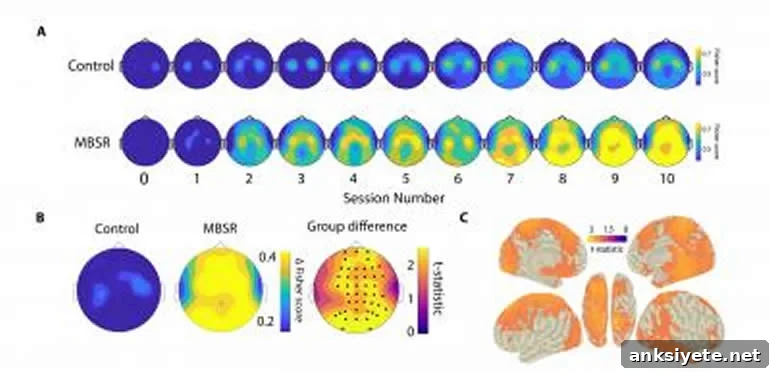
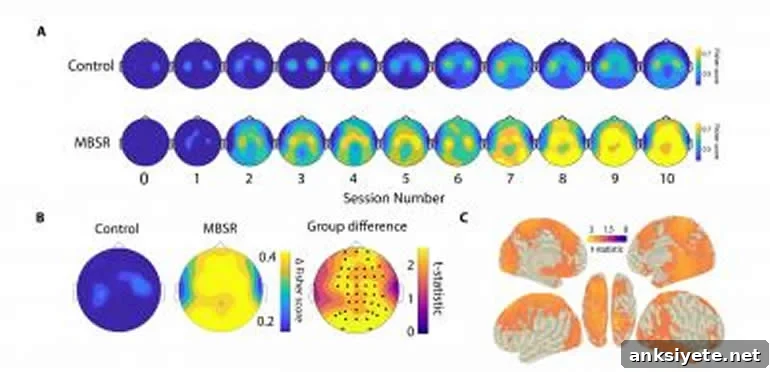
The study found that participants who completed eight lessons in mindfulness-based attention training (MBAT) showed marked improvements in BCI learning and control. Compared with controls, the MBAT group demonstrated faster acquisition of BCI skills and higher initial proficiency when first attempting the EEG-based task. Performance gains were sustained throughout the training sessions.
Crucially, the investigators linked behavioral improvements to measurable changes in neural signals. The mindfulness-trained participants showed greater ability to modulate alpha-band activity—an EEG rhythm the BCI relied on to detect intentional rest and control signals. Alpha-band modulation increased across sessions for the MBAT group and reliably predicted final BCI performance, indicating that mindfulness practice changed a neural feature directly relevant to noninvasive BCI control.
“Meditation has been widely practiced for well-being and improving health,” said Bin He.
“Our results show that mindfulness practice can also strengthen the mental skills needed for mind control and could broaden the practical use of noninvasive BCI technology,” He added.
Beyond immediate performance benefits, these findings have practical implications for BCI design, clinical deployment, and long-term maintenance. Machine learning algorithms that translate EEG signals into commands depend on consistent neural patterns. If short-term mindfulness training enhances users’ control over the specific neural rhythms used by BCIs, it could reduce training time, improve initial calibration, and lower the frequency of recalibration needed for reliable performance.
The study also offers a new application for a widely practiced, low-cost intervention. While previous work suggested that long-term meditators may be better at noninvasive mind control, this research demonstrates that even a brief, standardized MBAT program can produce measurable neural and behavioral changes relevant to BCI use. That opens the possibility of incorporating mindfulness training into standard BCI preparation protocols for patients and healthy users alike.
Funding: This research received partial support from the National Center for Complementary and Integrative Health, the National Institute of Mental Health, the National Institute of Biomedical Imaging and Bioengineering, and the National Institute of Neurological Disorders and Stroke.
The first author of the study was visiting Ph.D. student James Stieger. Co-authors included Stephen Engel, Haiteng Jiang, Christopher C. Cline, Mary Jo Kreitzer, and Bin He.
Abstract
Mindfulness Improves Brain–Computer Interface Performance by Increasing Control Over Neural Activity in the Alpha Band
BCIs hold promise for assisting people with paralysis and other motor impairments, but they are hindered by lengthy training and variable user proficiency. Mind–body awareness training (MBAT), including mindfulness-based stress reduction (MBSR), may speed BCI learning, yet the neural mechanisms were not fully understood. In this randomized study, MBAT participants learned to volitionally increase alpha-band neural activity during tasks that incorporated intentional rest. The MBAT group learned faster than untrained controls, and alpha-band EEG activity during volitional rest rose across sessions in parallel with better performance. Alpha levels correlated with both mindfulness practice and performance on a breath-counting measure, linking the behavioral benefits to a specific neural signal. These findings indicate that MBAT changes a neural feature used by EEG-based BCIs and suggest MBAT could enhance the effectiveness of noninvasive BCI approaches for a broad population.