
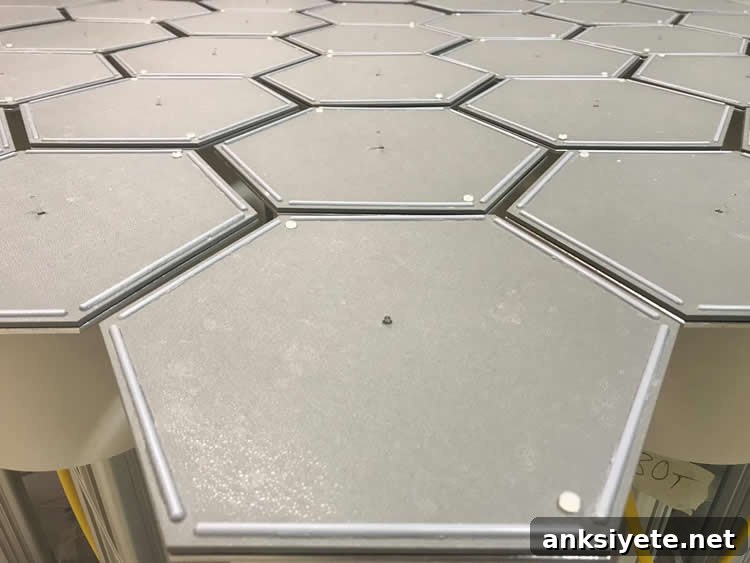
Summary: Researchers have designed a new maze to evaluate spatial and navigational memory. The Honeycomb Maze is reported to be a substantial improvement over the widely used Morris Water Maze.
Source: Sainsbury Wellcome Center.
A new behavioral tool for studying spatial memory, the Honeycomb Maze, offers researchers more precise and controllable measures of navigation than traditional tests such as the Morris Water Maze. Described today in Nature, the Honeycomb Maze enables systematic analysis of the choices an animal makes while navigating toward a hidden goal.
Spatial navigation tasks are essential for studying how animals determine their location and choose routes toward desirable places while avoiding undesirable ones as environmental conditions change. Such tasks probe the neural circuits that support orientation, memory, and decision-making.
Professor John O’Keefe of the Sainsbury Wellcome Centre at UCL, awarded the 2014 Nobel Prize for the discovery of place cells—neurons that map location in the brain—commented on the development:
“Collaboration between the Sainsbury Wellcome Centre and the UCL Biosciences mechanical workshop made it possible to realize a maze we have planned and refined for more than ten years, testing a variety of technologies and configurations.”
The Honeycomb Maze was explicitly created to address limitations of common spatial tests such as the T- or Y-maze, the Olton radial arm maze, the Barnes maze and the Morris Water Maze. Professor O’Keefe explains how the new task works:
“The Honeycomb Maze is built from 37 independently movable platforms. This design allows an animal to be confined to a localized platform anywhere in the array and forces it to choose between two neighboring platforms en route to the goal. When the animal selects the path with the smaller deviation from the goal-heading direction, it demonstrates knowledge of the goal’s location and the most direct route to reach it.”
“Like the Morris Water Maze, the Honeycomb Maze requires animals to approach a hidden goal from multiple directions, which prevents reliance on non-hippocampal strategies. In addition, by presenting a binary choice at each step it provides a clear, simple measure of success for each decision,” Professor O’Keefe added.
The research compares performance on the Honeycomb Maze between control rats and rats with hippocampal lesions, analyzing factors that influence navigation. The authors report the test is consistent and reproducible across multiple control groups of male Lister hooded rats, which learn the task quickly. Performance is influenced by three primary variables:
- The angle between the two choice platforms — accuracy improves when the two options are more widely separated.
- Distance from the goal — performance declines as the distance to the goal increases.
- The angle between the correct platform and the goal-heading direction — choices worsen when the correct platform deviates more from direct heading toward the goal.
Hippocampal-lesioned animals showed marked impairments: they were slower to learn the task and took longer to decide at choice points. These results reinforce the important role of the hippocampus in spatial learning and directed navigation.
The Honeycomb Maze also facilitates simultaneous study of behavior and neural activity. Because the maze constrains choices at each step, it makes it practical to correlate decision-making with the activity of place cells and other single neurons recorded in the hippocampus while the animal navigates.
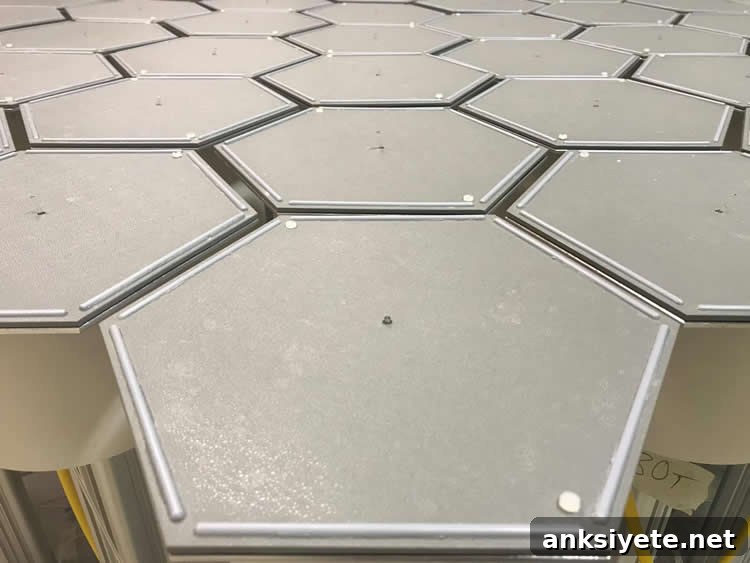
Professor O’Keefe emphasized the broader potential of the apparatus: “We view the Honeycomb Maze as a general-purpose behavioral platform. It can be adapted to study other spatial behaviors such as following a directional cue and can also be used for non-spatial tasks like approaching a moving object.”
Recent advances in recording technologies and optogenetics have expanded the ability to monitor and manipulate large populations of neurons during naturalistic behaviors. The Honeycomb Maze complements these methods by offering a controllable, ethologically relevant task in which animals make repeated, well-defined choices while neural data are collected.
Professor O’Keefe concluded: “With the engineering support available at the Sainsbury Wellcome Centre and the UCL Biosciences workshop, we can develop increasingly naturalistic behavioral tasks where we retain precise control and monitoring of the animal’s decisions.”
Funding: Research funding was provided by Wellcome, Gatsby Charitable Foundation, Medical Research Council, Royal Society, Kavli Foundation, Isaac Newton Trust, Cambridge, and a Biomedical Research Centre.
Source: April Cashin-Garbutt — Sainsbury Wellcome Center.
Publisher: Organized by NeuroscienceNews.com.
Image Source: Image credited to Sainsbury Wellcome Center.
Original Research: Abstract published in Nature, doi: 10.1038/nature25433.
Sainsbury Wellcome Center (2018). Honeycomb Maze Offers Significant Improvement Over Current Spatial Navigational Tests. NeuroscienceNews.
Abstract
The Honeycomb Maze is a new paradigm for studying hippocampal-dependent spatial navigation.
This paradigm uses 37 independently controllable platforms. Place navigation requires a rat to reach a goal platform from various start platforms by making a sequence of binary choices. On each raised platform, the animal chooses between two adjacent platforms; the correct choice is defined as the platform whose heading direction deviates least from the goal direction. Rats learn the task rapidly, and their choices are influenced by three factors: the angular separation between choice platforms, the distance to the goal, and the angular deviation between the correct platform and the goal-heading direction. Rats with hippocampal damage are impaired in learning and are sensitive to the same three factors. The Honeycomb Maze improves on current tests such as the Morris Water Maze by controlling the animal’s options at each choice point, enabling assessment of goal-directed knowledge from any location, identifying factors that influence performance, and allowing concurrent single-cell recording during navigation.