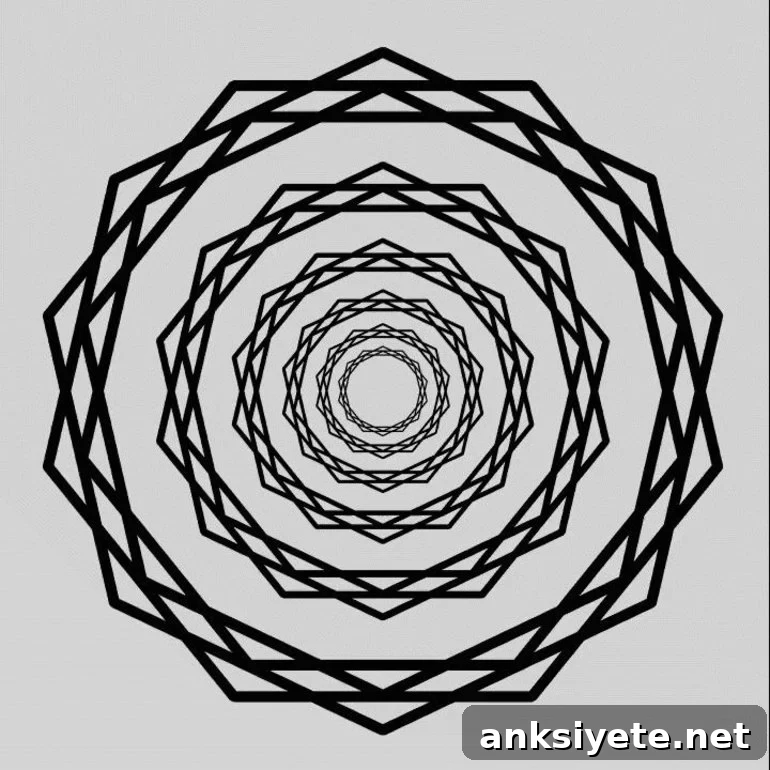
Summary: A newly designed optical illusion helps researchers probe how the visual system constructs perception. The illusion generates fleeting, shimmering rays that people perceive though they are not physically present, illustrating how vision creates a subjective interpretation of sensory input.
Source: NYU
A novel illusion developed by a visual artist and a psychology researcher highlights the constructive processes behind human vision.
Called the “Scintillating Starburst,” this new stimulus produces the impression of bright, brief rays radiating from the center of the image. Built from several concentric star polygons, the pattern prompts observers to perceive shimmering beams or lines that are not actually drawn in the image.
“The research shows how the brain infers structure from visual cues, effectively ‘connecting the dots’ to form a perceptual experience that goes beyond the raw sensory input,” says Pascal Wallisch, clinical associate professor in New York University’s Department of Psychology and Center for Data Science and the senior author of the study published in the journal i-Perception.
Michael Karlovich, founder and CEO of Recursia Studios and the study’s first author, adds that studying such illusions helps separate the physical properties of a stimulus from the perceptual experience it evokes, revealing the mechanisms that shape what we see.
Although the Scintillating Starburst shares superficial similarities with several grid-based illusions described previously, it produces distinct effects not reported before. Notably, many observers report subtle, fleeting diagonal lines that appear to connect intersection points across the concentric star polygons—an effect that emerges from the specific arrangement and scaling of the shapes.
To quantify these perceptual responses, the team tested more than 100 participants who each viewed 162 variants of the Scintillating Starburst. The stimuli differed in shape, complexity, contrast, and brightness, enabling the researchers to measure how these parameters influence the illusion’s strength and clarity.
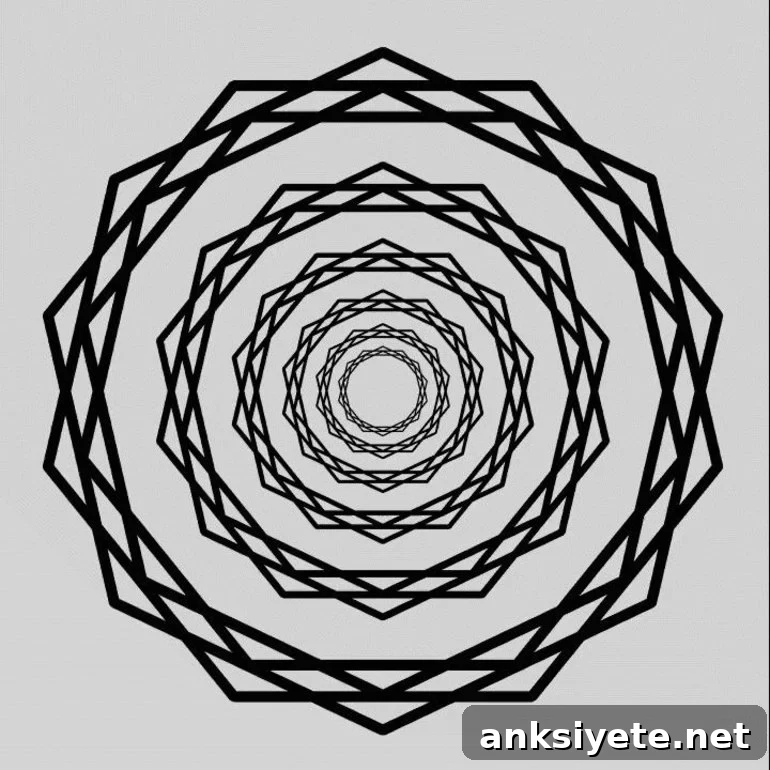
Participants reported their experience using graded response options, ranging from “I do not see any bright lines, rays, or beams” to “I see bright lines, rays, or beams that are subtle but noticeable.” These subjective reports were then analyzed against stimulus properties to identify which factors most strongly modulate the illusion.
The results point to a combination of factors governing the effect. Contrast between the pattern and background, the width of the lines composing the star polygons, and the number of vertices in the shapes all contribute to how vivid the perceived rays become.
“A greater number of prominent intersection points provides more cues for the visual system to infer implied lines, which strengthens the perceived rays,” Wallisch explains. In other words, when the pattern contains numerous clear junctions, observers are more likely to experience strong, scintillating rays.
Beyond identifying stimulus features that influence perception, the study helps clarify how different visual processes interact. The authors interpret the illusion as arising from the interplay between central and peripheral vision and from established mechanisms that group visual elements into coherent structures. By manipulating the pattern’s geometry and contrast, the researchers were able to tease apart how such mechanisms produce the starburst phenomenology.
Overall, the Scintillating Starburst adds a new tool for probing visual processing. Its distinctive effects expand the set of stimuli available for studying how the brain constructs perceptual reality from ambiguous or sparse visual information—an important step toward understanding normal vision and visual disorders.
About this visual perception research news
Source: NYU
Contact: James Devitt – NYU
Image: The image is credited to Michael Karlovich, Recursia LLC
Original Research: Open access. “Scintillating Starbursts: Concentric Star Polygons Induce Illusory Ray Patterns” by Michael Karlovich and Pascal Wallisch. i-Perception
Abstract
Scintillating Starbursts: Concentric Star Polygons Induce Illusory Ray Patterns
This work introduces Scintillating Starbursts, a family of stimuli formed from concentric star polygons that generate the perception of transient, scintillating rays or beams. We examine how specific stimulus parameters—such as contrast, line width, and the number of vertices—shape observers’ experiences of these patterns.
Through experimental testing, we identify the conditions that enhance or diminish the illusion and explain how it emerges from known visual processes, including differences between central and peripheral vision and the visual system’s tendency to infer continuous structure from discrete cues.
We also compare Starbursts to related illusions—such as illusory contours, grid-based effects like the pincushion grid illusion, and moiré patterns—highlighting both shared mechanisms and distinctive phenomenology.