
Summary: Greater left-brain asymmetry can predict both superior and average outcomes on a foundational measure of reading skill, depending on how asymmetry is measured.
Source: PLOS
Researchers led by Mark Eckert at the Medical University of South Carolina report that two previously competing theories about how the brain supports language processing can both be valid, depending on the spatial scale of analysis.
Published in the open-access journal PLOS Biology on April 5, the study shows that greater left-hemisphere structural asymmetry can be associated with better phonological decoding (the ability to translate written symbols into speech sounds) when asymmetry is measured across the entire cortex, while increased asymmetry in specific brain regions can instead be linked to average phonological performance. These results reconcile two different hypotheses about brain lateralization and behavioral outcomes.
Accurate mapping from letters to sounds — phonological processing — is a core skill for reading development. This ability varies widely across individuals and is often impaired in people with dyslexia and other reading difficulties. Previous research has suggested that differences in structural asymmetries between the left and right hemispheres influence phonological skills, but the precise nature of that relationship has been unclear.
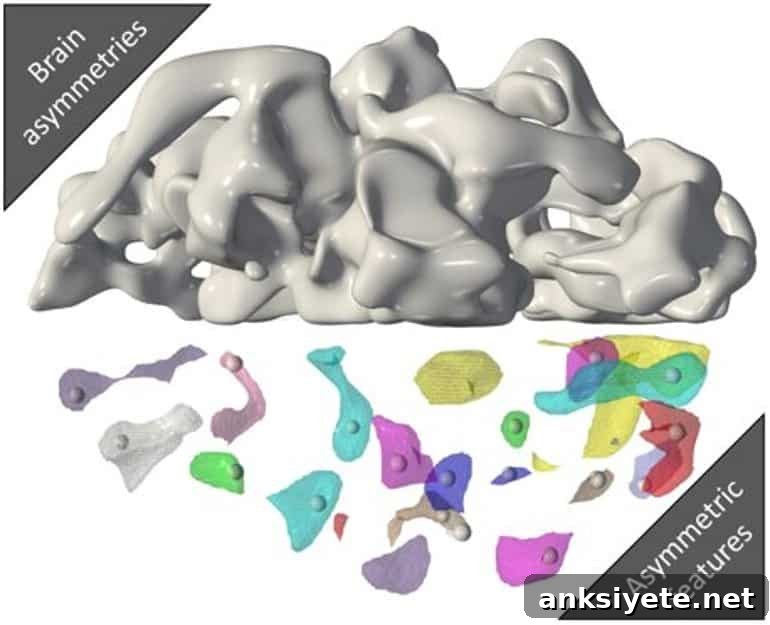
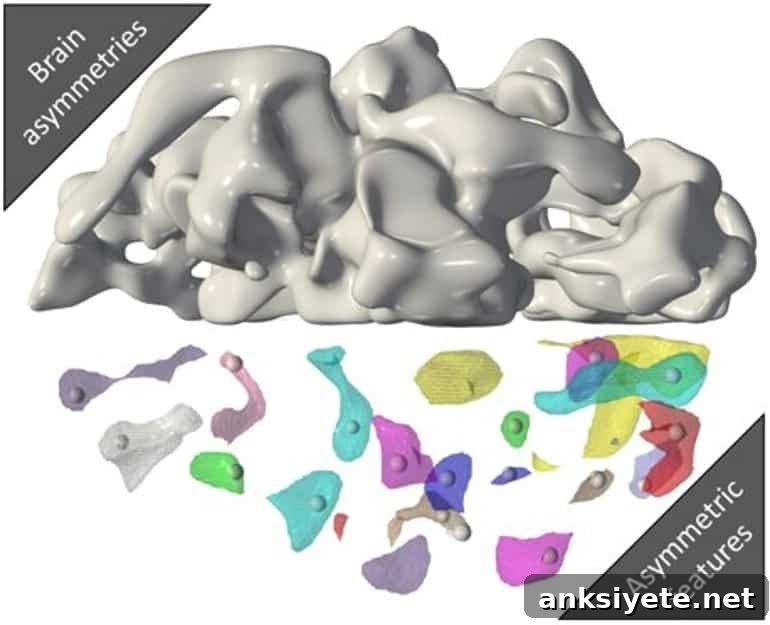
To investigate, the team analyzed structural MRI scans from more than 700 participants (both children and adults) and assessed phonological decoding using a pseudo-word reading task. They applied a topological data analysis technique called persistent homology to identify and quantify asymmetric structures in cortical anatomy. Persistent homology is a mathematical tool that extracts stable topological features from complex data across multiple spatial scales, helping to distinguish meaningful asymmetries from noise.
Using this approach, the researchers derived measures of asymmetry at different spatial hierarchies. When they considered the magnitude of the single most asymmetric cortical feature within each individual’s left hemisphere, greater leftward asymmetry predicted higher accuracy on the pseudo-word reading task. This pattern supports a cerebral lateralization view in which stronger left-hemisphere structural specialization facilitates foundational reading skills.
Conversely, when examining asymmetry at the level of particular cortical regions, the team observed a different relationship consistent with a canalization hypothesis. Specifically, greater leftward asymmetry in regions involved in motor planning and performance monitoring — including Brodmann Area 8 and the dorsal anterior cingulate — was associated with phonological decoding performance that fell within the typical, or average, range. In other words, asymmetries in these localized areas appeared to constrain performance toward a normative level, rather than producing a linear improvement with increasing asymmetry.
Notably, the study found limited evidence linking pseudo-word reading ability to structural asymmetries in classic language-related areas typically emphasized in language research. This indicates that the relationship between brain structure and phonological processing may be more distributed or scale-dependent than previously appreciated. The authors emphasize that how left/right structural asymmetries influence other aspects of reading and the functional dynamics of the left-lateralized language network still requires further investigation.
Eckert commented, “Our findings indicate that, at a population level, structural brain asymmetries are related to the normal development of a speech-sound processing ability that is important for establishing proficient reading.” The results suggest a nuanced picture: large-scale left-hemisphere specialization can support stronger phonological decoding, while localized asymmetries in motor or monitoring regions may stabilize performance within a typical range.
About this neuroscience research news
Author: Press Office
Source: PLOS
Contact: Press Office – PLOS
Image: The image is credited to Federico Iuricich
Original Research: Open access.
Title: “Cortical asymmetries at different spatial hierarchies relate to phonological processing ability” by Eckert MA, Vaden KI Jr, Iuricich F, Dyslexia Data Consortium (2022). PLOS Biology
Abstract
Cortical asymmetries at different spatial hierarchies relate to phonological processing ability
Mapping speech sounds to letters is essential for learning to read. Individuals differ in this phonological processing ability, and those differences have been hypothesized to arise from variation in hemispheric asymmetries within brain regions that support language and related cognitive functions.
Two competing theoretical frameworks make different predictions. The cerebral lateralization hypothesis predicts a linear relationship: greater leftward structural asymmetry should facilitate development of foundational reading skills like phonological decoding. The canalization hypothesis predicts a quadratic relationship: anatomical asymmetries constrain performance toward the population average, so individuals with the greatest asymmetries would tend to exhibit average phonological processing.
To test these ideas, the study examined relatively large pediatric (N = 424) and adult (N = 300) samples. Researchers applied a topological asymmetry analysis to T1-weighted MRI images and used a decoding measure of phonological processing based on pseudo-word reading. They observed limited associations between asymmetry and decoding in classic language regions, but found scale-dependent effects consistent with both hypotheses.
Specifically, modest effect sizes supported the cerebral lateralization hypothesis: phonological decoding accuracy tended to increase with the magnitude of the largest left-hemisphere structural asymmetry for both samples. At the same time, modest effect sizes also supported the canalization hypothesis: phonological decoding within the normal range was associated with increased asymmetries in specific cortical regions involved in motor planning and performance monitoring. These findings indicate that the relevance of each hypothesis may depend on the spatial scale at which brain organization is considered.