Summary: Researchers report that the gamma-CaMKII protein acts as a crucial shuttle for memory-related signaling. When this shuttle is impaired, as seen in some cases of intellectual disability, schizophrenia, and autism, the ability to form long-term memories is reduced.
Source: NYU Langone
Broken shuttle protein that fails to deliver signals from synapses to the nucleus may disrupt learning in disorders such as intellectual disability, schizophrenia, and autism.
Researchers at NYU School of Medicine report evidence that a transport protein known as gamma-CaMKII is essential for converting sensory experiences into long-term memories. The study, published June 22 in Nature Communications, shows that mice lacking the gene for gamma-CaMKII require substantially more time to learn a simple spatial task than normal mice, and that a mutation found in a human with severe intellectual disability produces equivalent learning deficits when introduced into mice.
“For the first time we show that gamma-CaMKII has a fundamental role in learning and memory in live animals,” says Richard Tsien, PhD, chair of the Department of Neuroscience and Physiology and director of the Neuroscience Institute at NYU Langone Health. He adds that introducing the same structural change seen in a human case of intellectual disability removed the animals’ ability to learn in the same way, suggesting the shuttle operates similarly in mice and humans.
Importantly, the team was able to restore learning by reintroducing the human version of the gamma-CaMKII shuttle protein into the genetically modified mice, demonstrating the protein’s direct role in memory formation.
The study focuses on how neurons transmit signals that begin at synapses—where sensory input like sights and sounds is first processed—and lead to gene activation in the nucleus to create durable changes in neural connections. When sensory stimulation triggers established processes at synapses, calcium ions enter neurons and bind to partner proteins, most notably calmodulin (CaM). The calcium–calmodulin complex must then reach the nucleus to activate CREB-dependent transcription, a key step in turning on genes that support long-term memory.
The missing link between synapses and the nucleus
Previously, how synapses communicated with the nucleus to support long-term plasticity and behavior was unclear. This work identifies gamma-CaMKII as the carrier that rapidly transports the calcium–calmodulin complex from the site of synaptic activation into the nucleus. Without this shuttle, the chain of events leading to gene activation and memory consolidation is interrupted.
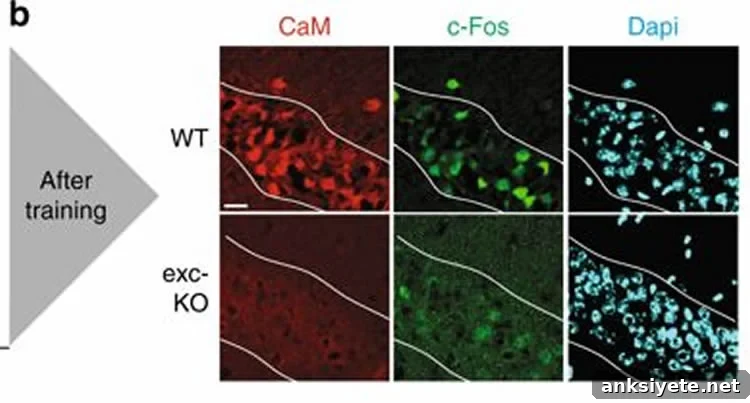
The researchers compared spatial memory in normal mice and mice engineered to lack gamma-CaMKII. In the Morris water maze—a standard test in which mice must find a hidden platform beneath murky water—normal mice learned the platform’s location quickly. In contrast, gamma-CaMKII “knockout” mice took much longer and exhibited impaired spatial learning.
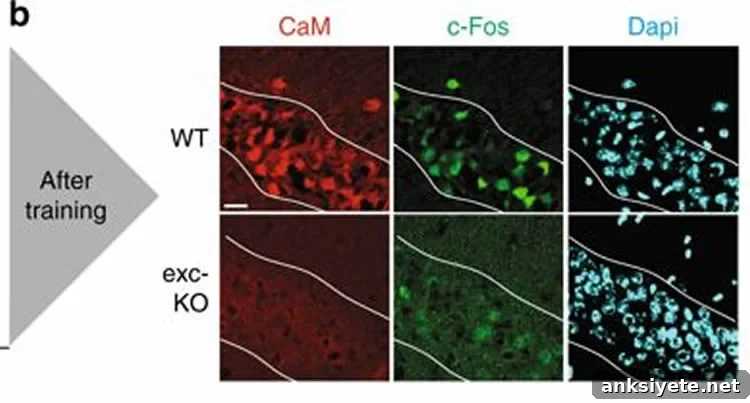
One hour after maze training, normal mice showed a clear rise in expression of three genes—BDNF, c-Fos, and Arc—known to be involved in experience-dependent, long-term spatial memory. These training-induced gene expression changes were absent in mice lacking gamma-CaMKII, indicating that the shuttle is required for the activity-dependent transcription that stabilizes learning.
In addition to deleting the entire gamma-CaMKII gene in one group of mice, the team engineered another group to carry a specific point mutation previously identified in a child with severe intellectual disability. At amino acid position 292, arginine normally occupies the site; the mutation substitutes proline (R292P). That substitution severely impairs the protein’s ability to bind and retain the calcium–calmodulin complex, so CaM often reaches the nucleus without its calcium cargo. This single amino acid change reduced CaM sequestration by roughly three orders of magnitude in prior biochemical analyses and, in the current study, was sufficient to prevent activity-dependent gene expression and spatial learning in vivo.
Looking ahead, the investigators plan to map where gamma-CaMKII fits within a broader feedback network of neuronal circuits previously described by Dr. Tsien and colleagues. That machine of genes and signaling pathways senses the frequency and intensity of neuronal activity and converts sensory input into persistent memory traces. Future experiments aim to determine how the system tolerates minor defects in components such as the gamma-CaMKII shuttle, and why it fails when multiple elements are compromised.
The NYU Langone research team includes Richard Tsien, Samuel Cohen, Huan Ma, Benjamin Suutari, Nataniel Mandelberg, Natasha Tirko, Caitlin Mullins, Sandrine Sanchez, Ilona Kats, and Alejandro Salah from the Neuroscience Institute and the Department of Neuroscience and Physiology. Tsien, Suutari, and Kats are also affiliated with the Center for Neural Science at New York University. Key contributions were made by collaborators Ma, Xingzhi He, Yang Wang, Guangjun Zhou, and Shuqi Wang from the Department of Physiology, Institute of Neuroscience, Zhejiang University School of Medicine, Hangzhou, China.
Funding: The research was supported by grants from the National Institute of General Medical Sciences, the National Institute on Drug Abuse, the National Institute of Neurological Disorders and Stroke, and the National Institute of Mental Health, as well as funding from the Druckenmiller, Simons, Mathers, and Burnett Family foundations and a Medical Scientist Research Service Award.
Source: Greg Williams, NYU Langone. Publisher: NeuroscienceNews.com. Image credit: Tsien et al. / Nature Communications.
Abstract
Calmodulin shuttling mediates cytonuclear signaling to trigger experience-dependent transcription and memory
Long-term learning and memory rely on synaptic plasticity that becomes persistent through nuclear gene expression. How synaptic activity is communicated to the nucleus has remained unclear. γCaMKII uniquely transports Ca2+/CaM complexes rapidly to the nucleus to activate CREB-dependent transcription. Here, elimination of γCaMKII prevents activity-dependent expression of key genes (BDNF, c-Fos, Arc), blocks persistent synaptic strengthening, and impairs spatial memory in vivo. Deleting γCaMKII in adult excitatory neurons produces similar effects. A point mutation in γCaMKII, identified in a case of intellectual disability, selectively disrupts CaM binding and shuttling; this mutation alone suffices to impair gene expression and spatial learning in living animals. These results indicate that this specific form of cytonuclear signaling is essential for learning and memory and may contribute to neuropsychiatric disorders.