Summary: Gene therapy can restore retinal structure and recover normal light responses in a model of retinal degeneration.
Source: SfN
Researchers report that after gene therapy the retina can reorganize itself and recover normal light-evoked signaling. Published work in the Journal of Neuroscience shows that rescued rod photoreceptors regain both normal physiology and connections to downstream retinal neurons, highlighting unexpected plasticity in the adult retina and reinforcing efforts to repair dying cells as a route to vision restoration.
Many forms of blindness are driven by degeneration of rod photoreceptors, the light-sensitive cells in the retina responsible for dim-light vision. Although several therapeutic strategies aim to preserve or repair these cells, a critical question has been whether the retinal circuit—altered during degeneration—can rebuild functional connections once rods are restored. The new mouse study addresses this question directly by testing whether rescued rods can re-establish normal synapses and restore visual signaling.
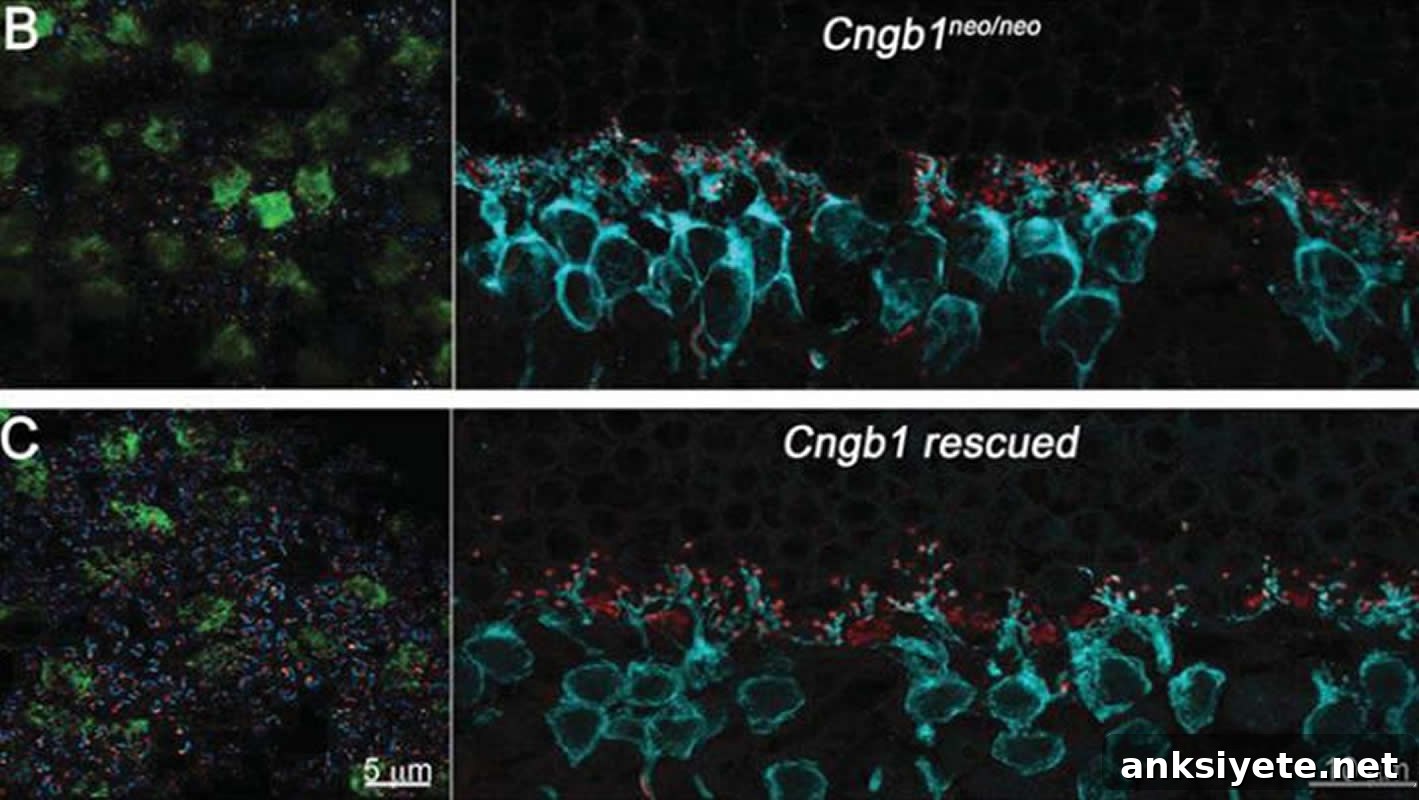
The research group led by Jeannie Chen, Alapakkam Sampath and Greg Field developed a genetically engineered mouse model in which rod photoreceptors carry a defective cyclic nucleotide-gated (CNG) channel gene. This defect mimics aspects of human developmental disorders that impair rod function and lead to progressive blindness. In these mice, rod dysfunction triggers stereotyped retinal remodeling: synaptic contacts between rods and rod bipolar cells disappear, and bipolar cell dendrites can become misdirected and form abnormal contacts.
To test whether repair of rod function could reverse this remodeling, the team used a tamoxifen-inducible Cre recombinase system to restore the endogenous CNG channel gene at different stages of degeneration. This approach allowed controlled activation of rod input in adult animals. Electrophysiological recordings showed that rods lacking functional CNG channels were hyperpolarized at rest and released less glutamate, consistent with diminished synaptic drive to downstream cells. After tamoxifen-induced gene repair, rescued rods recovered normal light responses and membrane physiology.
Crucially, structural and functional analyses revealed that the adult retina displays a surprising capacity for plasticity. Rod bipolar cells that had extended misdirected dendrites during degeneration retracted and re-established contact with repaired rods. Those regenerated synapses supported normal synaptic transmission, and light-evoked signals propagated through the retinal circuit to retinal ganglion cells, the output neurons that convey visual information to the brain.
Source:
SfN (Society for Neuroscience)
Media contacts:
Calli McMurray – SfN
Image source:
Image credit: Wang et al., Journal of Neuroscience 2019.
Original research (open access):
Article title: “Activation of Rod Input in a Model of Retinal Degeneration Reverses Retinal Remodeling and Induces Formation of Functional Synapses and Recovery of Visual Signaling in the Adult Retina” by Tian Wang, Johan Pahlberg, Jon Cafaro, Rikard Frederiksen, A. J. Cooper, Alapakkam P. Sampath, Greg D. Field and Jeannie Chen. Journal of Neuroscience, 2019.
Study overview and implications
This study combines genetic engineering, targeted gene repair, electrophysiology and anatomical analysis to show that functional recovery is possible even after the retina has undergone disease-related remodeling. The findings are significant for several reasons: they demonstrate that adult retinal circuits retain a degree of plasticity beyond developmental windows; they provide direct evidence that restored rods can re-engage downstream neurons to reconstitute visual signaling; and they support therapeutic strategies that aim to repair or replace damaged photoreceptors rather than only preserving remaining cells.
For patients with retinal degenerative conditions, these results offer cautious optimism. The retina’s ability to re-form appropriate synapses after rod rescue suggests that functional recovery could accompany successful gene therapies or cell-replacement approaches. At the same time, the study underscores the importance of timing and of restoring not only cell survival but also proper physiological function to drive circuit-level repair.
Significance statement
Strategies to treat neurodegenerative conditions often focus on restoring the primary affected cell type, yet the surrounding neural circuit also degrades during disease. If deprived neurons can be rescued, will the remodeled network reconnect and regain normal function? This research shows that the adult mammalian retina can restore communication: rescued rods re-establish synaptic contacts with rod bipolar cells, enabling normal synaptic transmission and propagation of visual signals to ganglion cells. These findings reinforce efforts to repair or replace rod photoreceptors as a pathway toward restoring vision in diseases characterized by rod loss.