
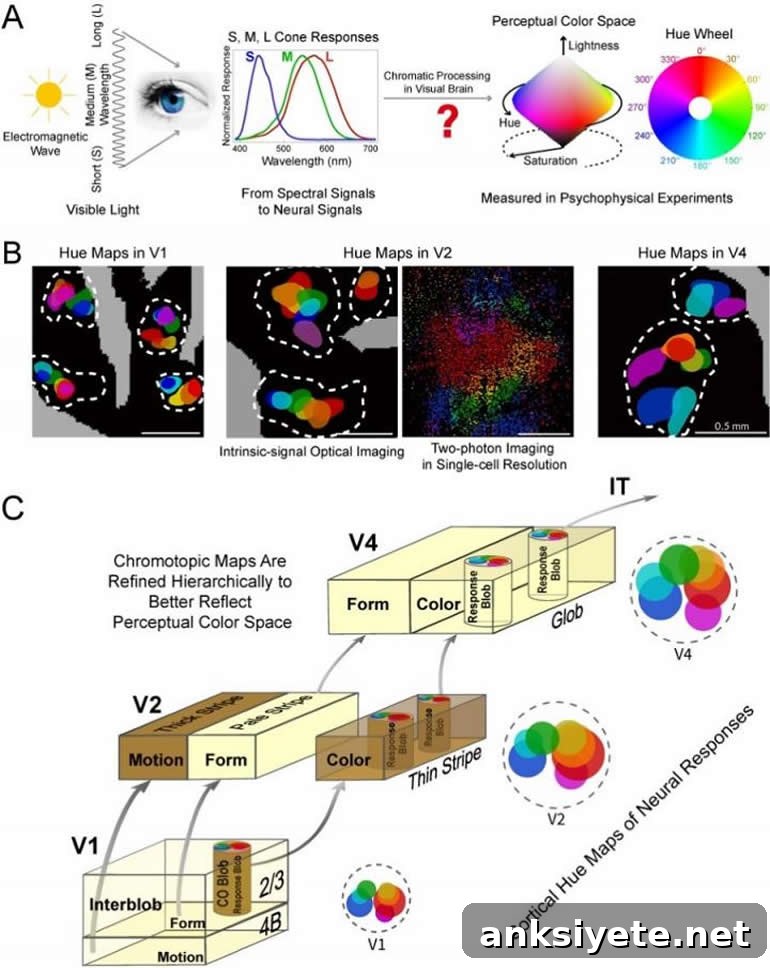
Summary: A new study links the physical organization of the primate visual cortex to color perception. High-resolution imaging revealed organized “hue maps” — spectrally arranged patterns of hue responses across cortical areas.
Source: Chinese Academy of Sciences
Researchers have now mapped how color sensations are represented in the cortex, clarifying how brain structure supports perceptual color space.
This advance results from a collaboration between Dr. WANG Wei’s laboratory at the Institute of Neuroscience, Center for Excellence in Brain Science and Intelligence Technology, Chinese Academy of Sciences, and Dr. TANG Shiming’s laboratory at Peking University. The team used multiple imaging techniques to examine how color information is processed across successive cortical stages, providing new insights into the neural basis of color perception and chromatic processing in primates.
Color perception is a classic example used to explore conscious experience because the sensation of color does not exist inherently in light itself. As Isaac Newton noted centuries ago, visible wavelengths of electromagnetic radiation are not colored on their own; instead, the brain interprets the spectral composition of light falling on the retina and constructs the experience we call color. In the retina, signals from cone photoreceptors that are sensitive to different wavelengths are combined and transformed by neural circuits, and those signals are further processed through multiple cortical stages to produce our perceptual color space.
Although the retina and early visual pathways encode basic wavelength information, how the brain converts these signals into the thousands of distinct hues we perceive has remained unclear. To address that question, the researchers focused on three cortical areas known to be central to color processing in macaques: primary visual cortex (V1), secondary visual cortex (V2), and area V4. They presented identical color patterns while recording neural activity across these areas, enabling a direct comparison of how the same chromatic input is represented at successive processing stages.
Across the measured cortex, the team identified organized chromatic patterns they call “hue maps.” These maps act like color palettes across the brain surface: spatially patterned arrangements of responses tuned to different hues. Visually, hue maps can be thought of as local rainbows — structured, spectrally organized regions that vary in scale and arrangement across cortical areas.
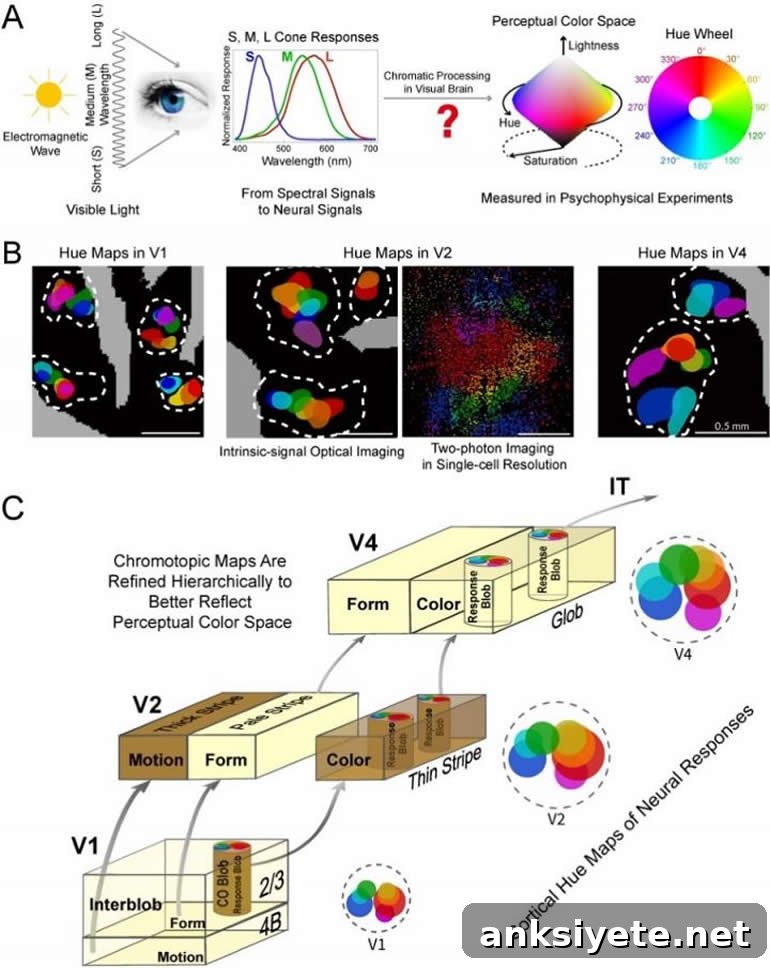
The most novel findings emerge from comparing the fine structure of hue maps across V1, V2 and V4. In V1, maps show a relative predominance of “endspectral” responses — especially red and blue tuning — a feature that becomes less pronounced in V2 and is almost absent in V4. In other words, as chromatic information ascends the cortical hierarchy the distribution of hue tuning becomes more spectrally uniform, moving toward an isotropic representation that better mirrors perceptual color space.
Computationally, the data suggest the cortex progressively integrates two main classes of cone-opponent signals that originate in the retina. The specific hue of a stimulus is already encoded in V1 by the relative activity of cone-opponent channels, but that information requires further combinatorial processing in higher areas — particularly in neurons of V4 — before it aligns with the perceptual experience of color. Thus V1 carries essential spectral information while V4 and later stages read out and refine those signals into a perceptual hue representation.
The study combined intrinsic signal optical imaging across areas V1, V2 and V4 with higher-resolution electrophysiology and two-photon cellular imaging in awake macaques. Two-photon results showed greater clustering of hue-specific cells in V2 than in V1, consistent with a progressive increase in spatial scale and precision of chromatic maps. Overall, the findings describe a hierarchical transformation: local cone-driven activity patterns are reorganized through successive cortical stages into a more uniform chromotopic map that underlies color perception.
Co-first authors on the paper are Drs. LIU Ye and LI Ming. Additional contributors include Stewart Shipp (University College London), Niall McLoughlin (University of Manchester) and YANG Yupeng (University of Science & Technology of China).
Funding: This research was supported by the Chinese Academy of Sciences, the Shanghai Municipality, the National Natural Science Foundation of China, and the Chinese Ministry of Education.
About this research
Source:
Chinese Academy of Sciences
Contacts:
WANG Wei – Chinese Academy of Sciences
Image credit:
CEBSIT
Original Research:
Closed access — “Hierarchical Representation for Chromatic Processing across Macaque V1, V2, and V4” by WANG Wei et al., Neuron. DOI: 10.1016/j.neuron.2020.07.037
Abstract
Hierarchical Representation for Chromatic Processing across Macaque V1, V2, and V4
Highlights
• Color-responsive blob-like modules form a consistent architecture in V1, V2, and V4
• Blob modules change progressively in spatial scale and in how hue is represented across areas
• Two-photon imaging reveals stronger hue-specific cell clustering in V2 compared with V1
• Chromotopic organization becomes more spectrally uniform from V1 to V2 to V4
Summary
Color perception assigns internal labels to the inferred spectral properties of visible surfaces. To understand how spectral representations are transformed across successive cortical modules, the authors performed simultaneous intrinsic-signal optical imaging in macaque V1, V2, and V4, supplemented with electrophysiology and two-photon imaging in awake animals. The results reveal a progressive refinement in the scale and specificity of chromotopic maps, all organized within a blob-like architecture for hue responses in each area. Two-photon imaging shows enhanced clustering of hue-selective cells in V2 relative to V1. A clear pattern of endspectral (red and blue) dominance in V1 diminishes in V2 and is absent in V4. The increased representation of mid- and extra-spectral hues through V2 and V4 reflects hierarchical processing, as higher areas decode chromatic space by integrating signals relayed from V1.