
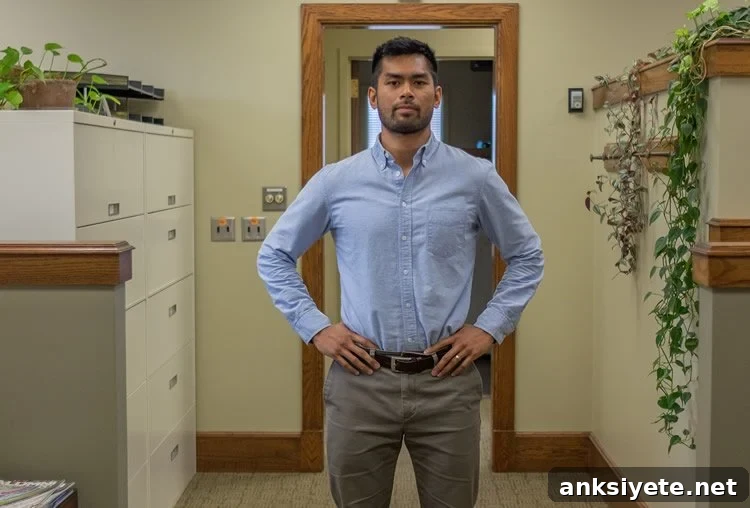
Summary: A well-known TED Talk promoted the idea that “power posing” boosts confidence and improves chances of success. Recent, larger-scale studies challenge that claim, finding that while power poses may increase feelings of power, they do not produce measurable changes in behavior or outcomes.
Source: Michigan State University.
The widespread claim that briefly adopting a “power pose” can improve real-life outcomes rose to fame with a highly viewed TED Talk, but a growing body of research now calls that claim into question.
New, rigorous research led by scientists at Michigan State University provides the most comprehensive evidence so far that power poses do not translate into meaningful life improvements. While the posture may change how people feel, the evidence indicates it does not change how they perform in real-world tasks.
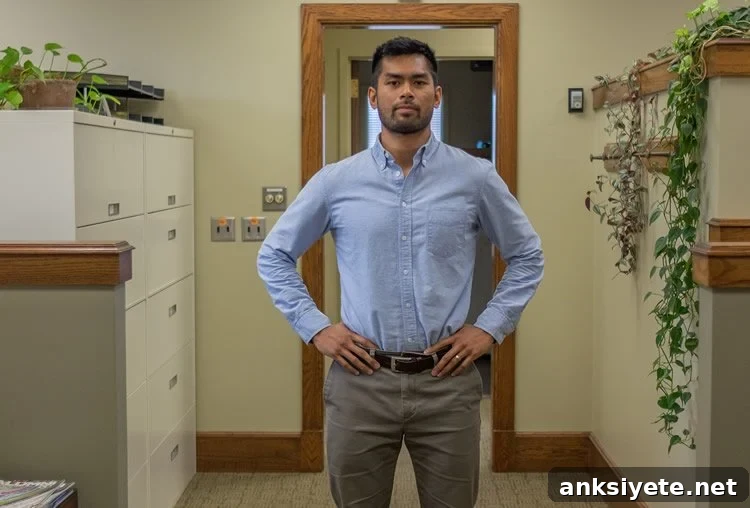
Joseph Cesario, an associate professor of psychology at Michigan State University, and colleagues reviewed multiple replication attempts and conducted new experiments to test the original power pose claims. “This new evidence joins an existing body of research questioning the claim by power pose advocates that making your body more physically expansive — such as standing with your legs spread and your hands on your hips — can actually make you more likely to succeed in life,” Cesario said.
Cesario co-edits the journal Comprehensive Results in Social Psychology, which recently published a special issue containing seven studies that attempted to replicate and extend the original power pose findings. None of those studies showed beneficial effects of power poses on behavioral outcomes like interview or negotiation performance. The seven papers were independently reviewed, including by Dana Carney, a University of California Berkeley professor who was a co-author of the original power pose research.
Separately, Cesario and MSU graduate student David Johnson published four new experiments in Social Psychological and Personality Science. These studies specifically tested whether brief periods of adopting expansive postures would affect important behaviors such as performance in business negotiations. Again, the results were clear: participants who held power poses did not outperform those who did not.
“There is currently little reason to continue to strongly believe that holding these expansive poses will meaningfully affect people’s lives, especially the lives of low-status or powerless people,” Cesario noted. The collective evidence shows that feeling more powerful after striking a pose does not reliably produce more powerful or effective behavior.
The original power pose study, led by Dana Carney and Amy Cuddy in 2010, suggested that making the body more expansive could increase confidence and improve outcomes, particularly for people who feel chronically low in status or power. Amy Cuddy’s 2012 TED Talk amplified that message to millions of viewers, encouraging people to spend two minutes in a confident posture—such as standing with hands on hips, leaning over a table with fingertips down, or reclining with feet up and arms behind the head—before a high-stakes event like a job interview.
Cuddy’s TED Talk argued that the technique could be performed in private, required no resources, and could significantly change life outcomes for people who lack other advantages. That message made the idea widely appealing, especially as a simple, accessible strategy that anyone could use.
However, the new wave of studies offers a different perspective. The MSU-led work and the papers published in the special issue find that while participants sometimes report feeling more powerful after adopting expansive poses, that subjective feeling does not translate into measurable differences in behavior, decision-making, or task performance. In a number of experiments, participants watched the TED Talk, held a power pose, then completed a negotiation or other behavioral task; those who posed did not perform any better than their counterparts.
“Feeling powerful may feel good, but on its own does not translate into powerful or effective behaviors,” Cesario said. He emphasizes that the newer studies include more total participants than nearly every prior study on the topic, strengthening the conclusion that power posing does not produce behavioral or cognitive changes.
Some of the researchers involved in earlier work have updated their views. Dana Carney, who co-authored the original research, has publicly stated that, in light of subsequent evidence, she no longer believes the behavioral effects of power poses are real.
Source: Andy Henion – Michigan State University
Image Source: NeuroscienceNews.com image is credited to Derrick Turner.
Video Source: The video referenced in this article was a TED Talk by Amy Cuddy.
MLA: Michigan State University. “‘Power Poses’ Don’t Work, Studies Suggest.” NeuroscienceNews. NeuroscienceNews, 11 September 2017.
APA: Michigan State University (2017, September 11). ‘Power Poses’ Don’t Work, Studies Suggest. NeuroscienceNews.
Chicago: Michigan State University. “‘Power Poses’ Don’t Work, Studies Suggest.” (accessed September 11, 2017).