
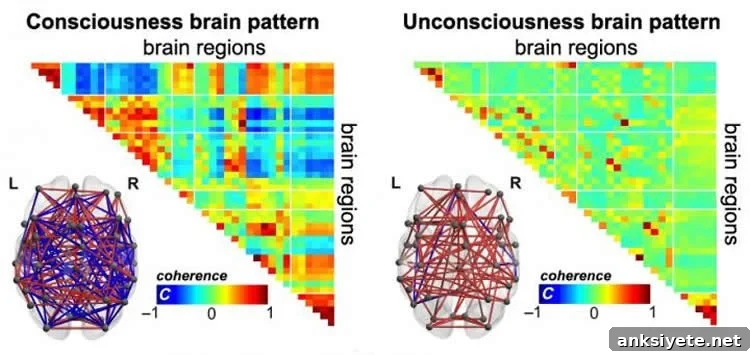
Summary: Researchers report that human consciousness is supported by dynamic, complex patterns of coordinated brain signals.
Source: AAAS.
Researchers using fMRI report reproducible brain-activity patterns that distinguish conscious from unconscious states. Detecting these patterns in real time could enable noninvasive interventions to restore awareness and improve clinical decision-making for patients with impaired consciousness.
Identifying reliable markers of consciousness has been a longstanding challenge. Patients may be temporarily unconscious because of anesthesia or permanently impaired after brain injury. In both cases, reliably determining whether subjective experience is present or absent is difficult, yet crucial for treatment and ethical decisions.
To search for such markers, A. Demertzi and colleagues collected resting-state functional magnetic resonance imaging (fMRI) data from 159 participants scanned at four independent research centers. The sample included healthy volunteers under anesthesia and patients with disorders of consciousness. Patients were classified with standardized behavioral assessments as either unresponsive wakefulness syndrome (UWS)—awake but lacking purposeful behavior—or minimally conscious state (MCS)—showing intermittent, inconsistent signs that may reflect awareness.
The team measured fluctuations of the fMRI blood oxygenation level–dependent (BOLD) signal across 42 brain regions spanning six large-scale networks known to support cognitive function. Rather than focusing on static connectivity, the authors examined how coordination between regions changed over time and identified four recurring patterns of whole-brain organization. Pattern 1 was the most complex: it exhibited widespread, long-range coordination and a mix of coordinated and anticorrelated activity across regions. This complex pattern occurred more often in healthy, conscious participants. Pattern 4 showed weak interregional coordination—signals close to zero coherence—and appeared most frequently in UWS patients.
Beyond characterizing static differences, the researchers found that conscious brains transition more frequently between distinct coordination patterns, whereas anesthetized and unresponsive patients tend to remain in the less complex patterns. In particular, anesthetized participants showed a reduced probability of switching among brain states, and unresponsive patients displayed a dominant low-coherence pattern that was largely shaped by structural connectivity rather than dynamic coordination.
Importantly, the complex pattern associated with consciousness was also observed in a subset of patients with covert cognition—individuals who do not show overt behavioral responses but can follow commands in neuroimaging mental-imagery tasks. This correspondence supports the idea that dynamic, large-scale coordination is a functional fingerprint of subjective awareness. The authors further validated their interpretation by showing that anesthesia increases the occurrence of the less complex pattern, reinforcing its link to unconsciousness.
These results indicate that consciousness depends on the brain’s capacity to sustain rich, time-varying coordination across distant regions. Detecting these dynamic patterns could provide objective, generalizable markers to help clinicians assess awareness in patients with disorders of consciousness and guide therapeutic interventions that aim to restore or modulate conscious states without invasive procedures.
Source: AAAS
Publisher: NeuroscienceNews.com (organized coverage)
Image credit: E. Tagliazucchi & A. Demertzi
Original research: A. Demertzi et al., “Human consciousness is supported by dynamic complex patterns of brain signal coordination,” Science Advances, published February 1, 2019. doi: 10.1126/sciadv.aat7603
AAAS. “Brain Patterns Indicative of Consciousness, in Unconscious Individuals.” NeuroscienceNews, February 6, 2019.
Abstract
Human consciousness is supported by dynamic, complex patterns of brain signal coordination.
Using a framework that treats brain dynamics as central to consciousness, the authors tested whether transient patterns of coordinated neural signals reliably distinguish conscious and unconscious states after brain damage. They identified a dynamic pattern of coordinated and anticoordinated fMRI signals that characterized healthy participants and minimally conscious patients. Unresponsive patients predominantly showed a pattern of low interareal phase coherence that appeared to reflect structural connectivity and exhibited reduced transitions between patterns. The complex coordination pattern was also present in patients with covert cognitive processing detected through mental imagery tasks, supporting its relationship to conscious experience. Anesthesia increased the prevalence of the less complex pattern, validating its association with unconsciousness. Together, these findings suggest that the ability to sustain rich, time-varying brain dynamics is a hallmark of consciousness and point toward specific, generalizable neural fingerprints for conscious and unconscious states.