
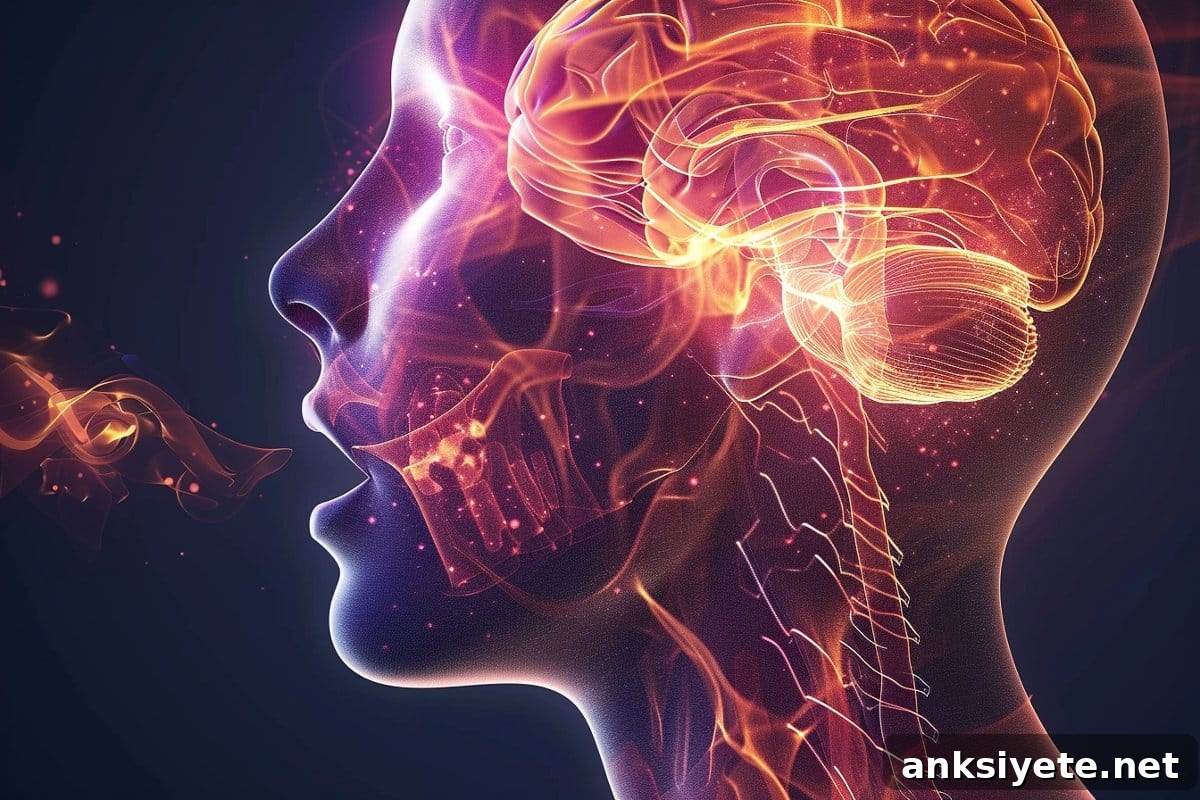
Summary: MIT researchers have identified a brain circuit that coordinates vocalization with breathing, ensuring that vocal sounds are produced primarily during exhalation. The circuit controls both the narrowing of the larynx and the forceful exhalation needed for sound, and it is directly regulated by a brainstem rhythm generator that inhibits vocal output during inhalation.
Using a mouse model, the team traced the neural pathway responsible for producing ultrasonic vocalizations (USVs) and demonstrated how breathing rhythm overrides vocalization to preserve the vital function of respiration. Their experiments reveal a precise neural mechanism by which inhalation suppresses speech-like activity, a mechanism likely conserved across mammals.
Key facts
- Vocalization circuit mapped: Researchers identified premotor neurons that drive vocal cord closure and coordinated exhalation required for sound production.
- Inhibition during inhalation: The pre-Bötzinger complex, a brainstem rhythm generator for inhalation, sends inhibitory signals to the vocalization circuit, preventing vocal output while breathing in.
- Cross-species relevance: Although the experiments were performed in mice, the core phonation process—vocal cord adduction combined with exhalation—is shared by mammals, suggesting a similar coordination mechanism in humans.
Discovery overview
Vocal sounds are produced when the vocal cords (located in the larynx) adduct so that exhaled air passing between them generates sound. To understand how the brain controls this process and coordinates it with breathing, the researchers used mice because they naturally emit ultrasonic vocalizations using a whistle-like mechanism that requires nearly closed vocal cords and controlled exhalation.
The investigators began by tracing neurons that synapse onto laryngeal motor neurons. This tracing revealed a prominent input from premotor neurons in the retroambiguus nucleus (RAm) of the hindbrain. Activity measurements showed that a subset of these RAm neurons became strongly active during USVs. The team labeled these behaviorally defined neurons as RAmVOC and used activity-dependent targeting combined with chemogenetic and optogenetic tools to test their function.
Silencing RAmVOC neurons abolished all vocalizations: mice stopped producing USVs, vocal cord adduction did not occur, and the abdominal contractions that normally drive exhalation during vocalization ceased. Activating RAmVOC neurons induced vocal cord closure and exhalation, triggering USVs. However, prolonged optogenetic stimulation was interrupted by inhalations, indicating that an independent breathing circuit can override vocal drive.
Breathing rhythm and inhibition
Further synaptic mapping identified the pre-Bötzinger complex—a brainstem rhythm generator for inhalation—as a direct source of inhibitory input to RAmVOC neurons. Neurons in the pre-Bötzinger complex generate inhalation rhythms automatically and continuously; their inhibitory projections to vocal premotor neurons effectively shut down vocal output during inhalation. This gating mechanism prioritizes breathing over vocalization, ensuring survival-critical respiration is not disrupted by speech or other vocal behaviors.
The study’s findings explain why humans naturally pause speech to inhale and why vocalization is typically restricted to exhalation. Although human speech adds layers of complexity beyond the mouse model, the underlying phonation requirement—vocal cord closure plus exhalation—is conserved, supporting the idea that a similar circuit coordinates breathing and vocal production in humans.
Implications and future directions
Beyond speech, the researchers plan to explore how this breathing–vocalization circuitry interacts with other airway behaviors such as coughing and swallowing, which also require tight coordination with respiration. Understanding these interactions could inform treatments for disorders that disrupt breathing–speech coordination.
Study details
The research, led by Fan Wang, professor of brain and cognitive sciences at MIT and member of the McGovern Institute for Brain Research, includes lead author Jaehong Park (Duke University, visiting student at MIT), MIT technical associates Seonmi Choi and Andrew Harrahill, former MIT research scientist Jun Takatoh, and Duke researchers Shengli Zhao and Bao-Xia Han. The findings are published in the journal Science. The work was funded by the National Institutes of Health.
About this neuroscience research news
Author: Sarah McDonnell
Source: MIT
Contact: Sarah McDonnell – MIT
Image: The image is credited to Neuroscience News
Original Research: The findings appear in Science