
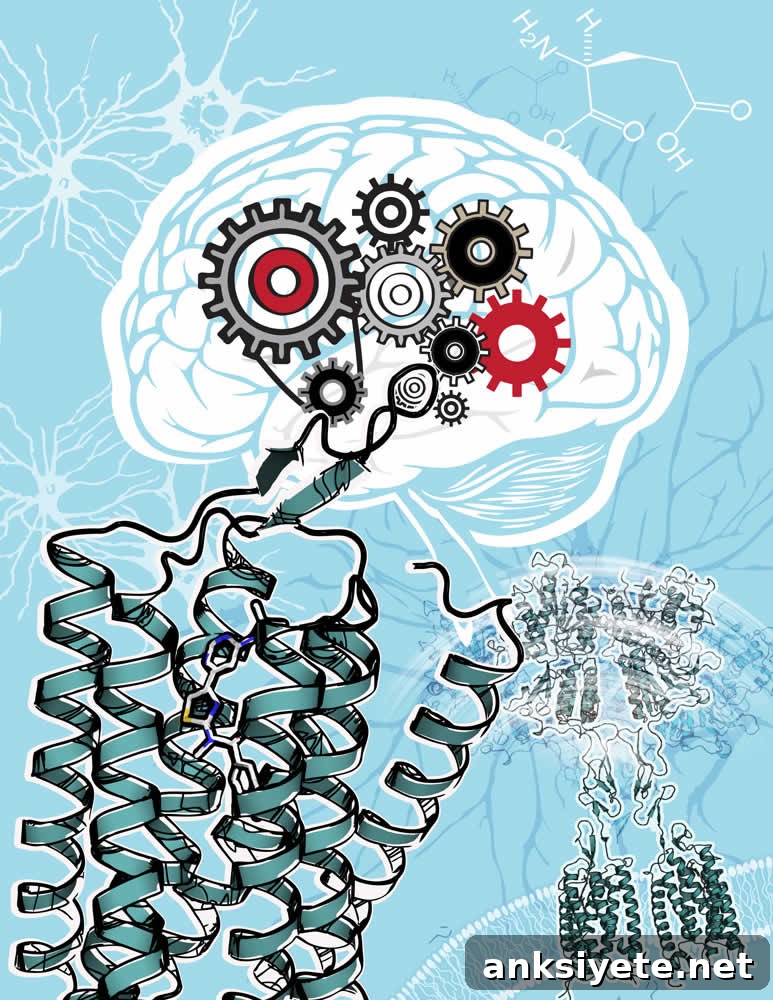
Researchers at The Scripps Research Institute and Vanderbilt University have produced the most detailed three-dimensional image to date of a membrane protein linked to learning, memory, anxiety, pain and a range of neurological disorders including schizophrenia, Parkinson’s, Alzheimer’s and autism.
“This receptor family is an exciting new target for future medicines to treat brain disorders,” said P. Jeffrey Conn, PhD, Lee E. Limbird Professor of Pharmacology and director of the Vanderbilt Center for Neuroscience Drug Discovery, who co-led the study with Raymond Stevens, PhD, professor in the Department of Integrative Structural and Computational Biology at TSRI. “Understanding how drug-like molecules bind this receptor at the atomic level should have a major impact on new drug discovery efforts.”
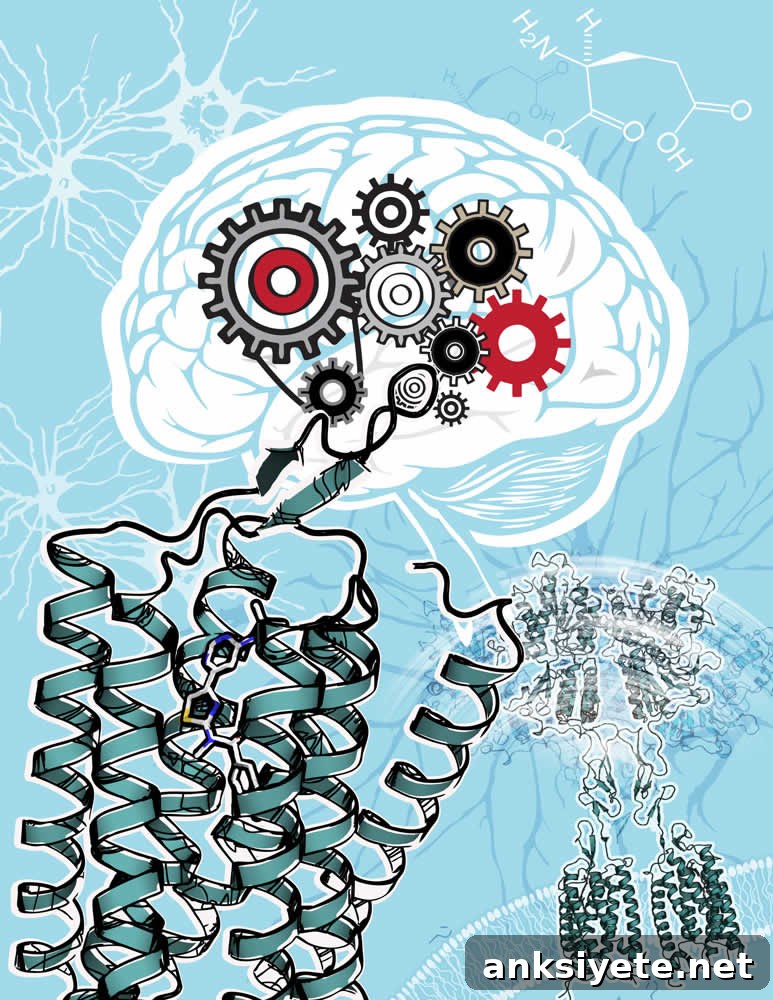
The work, focused on the metabotropic glutamate receptor 1 (mGlu1), was published in the March 6, 2014 issue of the journal Science. The structure reveals features that will inform efforts to design more selective and effective therapies that act on this receptor family.
A family of important drug targets
mGlu1 is part of the large superfamily of G protein-coupled receptors (GPCRs). These membrane proteins detect signals outside the cell—such as neurotransmitters, hormones, odors and light—and translate those signals into cellular responses. GPCRs are central to physiology and medicine: more than one-third of marketed drugs act on GPCRs, including treatments for cardiovascular conditions, allergies and disorders of the central nervous system.
The Stevens laboratory at TSRI has focused on uncovering GPCR structure and function. Recent advances have changed the way scientists view GPCRs, revealing them as dynamic, regulated molecular machines influenced by elements such as cholesterol and sodium. When the Stevens team chose to study mGlu1 and other metabotropic glutamate receptors, collaboration with Vanderbilt was a natural fit.
“Vanderbilt researchers are leaders in understanding mGlu receptors,” Stevens said. “By combining our structural biology expertise with their pharmacology and molecular modeling strengths, we aimed to map how human GPCRs control cell signaling and how drug candidates interact with these receptors.”
Colleen Niswender, PhD, director of Molecular Pharmacology and research associate professor at the Vanderbilt Center for Neuroscience Drug Discovery, added that the collaboration brought complementary skills in structural biology, allosteric modulator pharmacology, mutagenesis and structure-activity analysis to validate the receptor structure.
The challenge of an unusual receptor
mGlu1 presented a particularly difficult structural problem. GPCRs are inherently unstable outside their native membrane environment, which complicates efforts to produce crystals suitable for X-ray crystallography. mGlu1 is more complex than many GPCRs because, in addition to the membrane-spanning domain, it contains a large extracellular domain and functions as a dimer—two receptor copies must associate to transmit glutamate’s signal across the membrane.
Adding to the difficulty, mGlu1 belongs to class C GPCRs, a group for which no high-resolution structure had been determined at the time. “We could not rely on previously solved GPCR templates to guide construct design or interpret diffraction patterns,” said TSRI graduate student Chong Wang, a first author on the study. The team applied classic techniques in novel ways to overcome these obstacles.
Strategies and surprising findings
The researchers solved the structure of mGlu1 bound to an allosteric modulator provided by the Vanderbilt group. Allosteric modulators bind at sites separate from the receptor’s natural agonist (glutamate) and modify receptor activity by changing its conformation. Such modulators are attractive as drug candidates because they can fine-tune receptor signaling, potentially offering greater selectivity and fewer side effects than conventional agonists or antagonists.
To obtain a high-resolution view, the team combined X-ray crystallography with structure-activity relationship studies, mutagenesis and computational modeling of the full-length dimer. The final structure showed expected similarities to other GPCR classes as well as unanticipated differences that could not have been predicted without direct structural data.
One notable discovery is that loops near the entry to a binding pocket within the transmembrane domain substantially cover the pocket, restricting access for allosteric modulators. “This occluded entrance helps explain why discovering allosteric drugs for these receptors can be difficult,” said Vsevolod Katritch, assistant professor of molecular biology at TSRI and a co-author. The structure provides a stronger foundation for modeling related receptors that are also targets in drug discovery.
Implications for drug discovery and neuroscience
Having an atomic-level model of mGlu1 enables more precise design and screening of compounds that modulate receptor function. It helps researchers understand how subtle changes in ligand shape or chemistry can shift receptor conformation and downstream signaling, which is critical for developing therapies aimed at cognitive disorders, mood and anxiety disorders, chronic pain and neurodegenerative diseases.
Beyond therapeutic applications, the structure sheds light on basic receptor mechanisms—how class C GPCRs assemble, how their extracellular and transmembrane domains communicate, and how allosteric sites can exert powerful control over receptor behavior.
Study contributors and funding
The published paper, “Structure of a class C GPCR metabotropic glutamate receptor 1 bound to an allosteric modulator,” lists authors from TSRI and Vanderbilt, including Raymond Stevens, P. Jeffrey Conn, Colleen Niswender, Huixian Wu, Chong Wang, Vsevolod Katritch, Karen Gregory, Gye Won Han, Vadim Cherezov, Hyekyung Cho, Yan Xia and Jens Meiler. Funding for the research included grants from the National Institutes of Health and additional support from the International Rett Syndrome Foundation.
Contact: Mika Ono – Scripps Research Institute
Source: Scripps Research Institute press release
Image Source: Image credit: Katya Kadyshevskaya, adapted from the Scripps Research Institute press release
Original Research: The research article was published in Science on March 6, 2014.