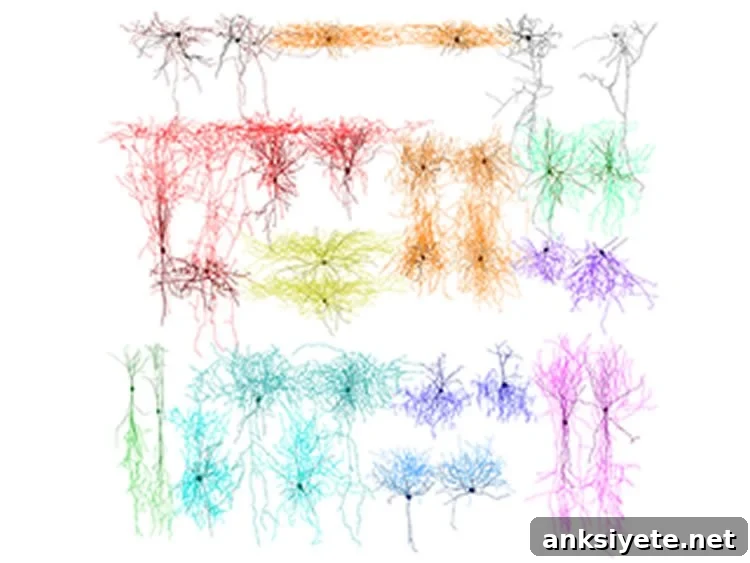
Our brains contain billions of neurons connected by trillions of synapses. Untangling that wiring may seem impossible, yet a research team from Baylor College of Medicine has taken a major step toward this goal by systematically mapping the local circuitry of the mouse neocortex, the brain’s outer layer associated with perception and higher cognitive functions.
The team set out to determine whether the apparent complexity of neocortical wiring can be reduced to a few general rules that govern how local networks are assembled. Their results, published in Science, show that the basic connectivity of the neocortex’s local circuits can be described by a small set of reproducible wiring principles that recur across cortical layers.
“To our knowledge, this is the most comprehensive effort to date to map a canonical circuit diagram of the mature neocortex,” said Dr. Xiaolong Jiang, assistant professor of neuroscience at Baylor College of Medicine and the study’s first author. “We identified the different cell types present in the neocortex and constructed a detailed wiring diagram of their local interactions.”
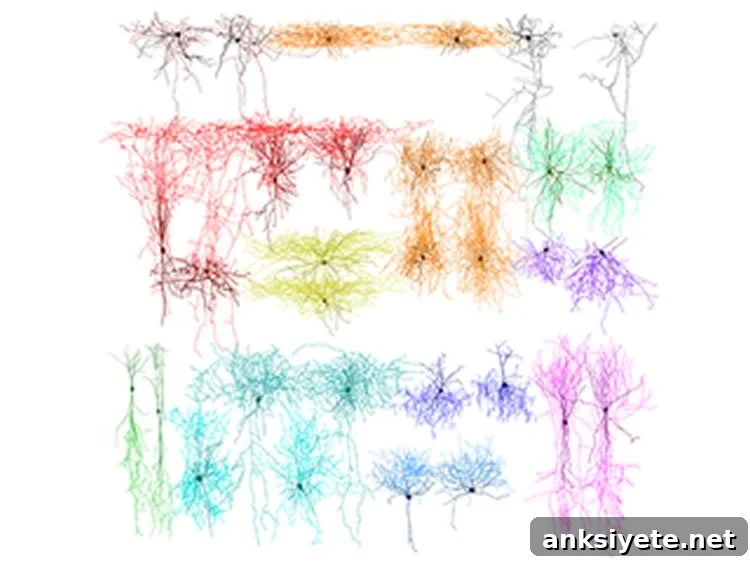
The researchers combined advanced tissue-slicing techniques with a novel protocol to preserve and recover neuron morphology. Working in Andreas Tolias’ laboratory at Baylor, Jiang and colleagues classified inhibitory neurons by shape and structure, identifying 15 distinct morphological types. They then used simultaneous multiple whole-cell electrophysiological recordings to characterize each cell type’s electrical properties and to map the synaptic connections among them and between inhibitory and nearby excitatory neurons.
In total, the study tested more than 11,000 potential synaptic pairings among morphologically identified neurons. From this large dataset the team extracted three broad organizational principles that describe how inhibitory cell types connect within local cortical networks.
First, the researchers found two inhibitory cell types that act as broad suppressors, connecting to and inhibiting nearly all other neuron types in the local circuit. These “master regulator” interneurons can exert wide-ranging influence over cortical activity.
Second, some inhibitory types were highly selective: they formed strong connections with a small subset of interneuron types while largely avoiding excitatory neurons. These selective connections create targeted inhibitory pathways that modulate interneuron activity without directly suppressing excitatory output.
Third, many inhibitory cell types showed a preference for inhibiting neurons of their own type while also maintaining connections with excitatory cells. Such self-inhibitory motifs and mixed inhibitory–excitatory connectivity can shape activity patterns within and across cortical layers.
“Importantly, these three connectivity principles were observed across multiple layers of the neocortex,” said Andreas Tolias, associate professor of neuroscience at Baylor and a senior author on the study. “The recurrence of these rules suggests a reusable set of wiring motifs that underlie cortical computation.”
Breaking cortical connectivity into a compact set of wiring rules has important conceptual and practical implications. Conceptually, these findings provide a clearer foundation for identifying the canonical algorithms implemented by a cortical column—the local microcircuit thought to perform basic computations in the cortex. Practically, a detailed and generalizable connectivity map offers a reference blueprint for researchers studying circuit dysfunction in neurological and psychiatric disorders.
Many diseases, including autism spectrum disorders and epilepsy, are thought to involve disruptions in cell-type–specific wiring. By providing a high-resolution map of how inhibitory and excitatory neurons are organized in healthy cortex, this work gives researchers a baseline to detect and interpret circuit-level abnormalities in animal models of disease. That, in turn, could guide development of more targeted, cell-type–specific therapeutic strategies.
The study’s contributors include Xiaolong Jiang, Shan Shen, Cathryn R. Cadwell, Fabian Sinz, Saumil Patel, Philipp Berens, and Alexander S. Ecker, with major contributions from the Tolias laboratory at Baylor College of Medicine and collaborators at the University of Tübingen and the Max Planck Institute for Biological Cybernetics. The team combined morphological classification, electrophysiology, and comprehensive pairwise connectivity testing to produce the connectivity principles reported.
Funding: The work was supported by grants DP1EY023176, DP1OD008301, R21EB016223, the McKnight Scholar Award, and the Arnold and Mabel Beckman Foundation Young Investigator Award to A.S.T.; P30EY002520 and T32EY07001; Deutsche Forschungsgemeinschaft (DFG, EXC 307); and the German Federal Ministry of Education and Research (BMBF; BCCN Tübingen, FKZ 01GQ1002). C.R.C. received support from F30MH095440, T32GM007330, and T32EB006350.
Source: Graciela Gutierrez, Baylor University.
Image Source: Image adapted from the Baylor University press release.
Original Research: Abstract for “Principles of connectivity among morphologically defined cell types in adult neocortex” by Xiaolong Jiang, Shan Shen, Cathryn R. Cadwell, Philipp Berens, Fabian Sinz, Alexander S. Ecker, Saumil Patel, and Andreas S. Tolias, published in Science on November 27, 2015.