
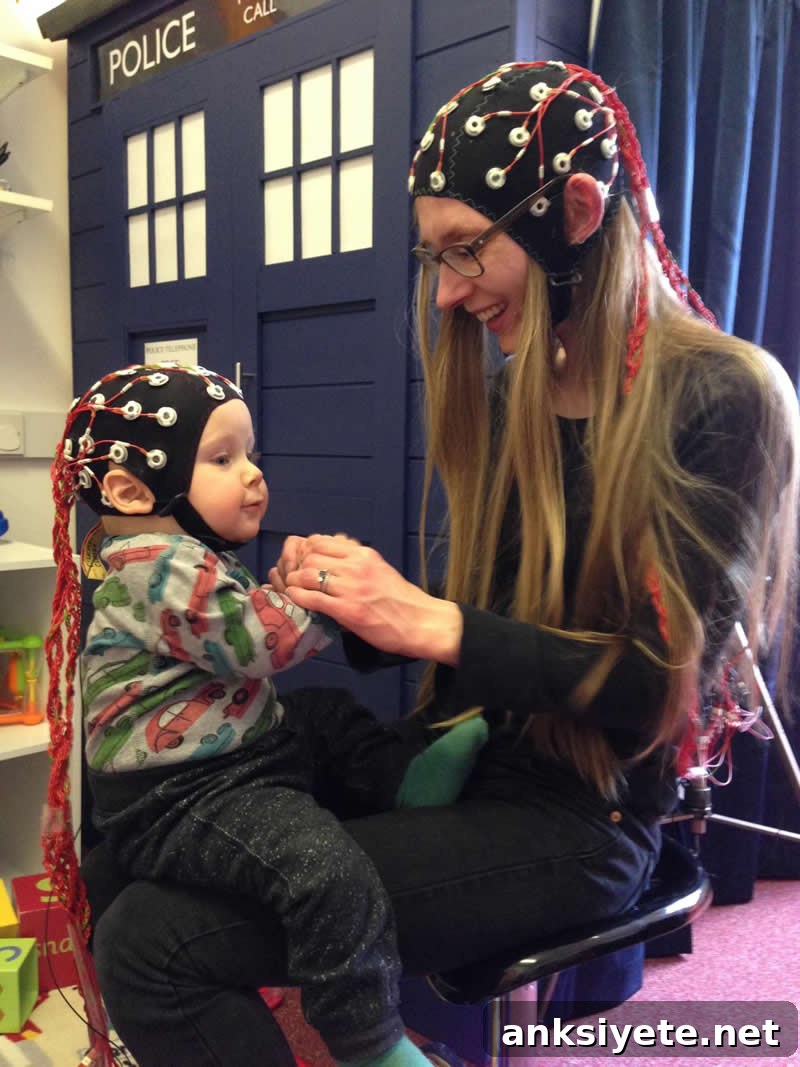
Summary: Direct, positive interactions—especially sustained eye contact—between mother and infant strengthen the synchronization of their brain waves, supporting learning and early development.
Source: University of Cambridge
Mothers’ and infants’ brains can synchronize and function together as a unified network during social interaction. The degree of this neural coupling changes with the mother’s emotional tone: when mothers display more positive emotion, their neural connectivity with their baby increases substantially. This enhanced synchrony may support the infant’s learning and brain development.
A study published in the journal NeuroImage used dual electroencephalography (EEG) to record brain activity from mothers and their infants simultaneously while they engaged in natural interaction. The researchers observed consistent synchronisation of brain rhythms between mothers and babies—an interpersonal neural connectivity effect—particularly in the 6–9 Hz band, corresponding to the infant alpha frequency range.
Using graph theory and network analysis, the team examined how information flowed inside each brain and how the two brains operated together as a combined network. These network measures revealed details about the structure and quality of inter-brain communication during different emotional exchanges.
The study found that positive, emotionally engaging interactions—characterised by frequent eye contact and warm affect—produce a stronger integrated brain network between mother and infant. In these moments, neural signals are shared more efficiently across the dyad, supporting clearer communication and potentially facilitating the infant’s readiness to learn.
“From our previous work, we know that when neural synchrony between mothers and babies is strong, infants become more receptive and better able to learn from their caregivers,” said Dr Vicky Leong from the University of Cambridge’s Department of Psychology, who led the research. “The infant brain is highly plastic at this stage, and early experiences shape its development. By adopting a positive emotional tone in everyday social interactions, parents can deepen their neural connection with their infants and stimulate the child’s emerging cognitive capacities.”
The findings also indicate potential developmental implications for infants of depressed mothers. When a caregiver experiences persistent low mood or clinical depression, typical social behaviours such as animated speech, eye contact, and contingent responsiveness often decline. The study suggests that these reductions in positive interaction correlate with weaker inter-brain connectivity, which may reduce opportunities for the infant to learn from social exchange.
“Our emotions literally alter how our brains exchange information with others,” Dr Leong added. “Positive emotions make that exchange more efficient. By contrast, depression can disrupt a parent’s ability to form those connections, limiting the social cues that help a child receive the optimal emotional and cognitive input needed to thrive.”
Emotional communication between parents and infants is essential during early life, but its neural basis has been poorly understood. This research is the first brain-imaging investigation of a parent–infant pair that directly tests how the emotional tone of interaction affects interpersonal neural connectivity. By measuring both participants’ EEG simultaneously, the study provides new insight into how social emotion shapes shared neural dynamics.
Humans are a social species that routinely share emotional states with close others. This work demonstrates that emotions can reshape the neural links between two people. The authors note that similar effects are likely to be found across other affiliative relationships—such as between partners, close friends, or siblings—where mutual attunement, familiarity, and trust influence the strength and pattern of inter-brain coupling.
Source:
University of Cambridge
Media contacts:
Jacqueline Garget – University of Cambridge
Image source:
Image credited to University of Cambridge.
Original research (open access):
“Emotional valence modulates the topology of the parent-infant inter-brain network.” Vicky Leong et al., NeuroImage. DOI: 10.1016/j.neuroimage.2019.116341.
Abstract
Emotional valence modulates the topology of the parent-infant inter-brain network
Emotional communication between parents and children is essential during early development, yet its neural underpinnings are not well known. This study applied a dual-connectivity approach to determine how positive and negative emotional expressions modulate the parent–infant neural network during natural interaction. Fifteen mothers modeled positive and negative emotions toward objects during play with their infants (mean age 10.3 months) while simultaneous EEG recorded brain activity in both participants. Network connectivity within and between brains in the 6–9 Hz range (infant alpha band) was evaluated using directed (partial directed coherence, PDC) and non-directed (phase-locking value, PLV) metrics. Graph-theoretical measures quantified how network topology changed with emotional valence. Inter-brain indices (density, strength, and divisibility) consistently showed robust effects of emotional valence: neural integration between parents and children was stronger during maternal demonstrations of positive emotion compared with negative emotion. Directed metrics indicated greater mother-to-infant directional influence during positive emotional expressions. These findings suggest that the parent–infant inter-brain network is modulated by the emotional quality of dyadic interactions and that inter-brain graph metrics are effective tools for characterising these changes in network topology.