
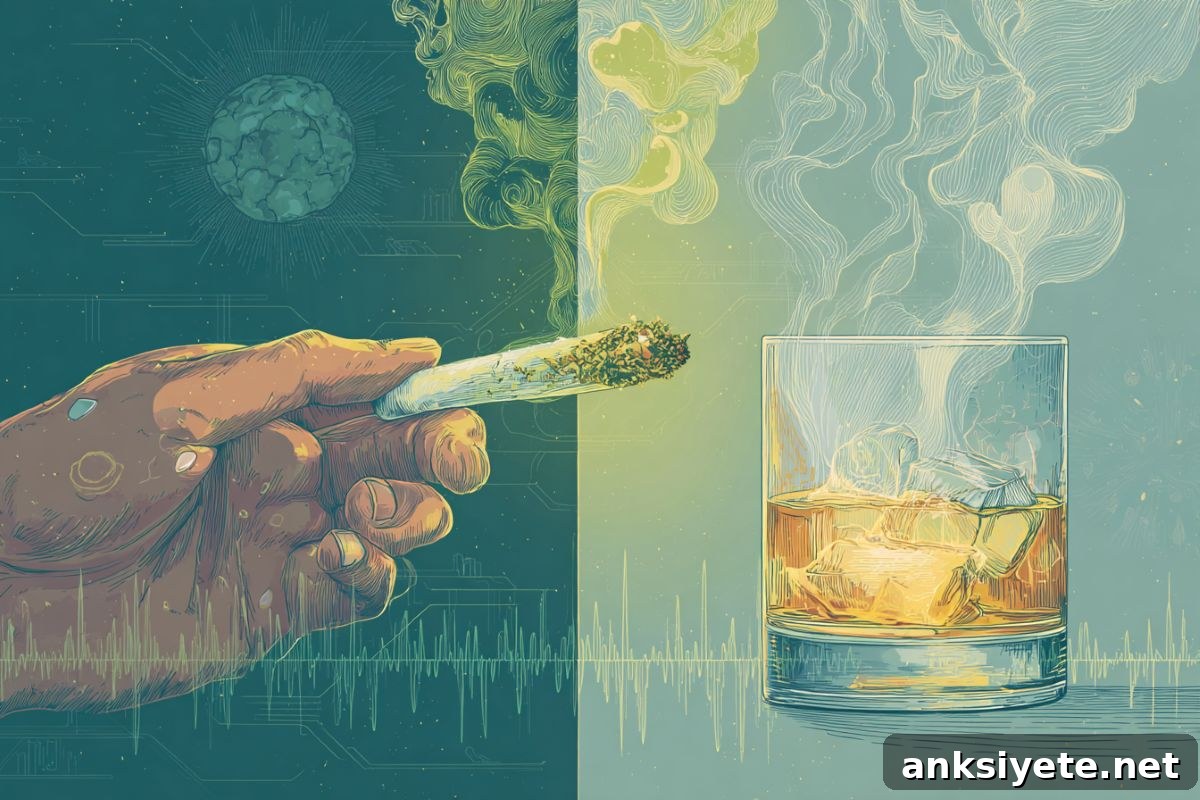
Summary: A randomized, placebo-controlled trial found that smoking cannabis containing active THC reduced immediate alcohol cravings and lowered short-term drinking among heavy-drinking young adults. Participants who smoked THC not only consumed less alcohol during a two-hour laboratory session, they also waited longer before taking their first drink and reported weaker urges to drink.
This study offers some of the most rigorous causal evidence so far supporting the idea—popularized as “California sober”—that cannabis can substitute for alcohol in the short term. Researchers caution, however, that cannabis is not an established treatment for alcohol misuse and carries its own potential risks.
Key Facts
- Short-term substitution: In a controlled, bar-like laboratory setting, THC-containing cannabis reduced alcohol consumption by as much as 27%.
- Craving reduction: Participants reported lower immediate urges to drink and delayed their first sip after using THC cannabis.
- Not a clinical recommendation yet: Long-term effects and real-world applicability remain unknown, and cannabis itself can be addictive.
Source: Brown University
The “California sober” trend—replacing alcohol with cannabis—has spread from celebrities and influencers into wider public awareness. One reason people try this approach is to cut back on alcohol, and this new randomized controlled trial tested whether cannabis can causally affect drinking behavior.
Published in the American Journal of Psychiatry, researchers at Brown University conducted the first double-blind, placebo-controlled randomized trial to measure whether cannabis use directly changes subsequent alcohol craving and consumption. Unlike survey-based work, this experiment was carried out under tightly controlled laboratory conditions to assess cause and effect.
“What we found was consistent with the substitution effect popularized by the California sober trend,” said Jane Metrik, professor of behavioral and social sciences and of psychiatry and human behavior at Brown. “Instead of seeing cannabis increase craving and drinking, we observed the opposite: cannabis lowered momentary urges for alcohol, decreased how much people drank during the session, and delayed when they began drinking once alcohol was available.”
The trial enrolled 157 adults aged 21 to 44 who reported heavy drinking and used cannabis at least twice weekly. Each participant completed three separate laboratory visits, during which they smoked cigarettes containing either a higher THC dose, a lower THC dose, or a placebo. The study used a double-blind, crossover design so neither researchers nor participants knew which cigarette was administered in a given session.
After smoking, participants completed an Alcohol Choice Task in a room staged to resemble a bar. They were offered servings of their preferred alcoholic beverage and could either drink or accept small cash payments for each drink they declined. The cash alternatives were intentionally modest so they would serve as a gentle incentive rather than a decisive motivator. During each two-hour session, alcohol was provided in amounts sufficient to raise blood alcohol concentration to roughly 0.10%—above legal driving limits in many states.
When participants smoked cannabis containing active THC, they drank less than when they smoked the placebo. Specifically, the lower THC dose (3.1%) reduced alcohol consumption by about 19% compared with placebo; the higher THC dose (7.2%) reduced alcohol consumption by about 27%. Participants also reported weaker immediate urges to drink after smoking THC, and the higher THC dose significantly delayed the time to first sip.
“We observed an acute reduction in the urge to drink,” Metrik noted. “But this study does not tell us what happens over weeks, months, or years.”
The authors stressed that these findings should not be taken as an endorsement of cannabis as a treatment for alcohol use disorder. Cannabis itself can be addictive, and some people progress to problematic cannabis use. Additionally, the substitution effect seen in the lab may not translate to real-world environments where people often combine substances socially or use higher-potency cannabis products.
Excessive alcohol use remains a major public health problem in the United States, linked to injury, loss of productivity, and disease. Cannabis and alcohol use frequently overlap: many people who struggle with cannabis use also meet criteria for alcohol use disorder. The researchers warned that combining cannabis and alcohol to enhance effects could increase, rather than decrease, drinking for some individuals.
To explore these issues further, the team is conducting a follow-up clinical trial funded by the National Institutes of Health to study simultaneous use of cannabis and alcohol and to examine how different cannabinoids, including CBD, might influence alcohol consumption both in the lab and in everyday settings.
For now, these results provide preliminary evidence that THC-containing cannabis can reduce alcohol consumption in a controlled laboratory setting, but more research is needed before cannabis can be recommended as a strategy to cut back or quit drinking.
“As researchers, our role is to continue answering these questions,” Metrik said. “We cannot yet advise anyone to use cannabis as a substitute for heavy or problematic drinking.”
Key Questions Answered:
A: In this randomized, placebo-controlled trial, THC-containing cannabis acutely reduced alcohol intake and delayed the first sip in the laboratory setting.
A: Participants drank about 19–27% less alcohol after smoking THC cannabis compared with placebo, depending on dose.
A: Not yet. Researchers emphasize that cannabis carries its own risks, long-term effects are unknown, and further study is required before clinical recommendations can be made.
Editorial Notes:
- This article was edited by a Neuroscience News editor.
- The journal article was reviewed in full by the editorial team.
- Additional context was provided by staff to clarify findings and limitations.
About this AUD, cannabis, and addiction research news
Author: Juan Siliezar
Source: Brown University
Contact: Juan Siliezar – Brown University
Image: The image is credited to Neuroscience News
Original Research (open access): “Acute Effects of Cannabis on Alcohol Craving and Consumption: A Randomized Controlled Crossover Trial” by Jane Metrik et al., American Journal of Psychiatry. DOI referenced in the original publication.
Abstract
Acute Effects of Cannabis on Alcohol Craving and Consumption: A Randomized Controlled Crossover Trial
Objective:
Cannabis use frequently co-occurs with heavy drinking and is associated with poorer outcomes in alcohol treatment. At the same time, cannabis may reduce alcohol consumption in some contexts. Until now, no human randomized trial had clearly established whether cannabis causally affects alcohol motivation. This double-blind crossover study tested dose-dependent acute effects of delta-9-tetrahydrocannabinol (THC) on alcohol craving and consumption.
Methods:
Across three experimental sessions, 157 adults who reported heavy drinking and cannabis use two or more times per week were randomized to smoke cannabis cigarettes containing 7.2% THC, 3.1% THC, or 0.03% THC (placebo). After smoking, participants were exposed to neutral and personalized alcohol cues and completed an alcohol choice task that allowed for voluntary self-administration. Primary outcomes included measures of craving and an alcohol urge question; the secondary outcome measured the percentage of the total available milliliters of alcohol consumed.
Results:
There were no consistent effects on one standardized craving scale during cue exposure, but the 7.2% THC dose reduced immediate alcohol urge after smoking. Participants consumed significantly less alcohol after smoking cannabis with 3.1% THC and 7.2% THC, showing reductions of roughly 19% and 27%, respectively, compared with placebo.
Conclusions:
After a period of overnight cannabis abstinence, smoking THC-containing cannabis acutely decreased alcohol consumption relative to placebo in a laboratory setting. Further controlled research across different cannabinoids and real-world conditions is needed before cannabis could be considered in clinical guidelines for alcohol treatment.