
Summary: New research shows that cannabinoid signaling can prune synapses and alter the formation of neural circuits in the developing brain.
Source: Osaka University.
Researchers led by Associate Professor Fumitaka Kimura in the Department of Molecular Neuroscience at Osaka University have identified multiple mechanisms that guide the formation and refinement of neuronal circuits in the cerebral cortex. Their work reveals that endocannabinoid signaling — and exposure to cannabis-like compounds such as Δ9-tetrahydrocannabinol (Δ9-THC) — can drive synaptic pruning and dismantle necessary neural connections during development.
Previous studies established that neural activity in both presynaptic and postsynaptic cells influences circuit formation, but the precise patterns of activity that guide wiring were not well understood. Thalamocortical projections to the cortex develop through a two-step process: as the cerebral cortex matures, initially widespread projections are refined by pruning of unnecessary connections until accurate, focused projections remain. The mechanisms that trigger this pruning had remained unclear.
In earlier work, this team discovered that many cortical areas follow a rule known as spike timing-dependent plasticity (STDP), where the relative timing of presynaptic and postsynaptic spikes determines whether synapses are strengthened or weakened. They also observed that this plasticity rule can change abruptly during circuit formation. Building on that insight, the researchers examined whether a similar developmental switch in STDP occurs at thalamocortical synapses and how such a switch might shape cortical wiring.
The team found that thalamocortical projection development begins with synaptic strengthening: coordinated activity in presynaptic and postsynaptic cells produces long-term potentiation that supports widespread axonal growth. After this initial phase, the rules governing plasticity switch so that synchronized activity instead leads to synaptic weakening, promoting pruning of excess projections. Crucially, this weakening phase is accompanied by release of endocannabinoids from neurons; these molecules act on Type 1 cannabinoid receptors (CB1Rs), likely located at thalamocortical terminals, to trigger retraction of unnecessary axonal branches.
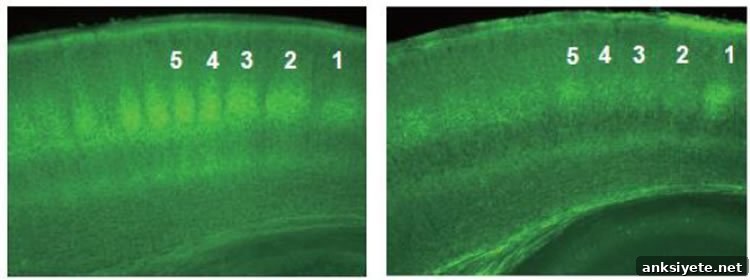
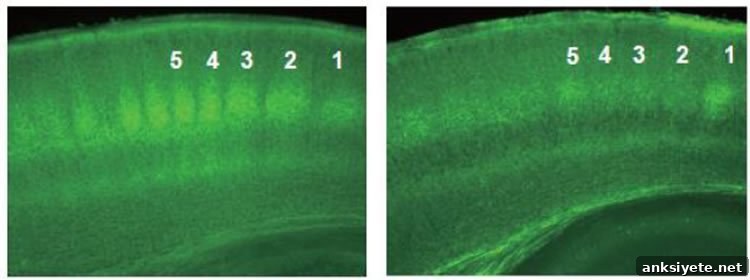
Experimental activation of CB1Rs with agonists, including Δ9-THC, mimicked this pruning process and caused substantial retraction of thalamocortical axons. Conversely, mice engineered to lack CB1Rs showed disordered thalamocortical projections that failed to undergo normal refinement, with persistent, exuberant innervation of upper cortical layers. These results indicate that endogenous cannabinoid signaling plays a key role in translating neural activity patterns into structural remodeling of thalamocortical circuits.
By revealing a developmental switch in STDP linked to the appearance of CB1Rs, this work provides a mechanistic explanation for how activity-dependent processes sculpt thalamocortical connectivity. It also offers a scientific basis for concerns that exposure to cannabis or other cannabinoid compounds during critical periods of brain development can disrupt the formation and refinement of neural circuits. Blocking or modulating cannabinoid signaling might therefore offer a strategy to prevent maladaptive circuit breakdown and could have implications for therapies aimed at restoring function after brain injury or in neurodegenerative conditions.
Funding: Study supported in part by the U.S. National Institutes of Health, including the National Institute on Deafness and Other Communication Disorders.
Source: Osaka University
Image Source: Image credited to the researchers.
Original Research: Abstract for “Developmental Switch in Spike Timing-Dependent Plasticity and Cannabinoid-Dependent Reorganization of the Thalamocortical Projection in the Barrel Cortex” by Chiaki Itami, Jui-Yen Huang, Miwako Yamasaki, Masahiko Watanabe, Hui-Chen Lu, and Fumitaka Kimura, Journal of Neuroscience. Published online June 29, 2016. DOI: 10.1523/JNEUROSCI.4280-15.2016
Osaka University. “How Cannabis Influences Formation of Neural Circuits.” NeuroscienceNews. Published September 12, 2016.
Abstract
Developmental Switch in Spike Timing-Dependent Plasticity and Cannabinoid-Dependent Reorganization of the Thalamocortical Projection in the Barrel Cortex
The formation and refinement of thalamocortical axons (TCAs) is an activity-dependent process, yet the specific patterns of activity and the mechanisms that convert activity into structural change have been unclear. This study examined spike timing-dependent plasticity (STDP) at thalamocortical synapses during early postnatal development in mice. At birth, TCAs infiltrate the cortical plate, and by postnatal days 3–4, layers 4 and 2/3 begin to differentiate. Some TCAs transiently extend toward the pia surface around P2–P4 but are later confined beneath the layer 2/3–layer 4 border.
Results show that neonatal TCA-cortical plate synapses exhibit robust timing-dependent long-term potentiation (t-LTP), which decreases in magnitude after P4–P5. Following layer 2/3 differentiation, TCA inputs to L2/3 shift to timing-dependent long-term depression (t-LTD) after P7–P8, while TCA inputs to L4 lose measurable STDP. t-LTP depends on NMDA receptors and PKA signaling, whereas t-LTD is mediated by CB1Rs, likely on thalamocortical terminals, as shown by both global and excitatory neuron–specific CB1R knockouts. Administration of CB1R agonists, including Δ9-THC, induced marked TCA retraction. In CB1R knockout mice, individual thalamocortical axons continued to innervate L2/3 abundantly at P12, indicating that endogenous cannabinoid signaling helps refine TCA projections. These findings suggest that a developmental switch in STDP and the emergence of CB1R-mediated signaling are critical for forming and refining thalamocortical connectivity.
SIGNIFICANCE STATEMENT: Neural activity is required for initial thalamocortical synapse formation, but the precise activity patterns and how these lead to structural changes were not known. The timing windows for inducing t-LTP and t-LTD align closely with the periods of synapse formation and elimination at thalamocortical synapses. Agonists that activate CB1Rs mimic t-LTD and drive axonal retraction, suggesting that cannabinoid signaling translates physiological plasticity into lasting morphological changes.
“Developmental Switch in Spike Timing-Dependent Plasticity and Cannabinoid-Dependent Reorganization of the Thalamocortical Projection in the Barrel Cortex” by Chiaki Itami et al., Journal of Neuroscience. Published online June 29, 2016. DOI: 10.1523/JNEUROSCI.4280-15.2016