
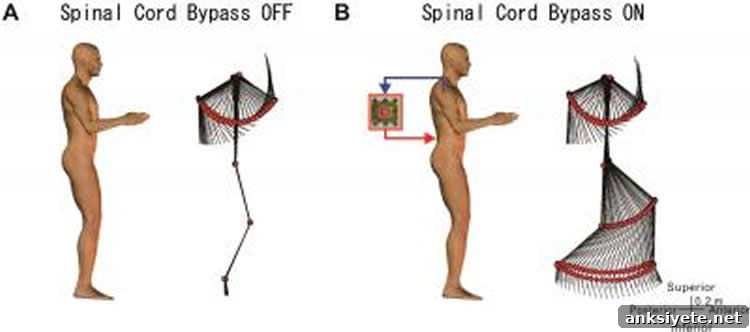
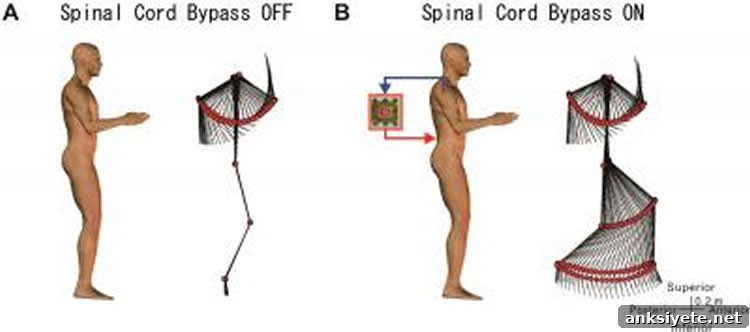
Potential rehabilitation of volitional walking in individuals with spinal cord injury.
Gait disturbances after spinal cord injury often result from disruption of the neural pathways that carry voluntary commands from the brain to the spinal locomotor networks. Neural circuits above and below a lesion frequently retain much of their intrinsic function, but without the brain’s input the spinal locomotor center cannot reliably initiate or modulate walking. A research team in Japan, led by Shusaku Sasada and Yukio Nishimura at the National Institute for Physiological Sciences (NIPS), National Institutes of Natural Sciences (NINS), has demonstrated an artificial bypass that reconnects volitional signals from the upper limb to the spinal locomotor center using a computer interface. The work, reported in the Journal of Neuroscience in August 2014, shows that noninvasive, muscle-controlled stimulation can activate rhythmic leg movements and allow subjects to control stepping cycles voluntarily.
Central pattern generators and other spinal networks are capable of producing rhythmic motor patterns such as walking or swimming independently of direct brain input. In intact individuals the brain controls these networks by sending commands to start, stop, and adjust gait speed. In many spinal cord injuries, the interruption of descending pathways prevents the brain from issuing those commands, which is a principal cause of walking impairment.
The research team designed a strategy to bypass the damaged descending connections by linking residual volitional signals to spinal locomotor circuits via a computer-mediated interface. Because arm movements are naturally coupled with leg movements during normal locomotion, the investigators used volitional activity in the upper limb as a reliable, controllable input signal. Surface electromyography (EMG) from arm muscles served as the user-controlled command. The computer interface translated those EMG signals into patterns of noninvasive magnetic stimulation delivered to the lumbar spinal cord, targeting the locomotor center.
In experiments with neurologically intact human volunteers, subjects were instructed to keep their legs relaxed while the system was inactive. When the bypass was activated and the subjects produced voluntary arm muscle activity, the interface triggered magnetic stimulation of the lumbar spinal cord and produced walking-like rhythmic activity in the legs. Subjects were able to start and stop stepping and to modulate the step cycle through intentional arm activity. Importantly, without the computer-mediated bypass, voluntary activation of the arm muscles did not elicit leg movements under the same conditions, demonstrating that the effect depended on the artificial connection between cortical intent and spinal pattern generators.
Yukio Nishimura, one of the senior authors, emphasized the translational goal: “We hope this technology can compensate for interrupted descending pathways by sending intentionally encoded commands to the preserved spinal locomotor center, potentially restoring volitionally controlled walking for individuals with paraplegia.” He also noted important limitations of the current approach: the system enables initiation and rhythmic control of stepping but does not by itself address balance, posture control, or obstacle avoidance. Those functions will require additional sensing, feedback, and integration with other motor circuits before the approach can be fully effective in everyday walking.
The study demonstrates a proof of concept for a brain-to-spinal cord bypass that uses upper limb muscle signals to drive noninvasive stimulation of lumbar spinal circuits. It highlights the potential for hybrid neuroprosthetic systems—combining voluntary intent, external signal processing, and targeted spinal stimulation—to restore elements of locomotor control after injury. Ongoing research is focused on refining stimulation protocols, improving closed-loop feedback for balance and posture, and translating the approach to clinical populations with spinal cord injury.
Source: Yukio Nishimura, National Institutes of Natural Sciences (NINS), National Institute for Physiological Sciences (NIPS).
Contact: National Institutes of Natural Sciences press office (public information and announcements).
Image credit: Yukio Nishimura, adapted from the National Institute for Physiological Sciences press materials.
Video credit: Yukio Nishimura / National Institute for Physiological Sciences, adapted from the press materials.
Original research: Abstract for “Volitional Walking via Upper Limb Muscle-Controlled Stimulation of the Lumbar Locomotor Center in Man” by Syusaku Sasada, Kenji Kato, Suguru Kadowaki, Stefan J. Groiss, Yoshikazu Ugawa, Tomoyoshi Komiyama, and Yukio Nishimura, Journal of Neuroscience, published online August 14, 2014. DOI: 10.1523/JNEUROSCI.4674-13.2014.