

Summary: A large, multiethnic study found that people who drink at least one cup of coffee daily have a lower risk of death from major causes — including heart disease, cancer, stroke, diabetes and respiratory and kidney disease — compared with those who do not drink coffee. The reduced mortality risk was similar for caffeinated and decaffeinated coffee, suggesting benefits are not limited to caffeine.
Source: USC
Caffeinated or decaffeinated, coffee consumption was linked to lower mortality, indicating the benefit does not rely solely on caffeine.
New research adds to the evidence that regular coffee drinkers tend to live longer. Scientists analyzing data from a large, long-running, ethnically diverse cohort report that drinking coffee is associated with reduced mortality from several leading causes of death.
The study found that people who drank one cup of coffee per day had about a 12 percent lower risk of dying during follow-up than those who did not drink coffee. The association was stronger for moderate intake: those who drank two to three cups per day had an approximately 18 percent lower risk of death. The pattern held across multiple racial and ethnic groups, including African Americans, Japanese Americans, Latinos and whites.
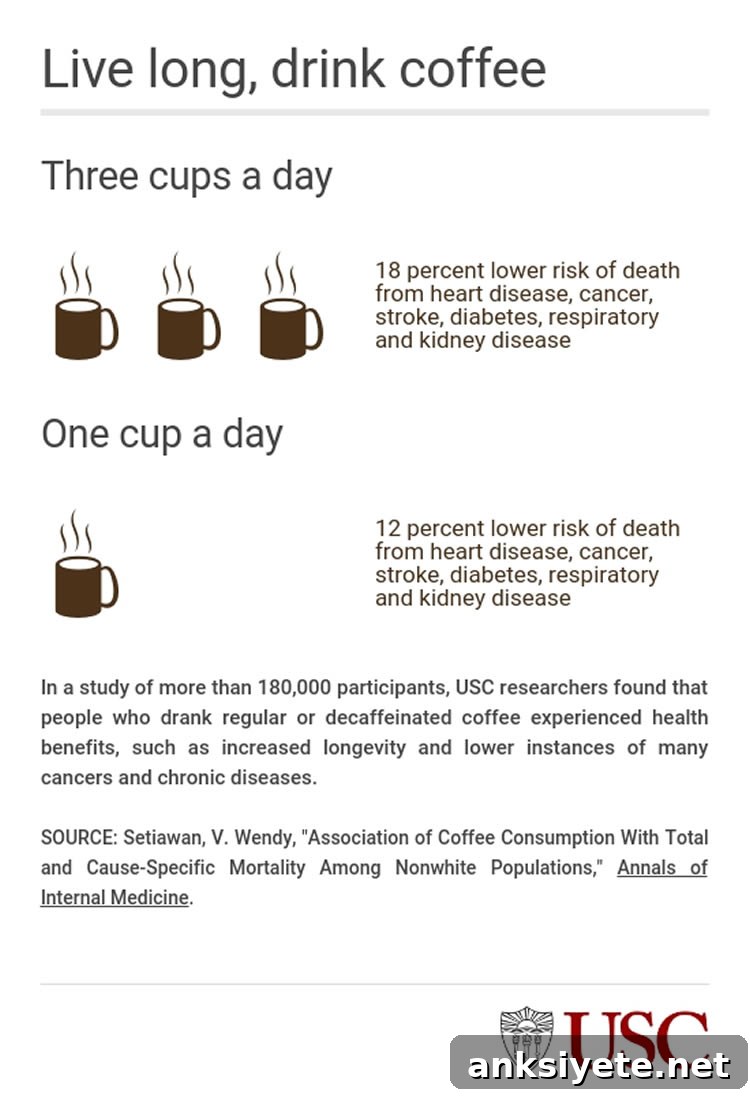
Importantly, the lower mortality risk was seen for both regular and decaffeinated coffee, which suggests the association is not driven solely by caffeine, said V. Wendy Setiawan, the study’s senior author and an associate professor of preventive medicine at the Keck School of Medicine of USC.
“We cannot conclude that coffee will lengthen your life, but we observe a consistent association,” Setiawan said. “If you enjoy coffee, our findings provide reassurance. If you don’t, you may want to consider the evidence when deciding whether to start.”
The findings appear in the Annals of Internal Medicine and are based on data from the Multiethnic Cohort Study, a collaborative effort of the University of Hawaii Cancer Center and the Keck School of Medicine at USC. The Multiethnic Cohort includes more than 215,000 participants and is one of the largest and most diverse prospective studies examining lifestyle factors and cancer risk.
Researchers emphasize the importance of studying diverse populations because lifestyle habits and disease risks vary across racial and ethnic groups. “Until now, few large-scale data existed on coffee and mortality among nonwhite populations in the United States,” the authors note. Observing a similar association across several ethnic groups strengthens the biological plausibility that coffee consumption may confer health benefits for many people.
Potential benefits and biological reasoning
Prior research has linked coffee drinking with lower risks of several chronic conditions, including some cancers, Type 2 diabetes, liver disease and Parkinson’s disease. Coffee contains antioxidants and phenolic compounds that may help protect cells and reduce inflammation, mechanisms that could plausibly lower the risk of chronic disease and premature death. However, the current study is observational and cannot prove cause and effect or identify which compounds may be responsible.
Setiawan, who reports drinking one to two cups daily, noted that any protective effect could have broad public-health relevance because coffee is widely consumed. “Although this study does not establish causation or pinpoint the specific chemicals in coffee responsible for the effect, the evidence suggests coffee can be part of a healthy diet and lifestyle,” she said.

While coffee has sometimes been viewed skeptically, most modern research finds little evidence of harm for the general population when consumed in moderation. The World Health Organization has updated its stance over the years, recognizing both potential risks (such as very hot beverages and esophageal cancer) and benefits (including lower risks for certain cancers). Overall, the balance of evidence in many studies points toward neutral to beneficial effects for regular coffee consumption.
Cohort details and results by the numbers
The analysis included 185,855 participants aged 45 to 75 at recruitment: 17 percent African American, 7 percent Native Hawaiian, 29 percent Japanese American, 22 percent Latino and 25 percent white. Participants completed validated food-frequency questionnaires on coffee intake at baseline and updated that information about every five years. Categories ranged from “never or hardly ever” to “four or more cups daily,” and respondents indicated whether they drank caffeinated or decaffeinated coffee. Average follow-up was about 16 years.
At baseline, 16 percent reported no coffee consumption, 31 percent reported one cup per day, 25 percent consumed two to three cups per day, 7 percent drank four or more cups per day, and 21 percent had irregular consumption. During follow-up, 58,397 participants (about 31 percent) died; cardiovascular disease (36 percent) and cancer (31 percent) were the leading causes. Statistical models adjusted for age, sex, ethnicity, smoking, education, preexisting conditions, vigorous physical activity and alcohol intake.
Inverse associations between coffee intake and mortality were observed for total mortality overall and for deaths due to heart disease, cancer, respiratory disease, stroke, diabetes and kidney disease. The pattern was consistent across several ethnic groups; the association in Native Hawaiians did not reach statistical significance in this analysis.
Funding: The Multiethnic Cohort Study is supported by the National Cancer Institute. Researchers from the University of Hawaii Cancer Center and the National Cancer Institute contributed to the work.
Source and attribution: USC reporting on the study published in Annals of Internal Medicine titled “Association of Coffee Consumption With Total and Cause-Specific Mortality Among Nonwhite Populations,” authored by Song-Yi Park, Neal D. Freedman, Christopher A. Haiman, Loïc Le Marchand, Lynne R. Wilkens and Veronica Wendy Setiawan. Published online July 11, 2017.
Conclusion: In this large, multiethnic cohort, higher coffee consumption was associated with a lower risk of death from several major causes among African Americans, Japanese Americans, Latinos and whites. While the study cannot prove causation, the consistent pattern across populations supports further investigation into coffee’s potential role in promoting health.