
Summary: Exposure to antidepressants during early pregnancy and the first weeks of life can produce lasting changes in how the brain processes sensory information.
Source: SfN
Exposure to antidepressants during pregnancy and the neonatal period can alter sensory processing into adulthood, according to a mouse study recently published in eNeuro.
Selective serotonin reuptake inhibitors (SSRIs) such as fluoxetine are increasingly prescribed to pregnant patients, yet their effects on the developing fetus and neonate are not fully understood. Serotonin is a key neurotransmitter implicated in mood regulation and is also essential for proper brain development. While SSRIs can relieve depressive symptoms in many adults, altering serotonin signaling during critical windows of brain maturation may have long-term consequences for neural circuits that handle sensory information.
Previous studies have reported behavioral and structural changes following prenatal and early-life SSRI exposure. The new work by Rahn and colleagues focused on how perinatal SSRI exposure affects brain activity. Using a mouse model, the researchers administered fluoxetine through gestation and continued exposure for the first two postnatal weeks, a period equivalent to important stages of human brain development. In adult offspring, they used in vivo optical imaging techniques to compare cortical responses in fluoxetine-exposed mice (FLX) and control mice (VEH).
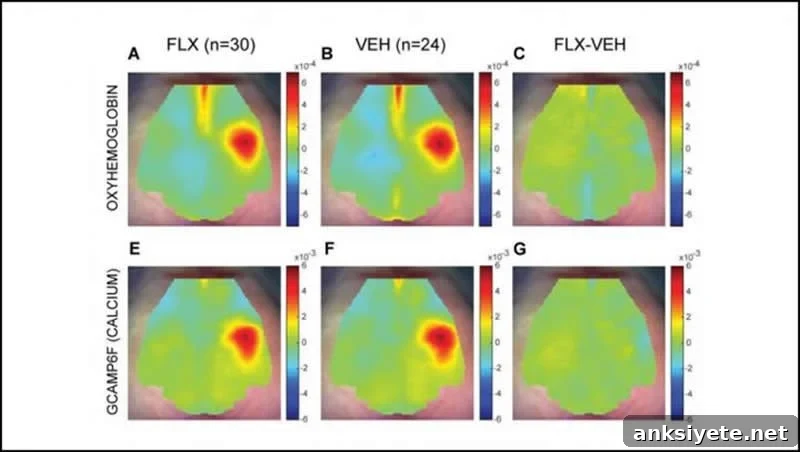
At rest, FLX and control brains showed virtually identical functional connectivity, indicating no global disruption of spontaneous cortical activity. However, when the researchers applied a somatosensory stimulus—brief stimulation of a front paw—differences emerged. Mice exposed to fluoxetine during development showed significantly reduced evoked activity in somatosensory cortical areas compared with controls. These differences were observed with two complementary measures: hemodynamic responses (oxyhemoglobin, HbO2) and neuronal calcium signaling (Thy1-GCaMP6f fluorescence), confirming that both vascular and neuronal response amplitudes were diminished.
The altered responses were especially notable in the cortex ipsilateral to the stimulated paw, where FLX mice displayed the largest reductions in both HbO2 and calcium signal amplitude compared to controls. The spatial pattern of reduced activation was similar across hemodynamic and calcium imaging methods, suggesting a consistent, global loss of stimulus-evoked response strength following perinatal fluoxetine exposure. Importantly, these neurophysiological changes persisted into adulthood, indicating that early SSRI exposure produced long-lasting alterations in somatosensory cortical processing.
Source:
SfN
Media Contacts:
Calli McMurray – SfN
Image Source:
The image is credited to Rahn et al., eNeuro 2019.
Original Research: Close access
“Maternal Fluoxetine Exposure Alters Cortical Hemodynamic and Calcium Response of Offspring to Somatosensory Stimuli”. Rachel M. Rahn, Susan E. Maloney, Lindsey M. Brier, Joseph D. Dougherty and Joseph P. Culver. eNeuro. DOI: 10.1523/ENEURO.0238-19.2019.
Abstract
Maternal Fluoxetine Exposure Alters Cortical Hemodynamic and Calcium Response of Offspring to Somatosensory Stimuli
Epidemiological studies have associated prenatal exposure to selective serotonin reuptake inhibitors (SSRIs) with a higher incidence of neurodevelopmental disorders in some populations. Optical imaging offers a minimally invasive approach to determine whether perinatal SSRI exposure produces lasting functional effects in cortex. In this study we evaluated a mouse model exposed to fluoxetine during gestation and early postnatal life to probe adult cortical function. Resting-state homotopic contralateral functional connectivity did not differ between fluoxetine-exposed (FLX) and control mice, indicating preserved baseline network coupling. By contrast, the evoked cortical response to forepaw stimulation was reduced in FLX mice. Both hemodynamic measures (oxyhemoglobin, HbO2) and neuronal calcium signals (Thy1-GCaMP6f fluorescence) showed decreased activity in FLX compared with controls, with the most pronounced differences in cortex ipsilateral to stimulation. The largest cortical regions of divergence between FLX and control mice were consistent across hemodynamic and calcium contrasts, particularly at the end of stimulation, pointing to a global reduction in response amplitude following perinatal SSRI exposure. These results suggest that developmental fluoxetine exposure can have long-term consequences on somatosensory cortical responsiveness.
Significance Statement
Use of SSRIs during pregnancy has risen in recent decades, prompting concern about potential long-term effects on offspring brain function. To isolate the effects of perinatal SSRI exposure from genetic or maternal psychiatric variables, this study used in vivo functional neuroimaging in a controlled mouse model. The findings show no broad disruption of resting cortical function but reveal a clear reduction in the cortical response to somatosensory stimulation, measured at both vascular and excitatory neuronal levels. These data indicate that perinatal SSRI exposure can specifically diminish sensory-evoked cortical activity and underscore the need for further research into how early-life modulation of serotonin signaling affects sensory circuits and behavior.