
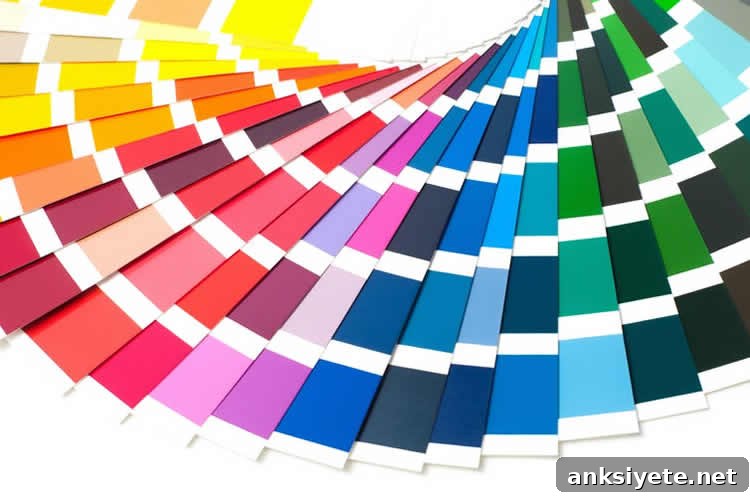
Summary: Researchers explain how the language we speak and our cultural experiences can shape the way we perceive color.
Source: The Conversation.
The human eye can physically perceive millions of colours, but we do not all recognise them the same way
The human retina contains photoreceptor cells called cones that allow us to detect a vast range of colours. Some people lack or have defective cones and experience colour blindness, which prevents them from distinguishing certain hues. Even among people with otherwise normal vision, the number, distribution and sensitivity of cones varies, so the exact appearance of a colour can differ slightly from one person to another.
More important than the raw signals from the eye, however, is how the brain interprets those signals. Colour perception is a constructive process: the visual system interprets wavelengths of light and combines them with context, memory and expectation to produce the colours we consciously experience. As a result, colour is subjective and shaped by individual experience.
For example, people with synaesthesia sometimes experience colours in response to letters, numbers or sounds. Synaesthetic associations—such as seeing a particular letter as a specific colour—are consistent for each person but vary across individuals, underscoring how perception is shaped internally rather than determined solely by external stimuli.
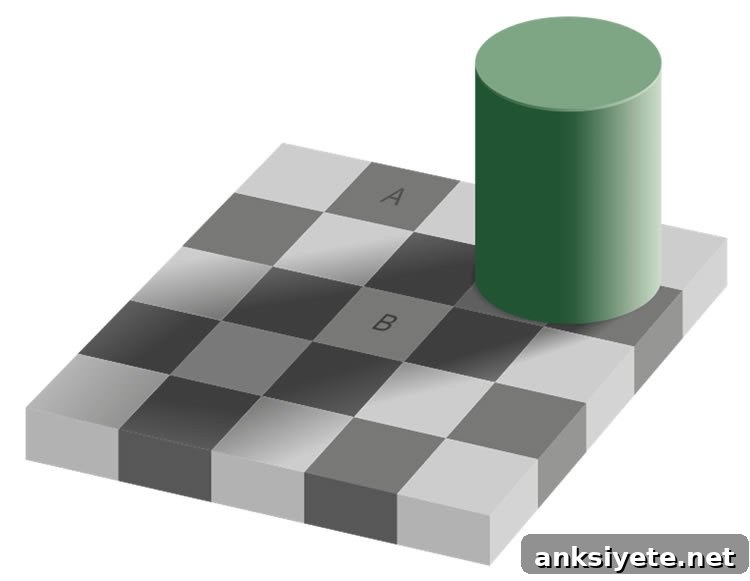
A classic demonstration of the brain’s interpretive role is Adelson’s checker-shadow illusion, in which two squares that are physically the same colour are perceived as very different because of surrounding contrast and inferred lighting conditions. Such illusions highlight that perception depends heavily on context and neural interpretation.
The culture of colour
From birth we use language to categorise objects, emotions and sensory experiences, and colour is no exception. Although the eye can detect thousands of hues, daily communication requires grouping that spectrum into meaningful, shared categories. These linguistic categories shape how speakers attend to and remember colours.
Experts such as painters, designers and fashion professionals often use fine-grained colour vocabulary to distinguish subtle variations that non-experts might group under a single term. More broadly, different cultures and languages divide the colour spectrum in distinct ways.
Some languages, for example, use only two basic colour terms corresponding roughly to “dark” and “light.” In those systems, dark shades like black, blue and green may be described using the same term as one another, while lighter tones such as white, red, orange and yellow share another term. Other cultures do not use a single word equivalent to “colour” at all; instead they describe surface appearance with terms related to texture, material, function or sensory quality.
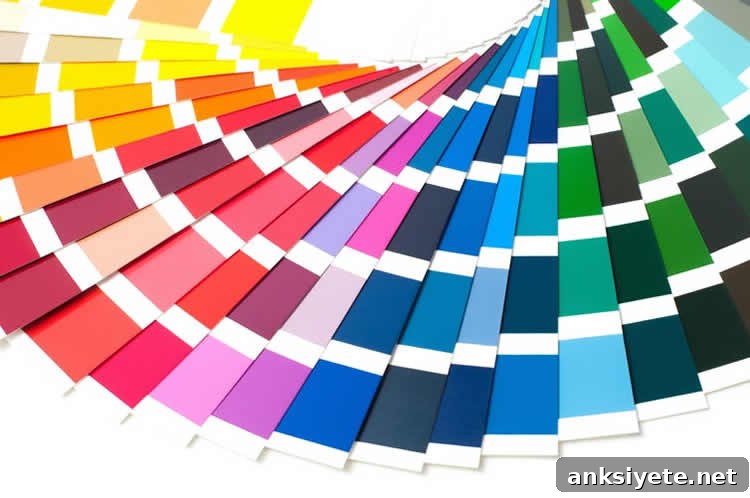
Five basic colour terms across many languages
Remarkably, most of the world’s languages have developed at least five basic colour terms. In many systems these include words for dark, light, red, yellow and a combined category often called “grue” that covers both blue and green. Examples of distinct cultural environments—from arid plains to tropical rainforests—show that similar linguistic solutions to colour naming emerge in different contexts.
Some languages that historically used a single “grue” term later developed separate words for blue and green. This change can happen internally, through shifts within the language, or externally through borrowing from other languages. In several modern languages, speakers also maintain two basic terms for what English would call “blue,” distinguishing darker and lighter blues with separate words.
Language, experience and shifting perception
Language can actively influence how we perceive colour over time. For instance, native speakers of a language that distinguishes two fundamental shades of blue may begin to treat those shades as more similar after prolonged exposure to an environment where a single term is used (for example, migrating to an English-speaking setting where both shades are called “blue”). Extended use of another language can reshape the brain’s colour categories by changing how colours are labelled, grouped and attended to in everyday life.
This effect is part of a broader phenomenon in which the languages we learn and use change how we interpret the world. Learning a new language introduces alternative ways to carve up sensory and conceptual space, which can alter perception, memory and attention across domains beyond colour.
About this research
Funding: Aina Casaponsa receives support from a British Academy/Leverhulme Trust small research grant. Panos Athanasopoulos reports no commercial conflicts of interest and discloses no relevant affiliations beyond his academic appointment.
Source: Aina Casaponsa & Panos Athanasopoulos – The Conversation. Publisher: Organized by Neuroscience News. Image source: images adapted from The Conversation news release.