
Summary: When people listen to music, neural activity in the frontal lobe follows activity in the temporal lobe; during musical recall, the frontal lobe leads the temporal lobe. These results reveal bottom-up and top-down processing in the cortex during listening and remembering, shedding light on how the human brain represents and tracks familiar music.
Source: SfN
Scientists have recorded how the human brain represents a familiar piece of music and found that listening and remembering rely on different temporal dynamics and information flow across brain regions.
Past neuroimaging work has identified a network of regions—often stronger on the right hemisphere—that respond to music. But less is known about how those regions activate over time and how information moves between them when we hear music versus when we imagine or recall it.
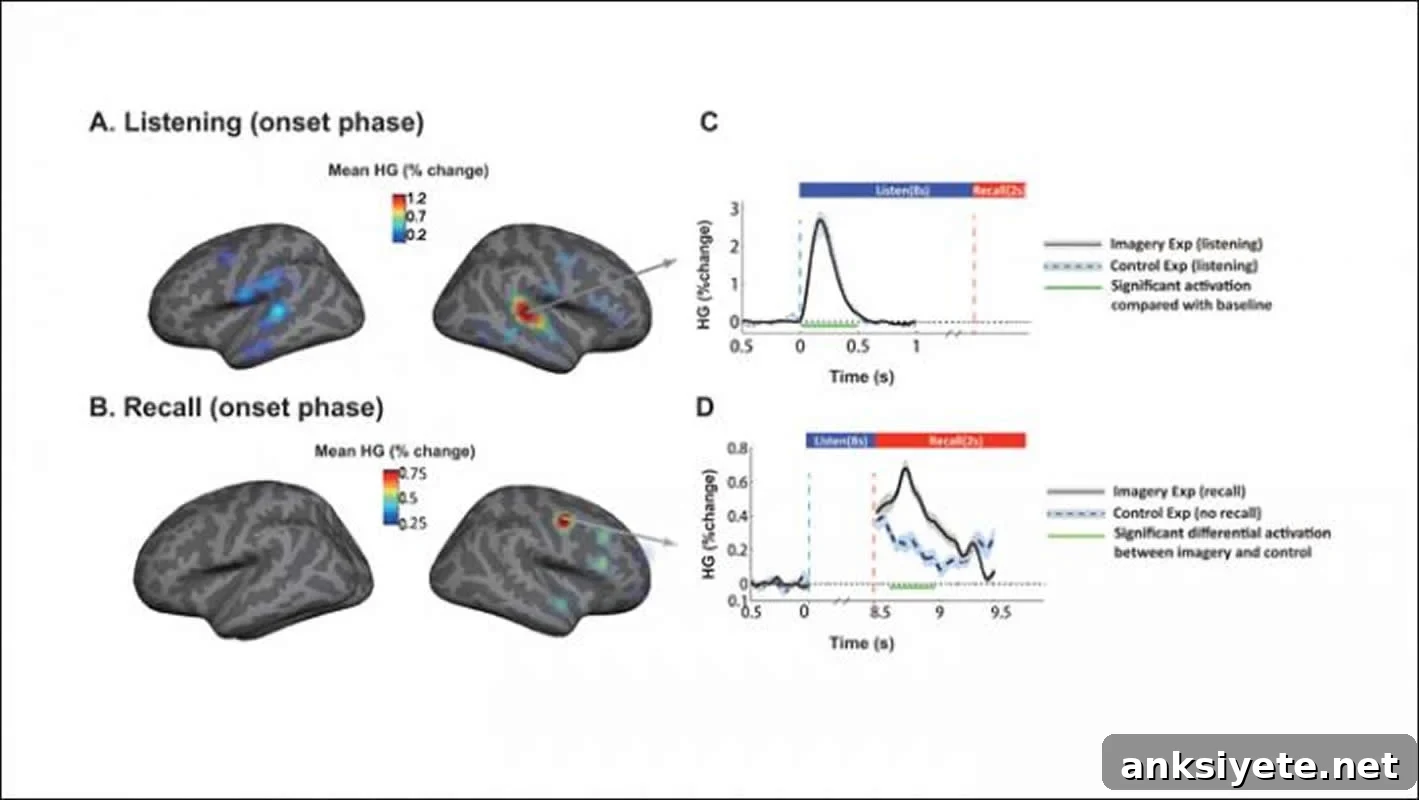
In a study of male and female patients with epilepsy, Yue Ding and colleagues used electrocorticography (ECoG)—direct recording of electrical activity from the brain surface—to measure neural responses while participants listened to familiar instrumental pieces such as Beethoven’s “Für Elise” and Wagner’s “Wedding March,” and while they later imagined or recalled those same melodies. Because ECoG records high-temporal-resolution signals directly from cortex, the method allowed the researchers to trace the timing and direction of neural activity as music was heard and then reconstructed in the mind.
The recordings revealed a consistent pattern in timing and direction. During the initial onset of listening (0–500 ms after a musical event), high-gamma activity first emerged in auditory regions of the temporal lobe and in the supramarginal gyrus, and then spread to motor-related and frontal areas including the precentral gyrus and inferior frontal gyrus. This sequence reflects a bottom-up flow from sensory processing toward higher-order frontal regions as the brain analyzes incoming sound.
By contrast, during music recall—when participants imagined continuing the melody without external sound—the temporal order reversed. High-gamma activity appeared first in frontal motor and prefrontal regions and then propagated back to temporal auditory regions, consistent with a top-down process in which frontal cortex drives the reconstruction of auditory representations.
Beyond onset timing, the study examined sustained responses (after about 500 ms) in both low-frequency (delta) and high-gamma bands. Neural activity in supramarginal, temporal, and frontal areas dynamically tracked the intensity envelope of the music—whether heard or imagined—but with different temporal delays depending on the task. During listening, frontal tracking lagged behind temporal tracking; during recall, frontal tracking preceded temporal tracking. These findings support the idea that perception and imagery engage the same distributed network but with reversed information flow depending on whether the brain is receiving sensory input or generating it internally.
Source:
SfN (Society for Neuroscience)
Media Contacts:
David Barnstone – SfN
Image Source:
Image credit: Ding et al., JNeurosci (2019).
Original Research: Closed access
“Neural Correlates of Music Listening and Recall in the Human Brain”, Yue Ding, Yang Zhang, Wenjing Zhou, Zhipei Ling, Juan Huang, Bo Hong and Xiaoqin Wang. Journal of Neuroscience, doi: 10.1523/JNEUROSCI.1468-18.2019
Abstract
Neural Correlates of Music Listening and Recall in the Human Brain
Although earlier neuroimaging studies have identified a set of brain regions responsive to music listening and to musical imagery or recall, the temporal sequence and time-resolved representation of music across these regions have remained unclear. To address this, the authors analyzed electrocorticography recordings from ten epilepsy patients (both sexes) implanted with subdural electrodes. Subjects listened to familiar instrumental music and later recalled the same pieces by mental imagery. During the onset phase (0–500 ms), listening evoked high-gamma activity beginning in the temporal lobe and supramarginal gyrus, then spreading to the precentral and inferior frontal gyri. During recall, this sequence reversed: high-gamma activity appeared first in the inferior frontal and precentral gyri and then propagated to temporal regions. In the sustained phase (after 500 ms), both delta- and high-gamma-band responses in supramarginal, temporal, and frontal regions tracked the intensity envelope of the music during listening and recall but with distinct temporal delays. Specifically, frontal neural tracking lagged behind temporal tracking during listening, while frontal tracking preceded temporal tracking during recall. These results demonstrate bottom-up and top-down cortical processes during music perception and internal reconstruction, offering detailed insights into how the human brain processes, stores, and retrieves musical information.
SIGNIFICANCE STATEMENT
Understanding how the brain analyzes, stores, and retrieves music is a fundamental challenge in neuroscience. Direct intracranial recordings reveal that listening and recall engage overlapping, distributed cortical regions but with opposite temporal flows of activity: a sensory-to-frontal (bottom-up) sequence during listening and a frontal-to-sensory (top-down) sequence during recall. Neural responses in frontal and temporal cortices dynamically track the moment-to-moment intensity of music, either heard or imagined, with task-dependent timing differences. Together, these findings clarify the cortical dynamics that support auditory perception and musical imagery.