
Have you ever wondered why the human brain evolved the way it did?
Researchers led by Northeastern physicist Dmitri Krioukov propose an intriguing answer: the brain’s wiring has evolved to speed information transfer between regions, allowing us to respond quickly and operate at high efficiency. Their analysis suggests the brain’s structural network is nearly optimal for routing signals, supporting everything from simple reflexes to complex behaviors.
The study, published in the July 3 issue of Nature Communications, finds that the brain’s connectivity approximates an almost ideal network for navigation of information. In practical terms, those connections let signals travel efficiently from areas such as the auditory cortex, which processes sound, to motor regions that control movement—enabling coordinated actions like raising a hand in class or instinctively following music.
Beyond confirming a remarkable evolutionary achievement, these findings may have significant implications for understanding neurological disorders and designing targeted therapies. If certain connections are essential for efficient information flow, their disruption could underlie disease symptoms; conversely, restoring or bypassing those connections might help recover function.
“An optimal network in the brain would have the fewest connections necessary to minimize biological cost while offering maximal navigability—direct routing between any two regions,” says Krioukov. The study identifies a balance between cost and navigability and presents an algorithmic approach to discover the set of links that achieve that balance—the network’s “sweet spot.”
Krioukov and his collaborators study networks across many scales, from large internet datasets to the human brain. Using mathematical tools inspired by game theory and the work of John Nash, they created a model of an idealized brain network that optimizes information routing. They then compared that theoretical network to maps of the brain’s actual structural connections to measure how closely biology matches the ideal.
The result was striking: about 89 percent of the connections present in the idealized model were also present in the real brain network. “That means the brain’s architecture is evolutionarily tuned to be very close to what our model predicts,” Krioukov explains.
Importantly, the team’s approach reverses the usual order of analysis. Rather than starting with the real network and only later examining function, they let function—specifically navigability—determine the ideal network structure. This functional-first strategy highlights the edges most important for efficient navigation, whereas traditional methods can obscure which links are truly critical.
The methodology is broadly applicable. In addition to the human brain, the researchers mapped six distinct networks to test their approach, including the Internet, U.S. airports, and Hungarian roads. In each case they identified a minimal “skeleton” of connections that supports optimal navigation. For example, the Hungarian road network’s skeleton explained how travelers can reach destinations reliably even without detailed maps.
Such skeletons offer practical value across fields. Knowing which edges are indispensable for navigation helps prioritize protection and maintenance of critical infrastructure—whether the Internet, transportation systems, or other networks. Conversely, identifying those links reveals strategic points that, if disrupted, could significantly impair a hostile or malicious network.
“If you are defending a system, these results tell you what to safeguard first,” Krioukov notes. “If you are designing or improving a network, they show where to add or strengthen connections to maximize navigability.”
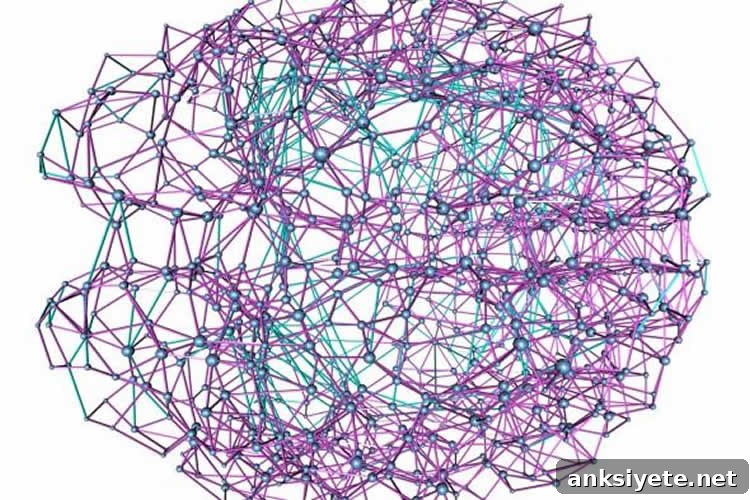
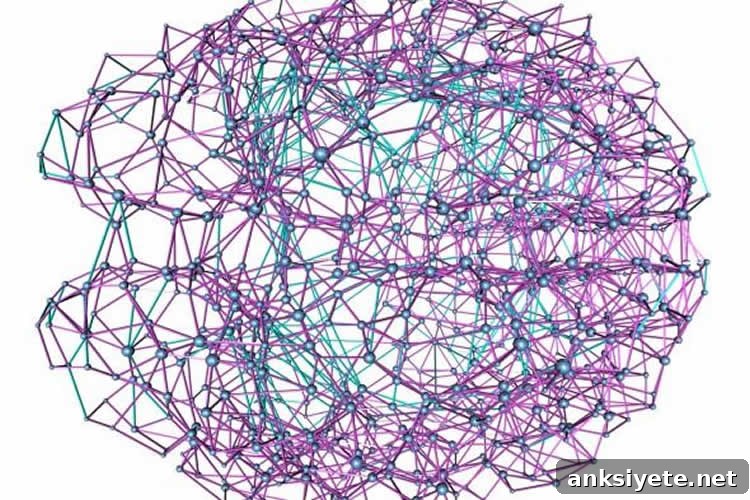
Within the brain, the links common to both the idealized and the real networks likely represent the connections most essential for normal function. In their illustrations, magenta pathways mark those shared links, standing out among a dense web of turquoise connections. The researchers suggest these magenta links are prime candidates for investigation when neurological diseases disrupt cognition or behavior.
Looking ahead, Krioukov envisions clinical applications: once critical links are identified, therapies—pharmacological, surgical, or technological—could be developed to repair, strengthen, or reroute information flow around damaged regions. “Ultimately, the goal is to restore a diseased network so it can resume normal function,” he says.
Source: Jessica Caragher, Northeastern University
Image Credit: Dmitri Krioukov
Original Research: “Navigable networks as Nash equilibria of navigation games” by András Gulyás, József J. Bíró, Attila Kőrösi, Gábor Rétvári and Dmitri Krioukov, published in Nature Communications, July 3, 2015. DOI: 10.1038/ncomms8651
Abstract
Navigable networks as Nash equilibria of navigation games
Many real-world networks are organized to support efficient targeted transport or navigation rather than being random. Using game-theoretic methods, the authors show that minimal networks designed to maximize navigability at minimal cost share core structural properties with empirical networks. These idealized networks emerge as Nash equilibria of a network construction game that balances cost and routing efficiency. The study demonstrates that such navigational skeletons appear in diverse systems—the Internet, metabolic networks, English word associations, U.S. airports, Hungarian roads, and a structural map of the human brain. Identifying these skeletons reveals the minimal set of edges whose alteration can most effectively improve or disrupt navigation.