
Summary: A newly identified biochemical interaction may explain how excess ApoE4 increases the risk of Alzheimer’s disease.
Source: Salk Institute.
Researchers at the Salk Institute have uncovered a biochemical connection between the Alzheimer’s risk gene variant apolipoprotein E4 (ApoE4) and the protein accumulations linked to the disease. Their results provide a testable mechanism for how elevated ApoE4 contributes to Alzheimer’s pathology.
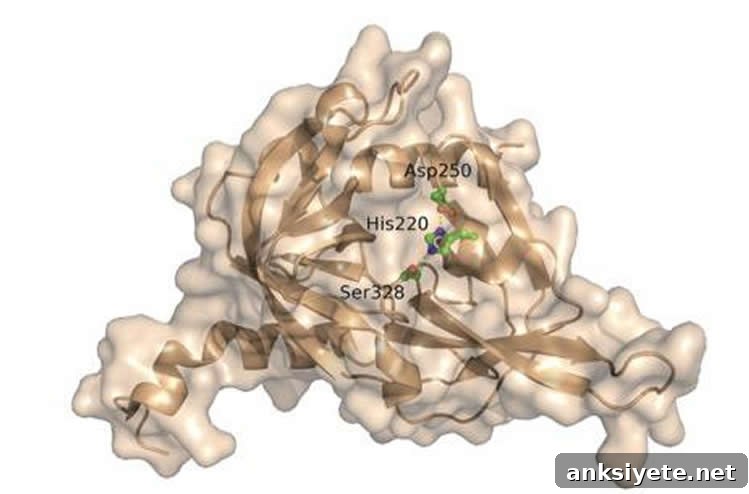
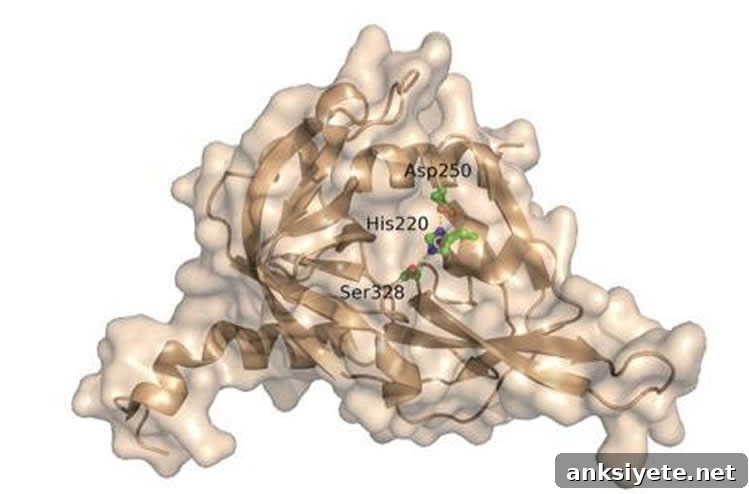
For decades, genetic studies have shown that people who carry two copies of the ApoE4 allele face substantially higher odds of developing late‑onset Alzheimer’s disease by age 65 compared with those carrying other APOE variants. The Salk team, led by Alan Saghatelian, reports evidence that the enzyme high-temperature requirement serine peptidase A1 (HtrA1) selectively degrades ApoE4 more rapidly than the common ApoE3 variant. This allele‑selective proteolysis may both reduce levels of full‑length ApoE4 and produce smaller ApoE4 fragments that could have harmful effects in the brain.
Late‑onset Alzheimer’s disease (LOAD) affects millions of older adults and is defined by progressive memory loss, cognitive decline and the build-up of characteristic protein deposits such as beta‑amyloid plaques and tau tangles. ApoE exists in three major forms—ApoE2, ApoE3 and ApoE4—and while ApoE2 seems protective and ApoE3 is considered neutral, ApoE4 is the strongest common genetic risk factor for LOAD. Prior work has suggested ApoE4 influences amyloid clearance, but the molecular processes behind its effect remained unclear.
Saghatelian and his colleagues pursued the possibility that ApoE4 is removed from brain tissues by a particular protease. Screening candidate enzymes, they identified HtrA1 as a protease that binds and cleaves ApoE4 more efficiently than ApoE3. In biochemical assays with purified proteins and in human cells, HtrA1 fragmented ApoE4 into smaller, less stable pieces while processing ApoE3 less aggressively. Those findings suggest that in individuals with ApoE4, brain cells may contain reduced amounts of intact ApoE and increased amounts of ApoE degradation products.
Intriguingly, the team found a second, potentially important consequence of this interaction. Because ApoE4 binds tightly to HtrA1, it can interfere with HtrA1’s ability to cleave other substrates, including the tau protein. HtrA1 has been reported to degrade tau and to process amyloid precursor protein in ways that could limit toxic aggregate formation. In competition assays, ApoE4 reduced HtrA1‑mediated tau degradation, suggesting ApoE4 may indirectly promote tau accumulation by sequestering or inhibiting HtrA1.
“These results expand how we think about protein regulation in Alzheimer’s disease,” said Alan Saghatelian, holder of the Dr. Frederik Paulsen Chair in the Clayton Foundation Laboratories for Peptide Biology. “Rather than considering only direct effects of amyloid or tau, it’s important to examine other proteins and enzymes that modulate their turnover. Identifying HtrA1 as an ApoE4‑selective protease gives a concrete biochemical hypothesis that can now be tested in models of the disease.”
The study’s authors emphasize that these in vitro and cell‑based findings require validation in animal models to determine whether HtrA1 activity links ApoE4 to Alzheimer’s progression in vivo. If replicated, this mechanism would help explain how ApoE4 contributes to both the loss of normal ApoE function and the accumulation of pathological proteins, pointing to new avenues for therapeutic development.
The research team included Qian Chu (first author), Jolene K. Diedrich, Joan M. Vaughan, Cynthia J. Donaldson, Michael F. Nunn, Kuo‑Fen Lee, and Alan Saghatelian of the Salk Institute. The work was reported in the August 2016 issue of the Journal of the American Chemical Society and published online in July 2016.
Funding: The project received support from the National Institutes of Health, the Clayton Foundation, the Schlink Foundation, the Gemcon Family Foundation, the Hewitt Fellowship, the Joe W. and Dorothy Dorsett Brown Foundation, the Helen McLoraine Chair in Molecular Neurobiology, the National Cancer Center and the Leona M. and Harry B. Helmsley Charitable Trust.
Source: Salk Institute. Image source: Salk Institute. Original research: Journal of the American Chemical Society (2016), article titled “HtrA1 Proteolysis of ApoE In Vitro Is Allele Selective.”
Abstract (summary)
The study demonstrates that HtrA1, a serine protease present in the nervous system, selectively cleaves the ApoE4 isoform more quickly than ApoE3 in vitro. This allele‑selective proteolysis was specific to HtrA1: related proteases such as HtrA2 showed minimal preferential activity, and general proteases like trypsin showed no allele preference. Because HtrA1 also acts on other Alzheimer’s‑relevant proteins—including tau and amyloid precursor protein—the strong binding of ApoE4 to HtrA1 creates a biochemical scenario in which ApoE4 is preferentially degraded while simultaneously inhibiting HtrA1’s capacity to clear tau. These results provide a possible biochemical link between ApoE4 and increased tau pathology and suggest new experimental directions to investigate how ApoE4 influences Alzheimer’s disease mechanisms.
“HtrA1 Proteolysis of ApoE In Vitro Is Allele Selective” by Qian Chu, Jolene K. Diedrich, Joan M. Vaughan, Cynthia J. Donaldson, Michael F. Nunn, Kuo‑Fen Lee, and Alan Saghatelian. Journal of the American Chemical Society, published online July 5, 2016.