
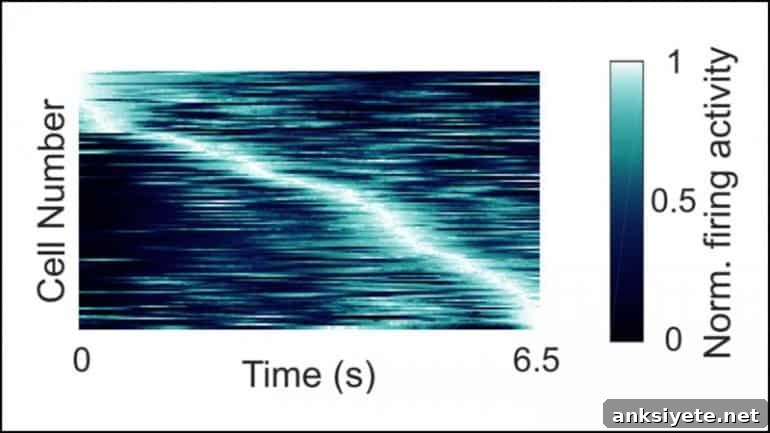
Summary: Specialized neurons in the human hippocampus appear to encode moments in time, providing a neural basis for the “when” component of episodic memory. New findings show the human brain contains neurons that track temporal moments within an experience.
Source: SfN
Neurons in the hippocampus become active at particular moments during a task, according to research published in the Journal of Neuroscience. These time-sensitive cells may help the brain encode the order and timing of events, which are essential features of episodic memory.
Episodic memory allows us to recollect what happened, where it happened, and when it happened. In the hippocampus, place cells are known to represent specific locations and contribute to the “where” component. Until recently, it was well established that rodents have hippocampal neurons tuned to specific moments in time—often called “time cells”—but evidence for similar temporal coding in the human hippocampus has been limited.
To investigate whether humans possess comparable time-tracking neurons, Reddy and colleagues recorded electrical activity from hippocampal neurons in patients with epilepsy who were undergoing invasive monitoring as part of pre-surgical diagnostics. While the electrodes recorded activity, participants viewed and memorized predictable sequences of images consisting of five to seven pictures presented in order.
During the task, the experiment included unsignaled, random quizzes asking participants to indicate the next image in the sequence before the sequence resumed. The researchers found neurons whose firing aligned with particular moments in the temporal structure of the task rather than with specific images: these neurons consistently fired at particular times between quizzes, independent of which picture was on the screen.
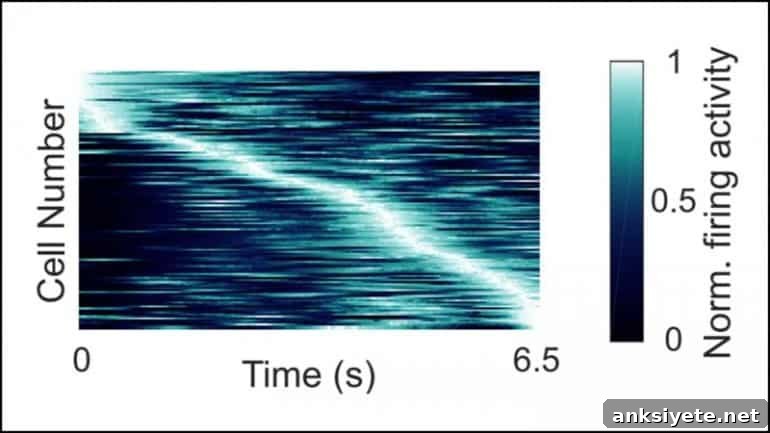
The temporal specificity of these cells persisted even during empty intervals: when the task included 10-second gaps with no images while participants simply waited for the sequence to continue, the same population of neurons exhibited time-locked firing patterns. By analyzing the combined activity of the recorded neurons, the researchers were able to decode which moment within the interval the brain was in, demonstrating that population activity carried reliable information about temporal epoch identity.
Together, these observations indicate that the human hippocampus contains neurons that represent time as well as space, and that this temporal representation is robust across both active sequence learning and passive waiting periods. The presence of these “time cells” in humans suggests a direct neural mechanism that could support the organization of distinct moments within an episodic memory.
About this neuroscience research news
Source: SfN
Contact: Calli McMurray – SfN
Image: The image is credited to Reddy et al., JNeurosci 2021
Original Research: Closed access.
Paper: “Human hippocampal neurons track moments in a sequence of events” by Leila Reddy, Benedikt Zoefel, Jessy K. Possel, Judith C. Peters, Doris Dijksterhuis, Marlene Poncet, Elisabeth C.W. van Straaten, Johannes C. Baayen, Sander Idema and Matthew W. Self. Journal of Neuroscience
Abstract
Human hippocampal neurons track moments in a sequence of events
An essential feature of episodic memory is the ability to assemble different elements of an experience in time so they form a coherent recollection. Hippocampal “time cells”—neurons that encode temporal information—have been proposed to support this capacity. While time cells have been repeatedly observed in animal models, demonstrating similar temporal selectivity in the human hippocampus has been more challenging.
In this study, the authors show that temporal context modulates the firing patterns of human hippocampal neurons during structured, time-locked experiences. Neuronal activity was recorded in patients as they learned predictable sequences of pictures. Analysis revealed cells that fired at successive moments within the task, forming a temporal pattern across the population of recorded neurons.
Importantly, these time-sensitive responses were not limited to active image presentation: during imposed 10-second blank intervals between trials, neurons continued to signal changing temporal context as participants waited for the task to resume. Population-level activity permitted decoding of which temporal epoch the participant was experiencing, both during sequence learning and during the gap periods.
These results suggest that human hippocampal neurons carry a robust representation of time and could play an essential role in organizing the temporal structure of experiences in episodic memory.
Significance Statement:
Remembering events requires knowing not only what happened and where, but also when it happened. Representing temporal structure is therefore a key component of episodic memory. The present findings provide evidence that human hippocampal neurons represent temporal information reliably across different task conditions. This temporal code appears both during active engagement in a structured memory task and during short, passive waiting periods, and the combined activity of hippocampal cells supports decoding of distinct temporal epochs. Together, these observations point to a robust temporal signature in the human hippocampus that likely contributes to how the brain orders and stores moments within a memory.