
Summary: Scientists have determined the three-dimensional structure of the human huntingtin protein. This advance could accelerate research toward new therapies for Huntington’s disease.
Source: Max Planck Institute.
Mutations in a single gene, the huntingtin (HTT) gene, cause Huntington’s disease by producing an abnormal version of the huntingtin protein. Using cryo-electron microscopy, researchers at the Max Planck Institute of Biochemistry in Martinsried together with Ulm University have now resolved the molecular, three-dimensional structure of the normal human huntingtin protein. This structural insight makes it possible to study huntingtin’s functions in detail and may inform the development of future treatments.
Huntington’s disease often begins with mood and behavioral changes and progresses to involuntary movements and cognitive decline. It remains a fatal, inherited neurodegenerative disorder with no cure. For more than two decades scientists have known that expansions in a polyglutamine region of the HTT gene produce a pathogenic form of huntingtin and cause the disease, yet knowledge of the normal protein’s structure and functions has been limited.
After years of effort, Rubén Fernández-Busnadiego of the Max Planck Institute of Biochemistry and Stefan Kochanek, head of Gene Therapy at the University Hospital Ulm, have succeeded in resolving the full molecular architecture of healthy human huntingtin.
Overcoming major technical challenges
Producing and purifying full-length huntingtin proved challenging for laboratory teams led by Kochanek, and two main obstacles delayed structural analysis for decades. Fernández-Busnadiego explains these obstacles: “First, cryo-electron microscopy only recently reached the level of optimization needed to resolve large proteins at near-atomic resolution. Second, huntingtin is highly flexible, which made it difficult to obtain a consistent set of images for three-dimensional reconstruction.”
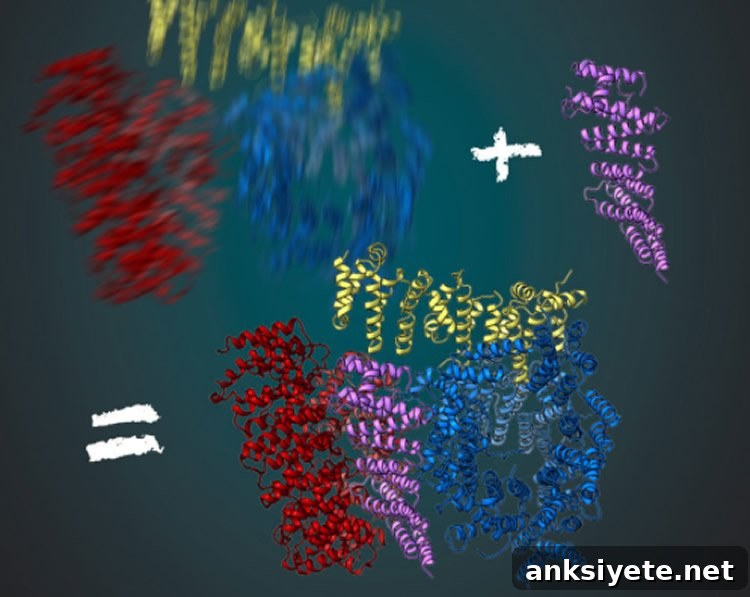
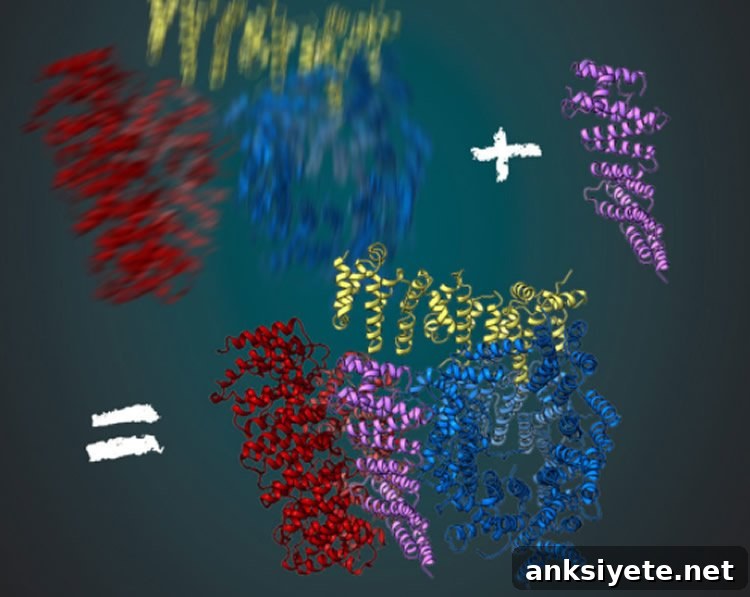
In cryo-electron microscopy thousands of two-dimensional projections of a molecule are collected from different orientations and then computationally combined into a three-dimensional map. If the molecule adopts many conformations, averaging the images blurs the resulting structure. Fernández-Busnadiego offers an analogy: “It is like photographing a person in the dark—if the person moves, the picture will be blurred.”
To reduce huntingtin’s flexibility during imaging, Kochanek’s group searched for natural binding partners that stabilize the protein. They found that the HTT-associated protein 40 (HAP40) binds to huntingtin and locks it into a defined conformation. “When huntingtin is bound to HAP40, it behaves like a person sitting on a chair: motion is reduced and images become sharp enough to reconstruct the three-dimensional structure,” Kochanek explains. Stabilization by HAP40 enabled the researchers to obtain high-quality cryo-EM data and compute the full structure of the HTT–HAP40 complex.
Implications for understanding function and developing therapies
“Although the genetic cause of Huntington’s disease has been known for a long time, we still have limited understanding of the normal functions of huntingtin,” Kochanek says. Proteins operate as the cell’s molecular machines, and their three-dimensional shapes determine how they interact with partners and perform tasks. Determining the precise architecture of huntingtin allows researchers to identify which regions are crucial for its interactions and functions, and to map where disease-related changes could have the greatest impact.
This structural information may also inform therapeutic strategies. One promising approach in current clinical research is the use of antisense oligonucleotides (ASOs) to reduce production of huntingtin protein. Some ASO candidates lower both mutant and normal huntingtin, while others aim to selectively reduce the mutant form. Because ASOs that non-selectively lower huntingtin could also reduce the normal protein, understanding the healthy protein’s roles becomes important for assessing potential side effects and designing safer treatments. “Knowing the structure moves us a big step forward,” Kochanek says.
Research into Huntington’s disease is advancing on several fronts. Clinical trials of antisense oligonucleotides are under way at a limited number of centers; the Neurological University Clinic Ulm coordinates testing efforts in Germany. Some ASO candidates lower both normal and mutant HTT, while others target the mutant form more selectively. It remains unclear whether partial reduction of normal huntingtin is safe without causing unwanted effects—another reason why detailed knowledge of the healthy protein’s structure and function is critical. Bernhard Landwehrmeyer, Director of the Huntington Outpatient Clinic at the University Medical Center Ulm, emphasizes that structural studies like this one will make an important contribution to those questions.
Source: Christiane Menzfeld — Max Planck Institute
Publisher: Organized by NeuroscienceNews.com
Image source: MPI of Biochemistry / Illustration: Gabriele Stautner, ARTIFOX
Original research: Published in Nature (abstract).
DOI: 10.1038/nature25502
Max Planck Institute. “Decoding the Structure of Huntingtin.” NeuroscienceNews, 23 February 2018.
Abstract (rephrased)
Huntingtin (HTT) is a very large protein (approximately 348 kDa) essential for embryonic development and implicated in multiple cellular functions, including vesicle transport, endocytosis, autophagy and transcriptional regulation. HTT interacts with many partner proteins and likely acts as a hub for protein–protein interactions. Huntington’s disease arises from an expanded polyglutamine tract near HTT’s amino terminus. Until now, structural information for full-length HTT has been limited. Using cryo-electron microscopy, the authors determined the structure of full-length human HTT bound to HTT-associated protein 40 (HAP40) at an overall resolution of about 4 Å. HTT is largely alpha-helical and organized into three major domains: amino- and carboxy-terminal domains composed of HEAT repeats arranged in a solenoid formation, connected by a smaller bridge domain with additional tandem repeats. HAP40 is also predominantly alpha-helical with a tetratricopeptide repeat–like architecture and occupies a cleft that contacts all three HTT domains through hydrophobic and electrostatic interactions, stabilizing HTT’s conformation. These results help explain previous biochemical observations and provide a framework for understanding HTT’s diverse cellular functions.