
Summary: A new study explains how the brain anticipates what comes next during speech.
Source: PLOS
International team identifies conserved auditory-cortex mechanisms that predict upcoming speech
Researchers from Newcastle University (UK) and the University of Iowa (USA) report new evidence about how the auditory cortex supports prediction during speech processing. Published in PLOS Biology, the study shows that mechanisms allowing neurons to anticipate upcoming sounds are shared between humans and nonhuman primates and are remarkably conserved across evolution. These predictive processes are central to normal perception and are disrupted in conditions such as dyslexia, schizophrenia and attention-deficit hyperactivity disorder (ADHD).
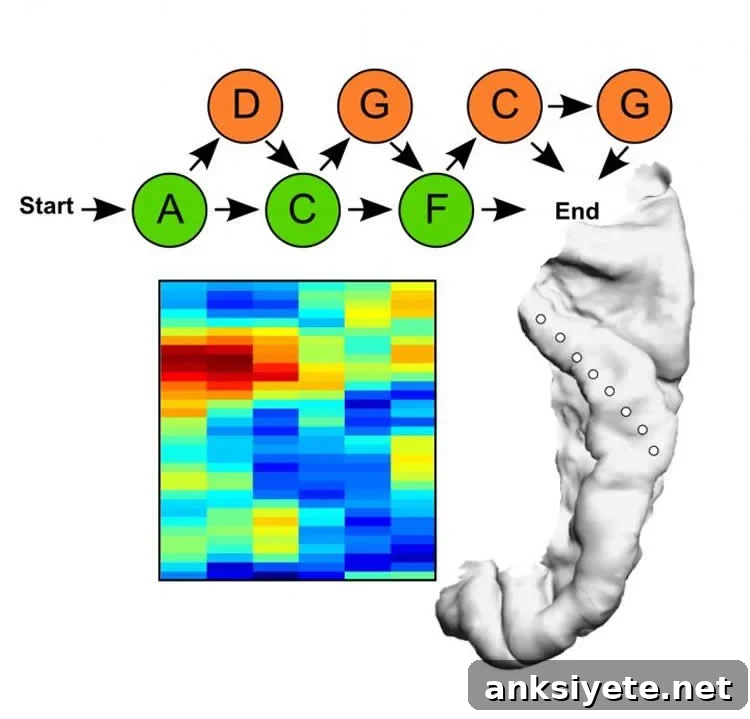
The investigators exposed both human volunteers and rhesus macaques to sequences of spoken nonsense words constructed with an “artificial grammar.” This implicit sequence-learning paradigm—originally developed to probe infant language acquisition—lets listeners learn the statistical relationships and ordering rules that govern syllable and word sequences. Both species learned these predictive relationships, enabling the team to compare neural responses to expected (legal) sequences versus sequences that violated learned orderings.
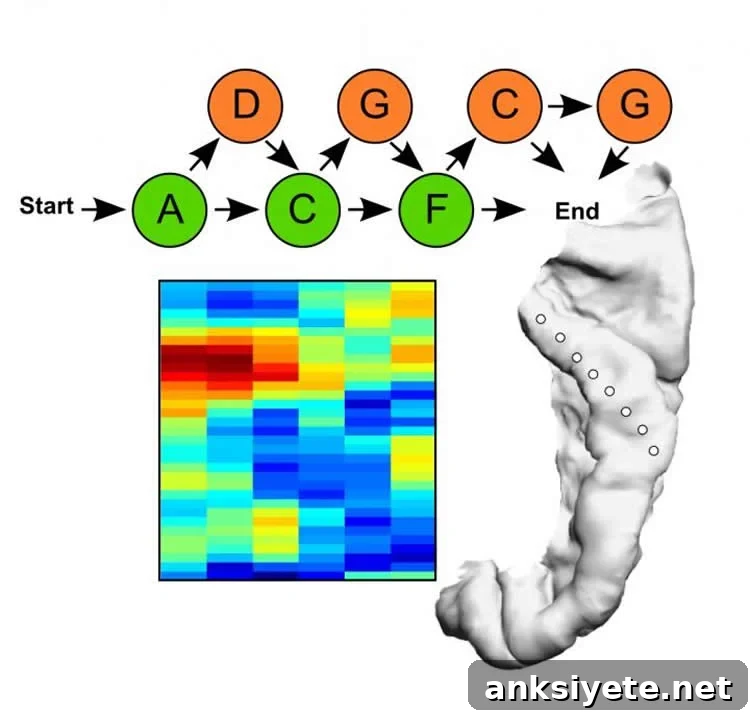
Direct neural recordings from auditory cortex revealed similar patterns of activity in humans and monkeys. In both species, responses to the nonsense-word sequences exhibited hierarchically nested coupling: low-frequency oscillatory phase aligned with bursts of higher-frequency activity (high-gamma amplitude). This form of phase–amplitude coupling, previously associated with human speech processing, was evident in monkeys as well, supporting the idea that these oscillatory signatures are evolutionarily conserved.
Beyond establishing similarity, the study demonstrates that learning sequence relations alters both oscillatory coupling and transient neuronal responses. When expected orderings were violated, the auditory cortex showed distinct changes in timing and coupling patterns, indicating that population-level neuronal coordination reflects learned predictions. These temporally specific changes suggest a mechanism by which neural populations coordinate to anticipate upcoming sensory events, improving processing efficiency and guiding attention.
“Predicting what will happen next is fundamental to perception and communication,” said Professor Christopher Petkov. “Finding these signature predictive processes in both humans and monkeys gives us a comparative foundation to study how predictive coding develops and how it fails in disease.” Dr. Yukiko Kikuchi added that the neural machinery functions in a way analogous to predictive text on a phone, automatically anticipating likely continuations based on learned patterns.
Building on these findings, the research team is developing translational projects that use measures of predictive signaling to model how prediction breaks down after stroke or in dementia. The long-term aim is to identify objective biomarkers of impaired predictive processing that could improve prognosis and guide therapeutic strategies for patients with neurodegenerative or acquired brain injuries.
Funding: The research was supported by a range of public and charitable funders, including the Biotechnology and Biological Sciences Research Council (BBSRC), the Wellcome Trust, NIH funding and institutional awards. Funders did not influence study design, data collection and analysis, decision to publish, or manuscript preparation.
Competing interests: The authors have declared that no competing interests exist.
Source and original research: Yuki Kikuchi and colleagues. The original open-access research article is titled “Sequence learning modulates neural responses and oscillatory coupling in human and monkey auditory cortex” and was published in PLOS Biology (April 25, 2017). Authors include Yukiko Kikuchi, Adam Attaheri, Benjamin Wilson, Ariane E. Rhone, Kirill V. Nourski, Phillip E. Gander, Christopher K. Kovach, Hiroto Kawasaki, Timothy D. Griffiths, Matthew A. Howard III, and Christopher I. Petkov. DOI: 10.1371/journal.pbio.2000219.
Sequence learning modulates neural responses and oscillatory coupling in human and monkey auditory cortex
Learning ordering relationships between events in a sensory sequence is fundamental to perception and communication. Although rhythmic sensory inputs can entrain brain oscillations at multiple frequencies, it has been unclear how learned sequence relationships shape neocortical oscillations and neuronal responses. Using an implicit artificial-grammar paradigm, humans and monkeys were exposed to sequences of nonsense words with structured ordering regularities. Direct recordings from auditory cortex in both species showed strikingly similar nested coupling between low-frequency phase and high-gamma amplitude—an oscillatory signature previously linked to human speech processing and now demonstrated as evolutionarily conserved. Learned ordering relationships modified this oscillatory coupling and produced temporally distinct modulations of neuronal responses, indicating coordinated population dynamics that monitor and predict temporal structure in sensory input.
Feel free to share this summary of the research, acknowledging the original authors and PLOS Biology as the source.