
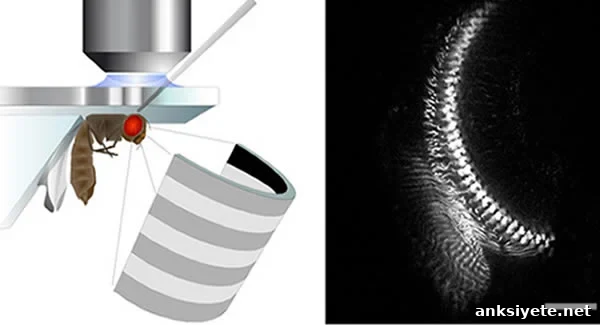
Neurobiologists have for the first time isolated the responses of individual neurons in the fly brain to specific motion stimuli. This advance in motion-vision research opens the door to a more detailed understanding of the fly’s motion-detection circuitry and the distinct roles single cells play within that neural network.
The brain of the fly – a high-speed computer
Neurobiologists employ cutting-edge methods to decode the fundamentals of motion detection
Imagine a soccer match in which players could not separate the ball from the background—unthinkable. Now imagine one player who sees the ball in slow motion; that advantage sounds fantastical for humans, yet flies effectively enjoy this kind of rapid visual processing. The tiny brains of these agile flyers process visual motion in fractions of a second. A mathematical model developed more than half a century ago predicts this speed and precision quite well, but after 50 years of research the exact wiring among nerve cells in the fly visual system remained unclear. Researchers at the Max Planck Institute of Neurobiology have now established the technical methods necessary to decode how motion vision is implemented at the cellular level. Their initial findings also reveal that much remains to be discovered (Nature Neuroscience, July 11, 2010).
In 1956 a mathematical framework was proposed to explain how flies detect and process motion, and numerous experiments have supported its central assumptions. What has been missing is a direct mapping of which neurons connect to one another to realize the computations predicted by the model. “We simply lacked the technical tools to measure activity from individual cells within the fly’s tiny but powerful brain,” explains Dierk Reiff of the Max Planck Institute of Neurobiology in Martinsried. The motion-processing region occupies only a fraction of a cubic millimeter yet contains more than 100,000 neurons, each with many synaptic contacts. Picking out the response of a single neuron to a specific motion cue seemed almost impossible—until now.
The fly brain outperforms conventional computers
Typical electrophysiological recordings use ultra-fine electrodes to measure the electrical activity of single neurons, but most fly neurons are too small for such probes. Despite the challenge, the fly remains the premier model for studying motion perception, and researchers were determined to unlock its secrets. Although a fly has far fewer neurons than larger animals, those neurons are highly specialized and rapidly process the flow of visual information during flight. Flies calculate motion and movement in their environment in real time—an efficiency and compactness that no standard computer, and certainly not a computer the size of a fly brain, can match. That remarkable capability makes deciphering the fly’s visual system a valuable scientific pursuit.
Fluorescent indicators and advanced microscopy
“We needed a method to visualize the activity of tiny neurons without using electrodes,” says Dierk Reiff, describing a central technical obstacle. To meet that challenge the team used the fruit fly Drosophila melanogaster and modern genetic tools to express a fluorescent calcium indicator, TN-XXL, in individual neurons. TN-XXL changes its fluorescence with neural activity, allowing researchers to monitor when a cell becomes active.
To probe motion processing, flies were shown moving stripe patterns on an LED screen. Neurons responding to the visual stimulus alter the brightness of TN-XXL, but isolating this fluorescence from the LED stimulus light and the relatively small signal size required a precise solution. Reiff and colleagues synchronized a two-photon laser scanning microscope with the LED display to within a few microseconds. This tight timing allowed them to separate the TN-XXL fluorescence from the LED light and selectively record neuronal responses using two-photon microscopy.
Identifying the cells behind the model
“After more than five decades of inquiry, we can finally examine the cellular architecture of the fly’s motion detector,” reports Alexander Borst, who has led this effort in his laboratory. The initial experiments already showed unexpected complexity. The team first recorded activity from L2 neurons, which receive direct input from the photoreceptors. Photoreceptors respond to increases and decreases in light intensity, and parts of the L2 cell reflect those inputs. However, the researchers discovered that L2 neurons transform this input: they selectively convey reductions in light intensity while filtering out increases. Downstream neurons then use that information to compute motion direction and relay it to the flight-control system. “In short, L2 cells pass on ‘light-off’ signals while filtering ‘light-on’ responses,” summarizes Dierk Reiff. “Since flies respond to both increases and decreases in light, other cell types must carry the complementary ‘light-on’ signals.”
With the proof of principle established, the research team plans to map the motion-detection circuit cell by cell, tracing how each component contributes to the computation of visual motion. Colleagues working on robotics and bioinspired systems are watching closely, as these insights may inform efficient algorithms and compact hardware that mimic the fly’s remarkable visual processing.
Original work:
Visualizing retinotopic half-wave rectified input to the motion detection circuitry of Drosophila.
Dierk F. Reiff, Johannes Plett, Marco Mank, Oliver Griesbeck, Alexander Borst
Nature Neuroscience, online publication from July 11, 2010
Contact: Stefanie Merker, PhD, Public Relations
Source: Max Planck Institute of Neurobiology