
Summary: Researchers describe the brain mechanisms that explain why some people do not find music pleasurable.
Source: IDIBELL-UB.
New research reveals brain mechanisms linked to a reduced sensitivity to music
Researchers from the Cognition and Cerebral Plasticity group at the Bellvitge Biomedical Research Institute and the University of Barcelona (IDIBELL-UB), together with collaborators from McGill University (Montreal), have published a study identifying neural differences associated with a lack of sensitivity to musical reward. Published in the journal PNAS, the study sheds light on how connections between auditory and emotional brain regions contribute to the rewarding experience of music and why that experience is absent in a minority of people.
Listening to music is widely considered a rewarding and emotionally engaging activity across cultures. However, roughly 3–5% of healthy adults report no pleasurable response to music, a condition called specific musical anhedonia. These individuals perceive and process musical features such as melody, rhythm, and intervals normally and show typical pleasure responses to other reward types (for example, monetary rewards), yet they do not derive enjoyment from music.
Noelia Martínez-Molina, lead author and researcher at IDIBELL-UB, explains: “People with musical anhedonia do not have difficulty recognizing or processing musical structure, nor do they lack reward sensitivity in general. Their responses to nonmusical rewards remain intact, but musical stimuli do not elicit pleasure.” Until now, the neural basis of this dissociation was not well understood.
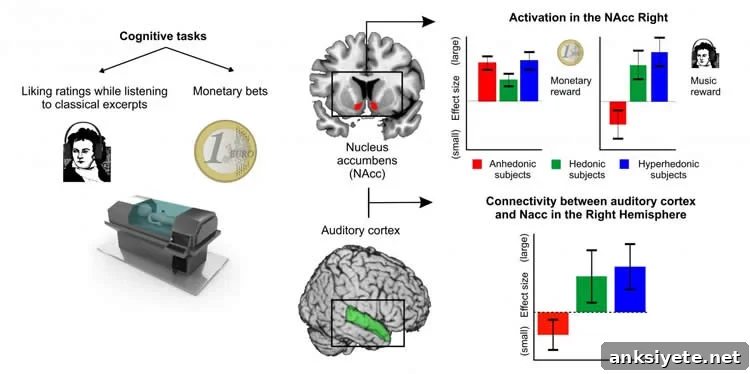
To investigate, the research team used functional magnetic resonance imaging (fMRI) to study 45 healthy volunteers. Participants were grouped into three categories based on their scores on the Barcelona Music Reward Questionnaire (BMRQ), a measure developed by the research team to quantify individual differences in music reward sensitivity. During fMRI scanning, participants listened to short excerpts of classical music and rated their moment-to-moment pleasure on a four-point scale. To compare responses to a nonmusical reward, participants also performed a monetary gambling task where they could win or lose real money.
The imaging results revealed a selective reduction of activity in the nucleus accumbens (NAcc) for participants with musical anhedonia when they listened to music. The nucleus accumbens is a key subcortical component of the brain’s reward system. Importantly, these same individuals showed normal NAcc activation during the monetary gambling task, indicating preserved reward processing for nonmusical stimuli.
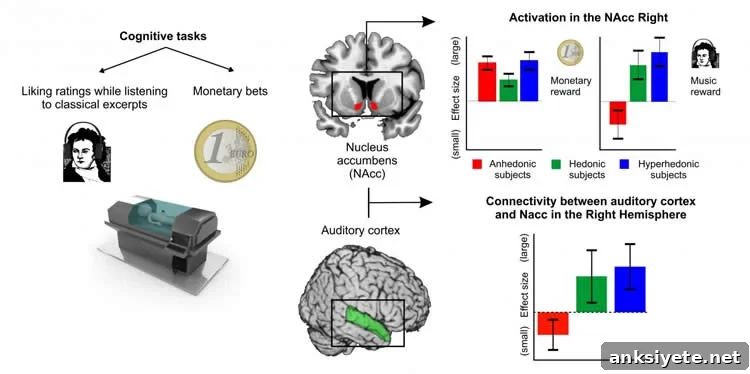
Beyond localized changes in activity, the study found differences in functional connectivity. Individuals with specific musical anhedonia exhibited reduced connectivity between the right auditory cortex and the ventral striatum, including the nucleus accumbens. Conversely, participants who reported above-average enjoyment of music showed stronger coupling between auditory cortical regions and subcortical reward structures. This pattern suggests that the interaction between auditory perception networks and the mesolimbic reward system is critical for experiencing music as rewarding.
“Considering the evolutionary significance of linking auditory cortical regions to more primitive emotional evaluation systems is insightful,” the authors note. In people who find music rewarding, strong cortical–subcortical coupling appears to make music highly pleasurable. When that coupling is diminished, music may lose its rewarding quality despite intact musical perception and general reward sensitivity. These findings point to a fundamental neural interaction that underlies musical pleasure and imply a potential evolutionary role for music-related reward circuitry, even if the direct biological advantage of cultural musical behavior is not obvious.
Source: Gemma Fornons – IDIBELL-UB
Image Source: Image credited to IDIBELL.
Original Research: “Neural correlates of specific musical anhedonia” by Noelia Martínez-Molina, Ernest Mas-Herrero, Antoni Rodríguez-Fornells, Robert J. Zatorre, and Josep Marco-Pallarés, published in PNAS (Online October 31, 2016). DOI: 10.1073/pnas.1611211113
Abstract
Neural correlates of specific musical anhedonia
Music is ubiquitous in human societies, yet a subset of individuals do not experience it as rewarding despite intact musical perception and normal reward responses in other domains. Previous work has suggested that music-induced pleasure emerges from interaction between auditory cortical networks and mesolimbic reward systems. Using fMRI in three groups of participants with varying sensitivity to musical reward, this study shows that music-anhedonic individuals have a selective reduction in nucleus accumbens activity during music listening but normal responses during a monetary reward task. They also show decreased functional connectivity between the right auditory cortex and ventral striatum, while individuals with heightened musical reward show increased connectivity. These results indicate that a reduced interaction between auditory cortex and subcortical reward networks may underlie specific musical anhedonia and highlight the central role of this cortical–subcortical interplay for the enjoyment of music.