
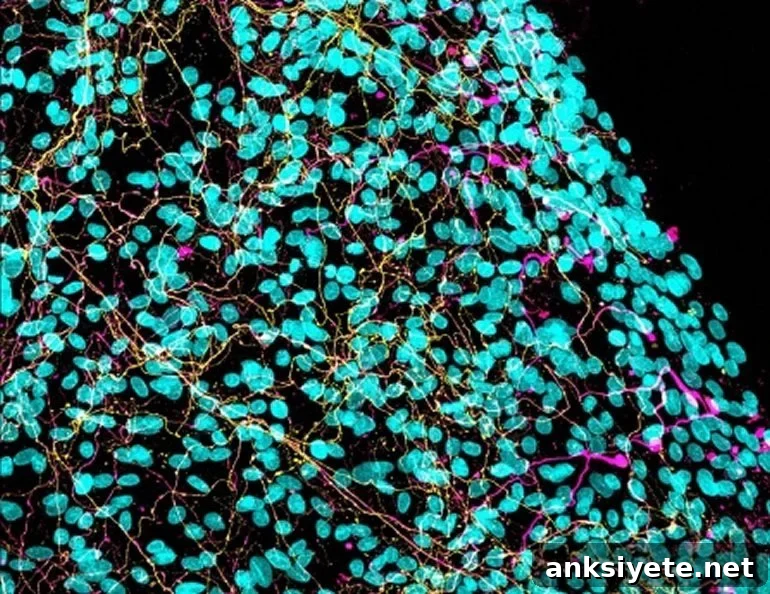
Summary: A preclinical study shows Schwann cells can protect injured axons by supplying sugars, revealing a metabolic support mechanism with promising implications for neurodegenerative diseases such as ALS and peripheral neuropathies.
Source: University at Buffalo
Axons are long, delicate projections of neurons that carry signals across the nervous system. Because of their length and fragility, axons are often among the first structures to fail in a range of neurodegenerative conditions, producing symptoms like muscle weakness, numbness, and loss of coordination.
New research from the University at Buffalo finds that Schwann cells—the glial cells that envelop axons in peripheral nerves—mount a protective metabolic response when nearby axons are injured. The work, published in Nature Neuroscience, documents a previously unrecognized role for Schwann cells in supporting axon survival.
“When axons are damaged early in neurodegenerative disease, the resulting disruption of neuronal networks causes debilitating symptoms,” said Bogdan Beirowski, MD, PhD, assistant professor of biochemistry at UB and a principal investigator at the Hunter James Kelly Research Institute. He noted that most emerging axon-protective therapies have focused on neurons themselves, overlooking the potential of neighboring glial cells.
The UB team describes a metabolic shift in Schwann cells that helps injured axons recover. “We found that stressed axons increase their reliance on sugars supplied by Schwann cells,” Beirowski said. “This reveals a glia-centered avenue to stabilize axons in disease, shifting the therapeutic focus away from neurons alone.”
Relevance to ALS and peripheral neuropathies
The findings are broadly relevant to disorders characterized by axon degeneration in the peripheral nervous system. Beirowski emphasized the potential interest to researchers studying amyotrophic lateral sclerosis (ALS, Lou Gehrig’s disease) and a range of peripheral neuropathies, where early axon loss contributes to clinical decline.
The study shows Schwann cells can “sense” axonal distress and respond by increasing production and release of metabolic substrates. At the cellular level, injury triggers a strong upregulation of glycolysis in Schwann cells—the pathway that converts glucose into pyruvate and yields energy and intermediate metabolites. Alongside this shift, Schwann cells increase expression of sugar transporters in their membranes, which facilitates export of energetic metabolites to nearby axons.
“It’s as if Schwann cells become an emergency energy supply for injured axons,” Beirowski explained. Importantly, the researchers could manipulate this pathway pharmaceutically and genetically in mice to either accelerate or delay axon degeneration, demonstrating the pathway’s functional relevance to axon stability after injury.
Investigating axon–glia metabolic coupling
Neurobiologists often study axons and Schwann cells independently, but this work deliberately examines their metabolic interactions during axon injury. “We brought axons and Schwann cells together to analyze their metabolic crosstalk in the context of injury,” said lead author Elisabetta Babetto, PhD, research assistant professor of pharmacology and toxicology at UB and investigator at HJKRI. Their experiments reveal a transcellular metabolic mechanism that soothes and repairs injured axons.
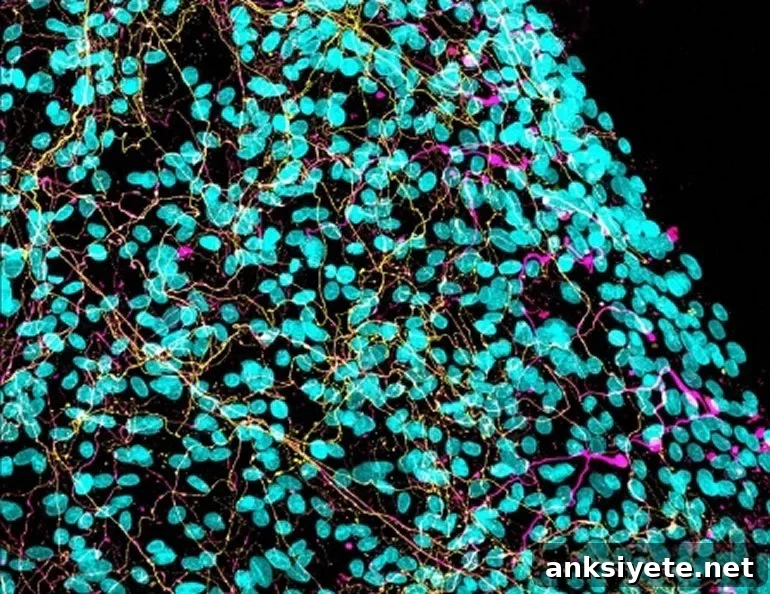
Mechanistically, the glycolytic shift in Schwann cells is driven largely by the metabolic signaling hub mTORC1 (mammalian target of rapamycin complex 1) and downstream transcription factors hypoxia-inducible factor 1-alpha (HIF-1α) and c-Myc. Together these factors promote expression of glycolytic genes that enable Schwann cells to increase production and export of sugars that injured axons can use as fuel.
Beyond the peripheral nervous system, the team suggests the strategy could prompt new studies of metabolic support from central nervous system glia—oligodendrocytes and astrocytes—to determine whether similar protective mechanisms exist for central axons.
“What’s especially intriguing about these findings is that we show for the first time a physiological transcellular mechanism that has a soothing and reparative effect for injured axons,” said Babetto.
The researchers propose that therapies aimed at enhancing glycolytic metabolism in Schwann cells could strengthen axons or act preventively in contexts where axons are especially vulnerable—examples include chemotherapy-induced peripheral neuropathy and diabetic neuropathy. Because the pathway is regulated by nutrient and energy sensors, these results may also help explain how lifestyle factors such as diet and exercise influence peripheral axon health.
Co-author Keit Men Wong, PhD, completed doctoral research at the HJKRI and is now a postdoctoral researcher at the University Medical Center Göttingen.
Funding: This work was supported by grants from the Muscular Dystrophy Association awarded to Bogdan Beirowski and Elisabetta Babetto.
The Hunter James Kelly Research Institute (HJKRI) is named in memory of Hunter Kelly, the son of former Buffalo Bills quarterback Jim Kelly. Hunter died at age 8 in 2005 from complications of Krabbe disease.
About this neurology research article
Source:
University at Buffalo
Contacts:
Ellen Goldbaum – University at Buffalo
Image Source:
Image credited to Elisabetta Babetto, HJKRI.
Original Research:
“A glycolytic shift in Schwann cells supports injured axons” by Elisabetta Babetto, Keit Men Wong & Bogdan Beirowski. Published in Nature Neuroscience.
Abstract (summary)
Axon degeneration is a defining feature of many neurodegenerative disorders. Contrary to the idea that axon degeneration is governed solely by neuron-intrinsic mechanisms, this study shows Schwann cells protect injured axons through a pronounced upregulation of glycolysis. This glial glycolytic response, coupled with enhanced metabolic coupling between axon and glia, sustains axon survival. The shift is largely controlled by mTORC1 and downstream transcription factors HIF-1α and c-Myc, which drive glycolytic gene expression. Modulating glial glycolysis through this pathway was sufficient to speed or delay axon degeneration in rodent models, revealing a non–cell-autonomous metabolic mechanism that influences the fate of injured axons.