
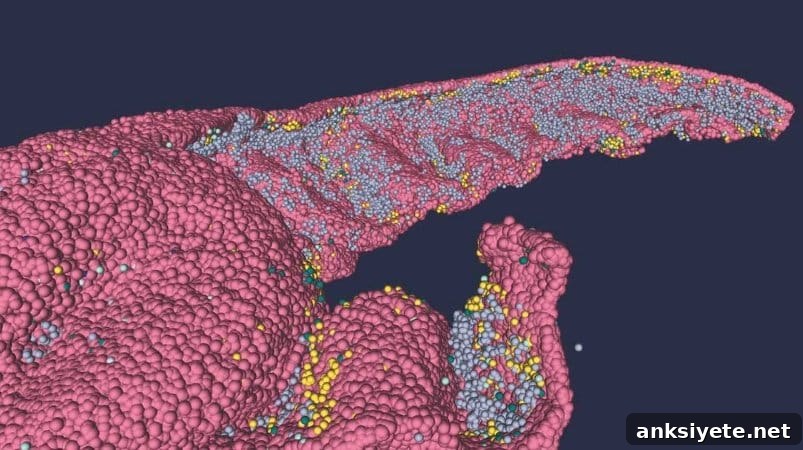
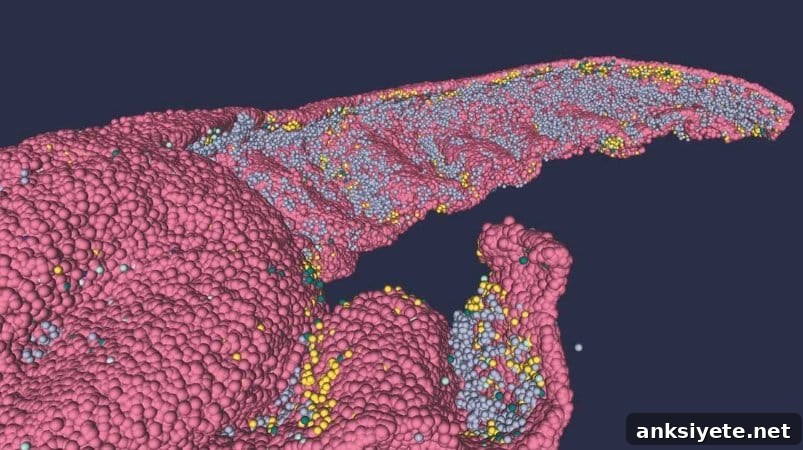
Summary: Researchers have created a new, high-resolution 3D model of the CA1 area of the human hippocampus at single-cell resolution.
Source: Human Brain Project
Researchers at the Institute of Biophysics of the Italian National Research Council (CNR-IBF) and the University of Modena e Reggio Emilia (UNIMORE), working with the Human Brain Project, have produced a detailed, full-scale 3D model of the CA1 region of the human hippocampus. This model captures individual neuron positions and their likely connectivity patterns, offering a new resource for computational neuroscience and brain mapping.
Developed from a dataset of high-resolution microscopy images, the model reproduces the structural architecture of CA1 at single-cell resolution. The researchers used imagery from the BigBrain Atlas and plan to make both the dataset and the reconstruction methods available on the EBRAINS platform. The study, published in Nature Computational Science, also outlines how the same approach could be extended to generate full-scale models of other human brain areas and could be integrated into co-simulation environments such as The Virtual Brain.
“Quantitative data on individual human neurons is still sparse, particularly when it comes to precise 3D coordinates and connectivity,” says Michele Migliore from CNR-IBF, Palermo. To address this gap, the team performed a careful data-mining effort on the BigBrain high-resolution images to extract soma positions and derive a realistic spatial distribution of neurons within CA1.
To translate image features into a usable computational scaffold, the group developed custom image-processing tools to detect neuron locations and to associate morphological characteristics with simplified geometric volumes. These geometrical approximations make it possible to model the likely spatial extent of dendrites and axons and to estimate connection probabilities between neuron pairs based on their relative positions and morphological types.
“We categorized dendritic and axonal shapes into classes that reflect how neuronal processes extend through tissue,” explains Daniela Gandolfi from UNIMORE, lead author of the study. “Some processes remain confined within narrow cones, while others spread into broader, more complex domains. By associating these morphological categories with geometric volumes, our algorithm computes the probability that two neurons connect, yielding both soma positions and an estimated connectivity matrix.”
Validation against published experimental data shows that the modeled neuron densities and spatial organization are consistent with existing anatomical observations of the hippocampus, supporting the biological plausibility of the reconstruction. The authors emphasize that the supplied data and code are ready to use and can support simulations at multiple scales, from network-level explorations to large-scale integrative models.
The team is sharing the dataset and the extraction methodology on the EBRAINS platform to make the resource available to the broader neuroscience community. Their stated goal is to facilitate further modeling efforts and to apply the same approach to other brain regions, enabling more comprehensive digital reconstructions and computational studies.
About this brain mapping research news
Author: Roberto Inchingolo
Source: Human Brain Project
Contact: Roberto Inchingolo – Human Brain Project
Image: The image is credited to Michele Migliore
Original Research: Open access. “Full-scale scaffold model of the human hippocampus CA1 area” by Daniela Gandolfi et al., published in Nature Computational Science.
Abstract
Full-scale scaffold model of the human hippocampus CA1 area
As quantitative human brain data becomes more accessible, researchers can create increasingly detailed computational models that support the study of neural function and dysfunction and advance digital twin approaches for personalized medicine. This work provides a methodological resource: a computational pipeline that generates full-scale scaffold models of human brain regions from microscopy images.
The method was benchmarked on the CA1 region of a right human hippocampus, representing a substantial portion of the hippocampal formation. In addition to precise 3D soma positioning, the approach generates a connectivity matrix using a morpho-anatomical connection strategy based on axonal and dendritic probability density functions that reflect neuronal morphology. The resulting data and algorithms are distributed in a ready-to-use format suitable for computational modeling at different levels of detail and scale.