
Summary: Researchers at Columbia University report that targeting a specific serotonin receptor can strengthen memory formation. The study highlights the 5-HT4 receptor as a promising target to improve cognitive function.
Source: Columbia University.
Columbia University Irving Medical Center (CUIMC) researchers have identified a serotonin receptor that, when targeted, can enhance memory formation — a discovery that may inform future treatments for cognitive impairment.
Using experiments in mice, the team explored how serotonin signaling in the hippocampus affects synaptic communication and memory. Their findings, published in the journal Neuron, show that serotonin release in the CA1 region of the hippocampus strengthens neuronal transmission and improves spatial memory. The study also identifies the 5-HT4 receptor as a key mediator of this effect, and demonstrates that pharmacological modulation of this receptor can alter memory performance.
“We discovered that when serotonin is released from local stores within the hippocampus during learning, the memory of that event is strengthened. By pinpointing a dominant serotonin receptor subtype involved in this process, we were able to test drug effects on memory. Systemic modulation of 5-HT4 receptor function enhanced memory formation,” said Catia M. Teixeira, PhD, Research Scientist at CUIMC, who co-led the study with Zev B. Rosen, PhD.
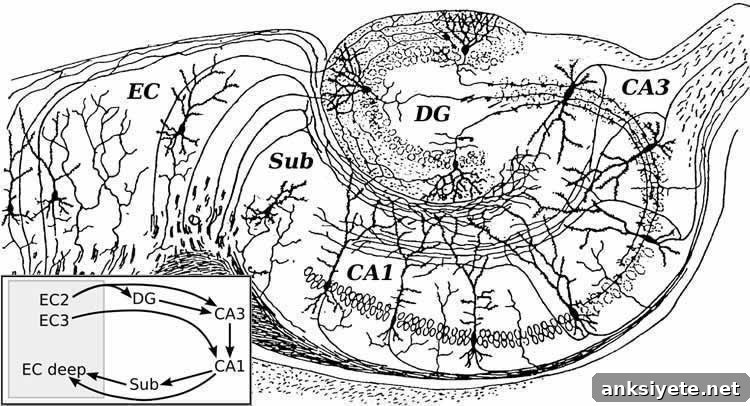
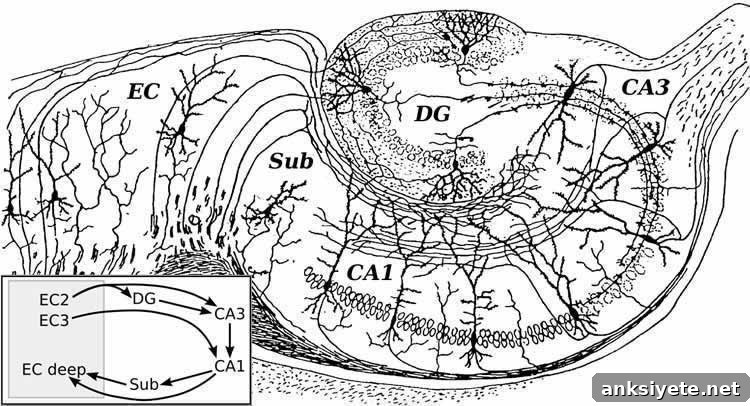
The hippocampus is central to forming new, explicit memories about events and places. Within the hippocampus, the CA1 region receives input from CA3 neurons via Schaffer collateral synapses. The strength and modulation of communication across these synapses provide a neural basis for memory encoding. Although the hippocampus receives substantial serotonergic input, how those serotonin pathways influence hippocampal circuits and memory formation has been unclear until now.
To investigate causality, the researchers applied optogenetics — a method that uses light to activate or silence genetically defined neurons — to selectively control serotonergic fibers projecting to CA1. They found that optogenetically evoked serotonin release at CA1 terminals potentiated excitatory transmission from CA3 to CA1 neurons and produced measurable improvements in spatial memory tasks. Conversely, optogenetic inhibition of those serotonergic axons impaired spatial memory, indicating that serotonin signaling in CA1 is both sufficient and necessary for normal memory formation.
Electrophysiological and behavioral results pointed to the 5-HT4 receptor as the principal mediator of the observed synaptic potentiation. When the team manipulated 5-HT4 receptor activity systemically using pharmacological agents, they were able to modulate memory formation bidirectionally. These experiments suggest that targeting 5-HT4 receptors could be a viable strategy for developing therapeutics aimed at cognitive deficits.
“Our data reveal a powerful modulatory influence of serotonin on hippocampal circuits and memory formation,” said Mark S. Ansorge, PhD, senior author on the study. “These results support the rationale for considering 5-HT4 receptors in pharmacotherapy for cognitive impairment.”
The research team included Catia M. Teixeira, Zev B. Rosen, Deepika Suri, Qian Sun, Marc Hersh, Derya Sargin, Iva Dincheva, Ashlea A. Morgan, Stephen Spivack, Anne C. Krok, Tessa Hirschfeld-Stoler, Evelyn K. Lambe, Steven A. Siegelbaum, and Mark S. Ansorge. Contributors represent Columbia University Irving Medical Center, the Kavli Institute for Brain Science, the University of Toronto, and other affiliated centers.
Funding: This research was supported by the National Institute of Mental Health (grant 1R01MH113569) and the Sackler Institute for Developmental Psychobiology.
Source: Eian Kantor – Columbia University
Publisher: Organized by NeuroscienceNews.com.
Image Source: NeuroscienceNews.com image is in the public domain.
Original Research: Abstract for “Hippocampal 5-HT Input Regulates Memory Formation and Schaffer Collateral Excitation” by Catia M. Teixeira et al., Neuron. DOI: 10.1016/j.neuron.2018.04.030
Columbia University. “Targeting Receptor Related to Serotonin May Boost Memory Formation.” NeuroscienceNews, May 10, 2018.
Abstract
Hippocampal 5-HT Input Regulates Memory Formation and Schaffer Collateral Excitation
Highlights
• Evoked release of serotonin in CA1 potentiates CA3-to-CA1 synaptic input.
• 5-HT4 receptors mediate the potentiation of CA3-to-CA1 inputs.
• Optogenetic stimulation of serotonergic axons in CA1 enhances spatial memory.
• Optogenetic inhibition of serotonergic axons in CA1 impairs spatial memory.
Summary
Neuromodulatory transmitters shape the efficacy and persistence of memory storage. While serotonin (5-HT) has established roles in forms of implicit memory in invertebrates, its impact on explicit, hippocampus-dependent memory has been less clear. This study used optogenetic approaches in mice to characterize how endogenous, spatially and temporally patterned 5-HT release affects hippocampal circuits. Activation of serotonergic terminals in CA1 potentiated excitatory transmission at CA3-to-CA1 synapses and enhanced spatial memory performance. In contrast, silencing CA1 serotonergic terminals impaired spatial memory. The synaptic potentiation depended on 5-HT4 receptor signaling, and systemic modulation of 5-HT4 receptor function bidirectionally influenced memory formation. Together, these results demonstrate a potent modulatory role for serotonergic input in hippocampal function and identify 5-HT4 receptors as a potential target for interventions addressing cognitive impairment.