
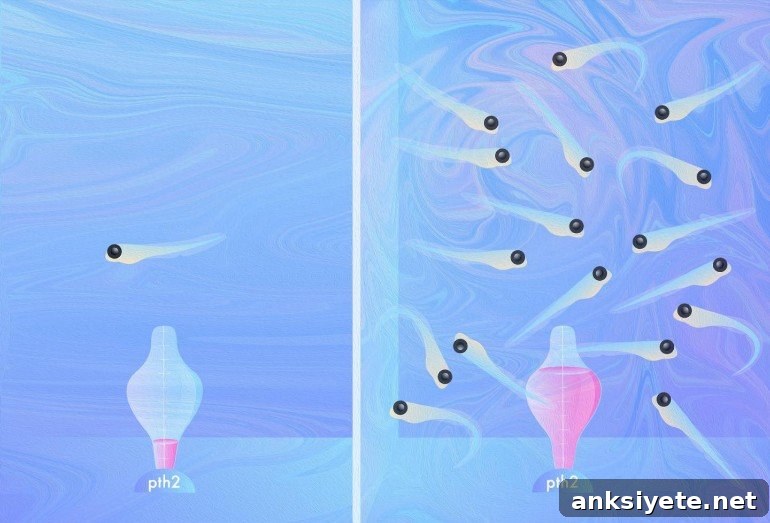
Summary: Researchers report that changes in specific neuronal genes correlate with time spent in social isolation.
Source: Max Planck Institute
Have you wondered how social distancing or brief periods of isolation might influence the brain? An international team led by Erin Schuman at the Max Planck Institute for Brain Research identified a brain molecule that functions like a biological “thermometer” for the presence and density of nearby conspecifics. In zebrafish, detection of other individuals occurs through mechanosensation—sensing water movements—which activates a neuropeptide encoded by the gene parathyroid hormone 2 (pth2).
Social environment strongly shapes behavior across many species. Extended isolation can produce profound behavioral and physiological effects in humans and animals, including zebrafish, yet the neuronal mechanisms that monitor social surroundings are not fully understood. To investigate how neural gene expression responds to changes in social conditions, graduate student Lukas Anneser and colleagues raised zebrafish either alone or in groups for varying durations and measured transcript levels across thousands of neuronal genes using RNA sequencing.
Tracking social density
The researchers identified consistent expression changes in a small set of genes in fish raised in isolation. Most notable was pth2, which encodes a relatively unstudied brain peptide. Rather than acting as a simple on/off indicator of social contact, pth2 expression scaled with the number of nearby fish: it fell dramatically in isolated animals and rose rapidly when other fish were introduced. “pth2 behaved like a thermometer for social density,” explains Anneser.
The change was both rapid and reversible. Fish that had been isolated showed significant recovery of pth2 transcription after only 30 minutes spent swimming with kin. After 12 hours in a social group, pth2 expression levels matched those observed in fish raised continually in group settings. This fast, strong regulation pointed to an intimate and dynamic link between gene expression and immediate environmental cues.
Which sensory channel conveys the presence of others to drive these molecular changes? The team found that neither vision nor chemical senses were responsible. Instead, mechanosensation—the detection of water motion produced by neighbors—activated pth2 expression, a surprising and specific use of tactile-like sensing in a social context.
Sensing water movements
Zebrafish detect nearby motion through the lateral line, a mechanosensory organ composed of neuromast cells that sense water displacement. To test whether mechanosensation is required for social regulation of pth2, the researchers chemically ablated lateral line neuromasts. When the mechanosensory cells were disabled, previously isolated fish no longer regained pth2 expression after being placed with conspecifics, demonstrating that lateral line input is essential for the social rescue of this neuropeptide.
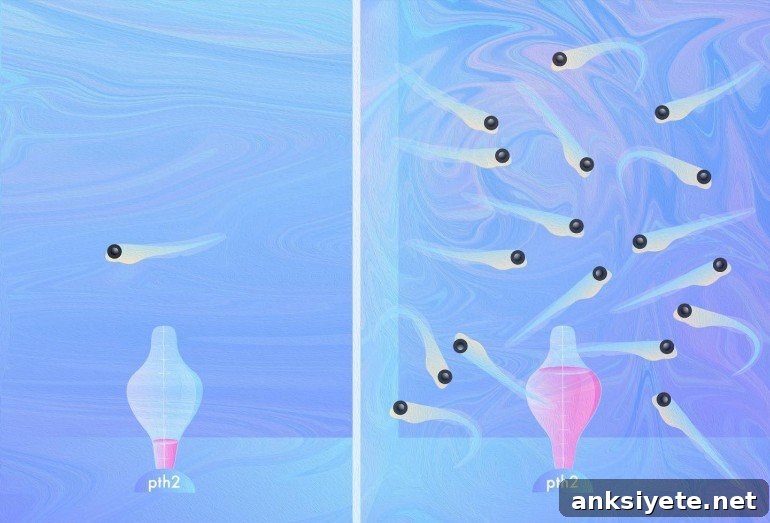
To further test whether water motion alone could substitute for live neighbors, the team mimicked fish swimming bouts by mechanically perturbing the water with a motor programmed to reproduce the frequency and pattern of larval tail beats. These artificial water movements were sufficient to rescue pth2 levels in previously isolated larvae, mirroring the effect of real conspecifics and confirming that the lateral line’s mechanical input is the critical driver.
The findings reveal a precise sensory-to-gene pathway: zebrafish use mechanosensory cues generated by nearby fish to adjust expression of a neuropeptide that reflects social density. “Pth2 appears to monitor the social environment dynamically,” says Schuman. Because group size and proximity influence access to resources, reproduction, and survival, this neuro-hormone likely plays a role in regulating neural circuits and behaviors tied to social context.
Implications and future directions
This work highlights how rapidly neuronal gene expression can respond to social cues and identifies mechanosensation as a specific modality for social sensing in an aquatic species. While the study focuses on zebrafish, the concept that specialized sensory circuits regulate social neuropeptides may extend to other animals. Future research will aim to map the downstream brain circuits influenced by Pth2 and to determine how this pathway affects behavior over longer timescales.
About this genetics research news
Source: Max Planck Institute
Contact: Dr. Irina Epstein – Max Planck Institute
Image: The image is credited to Max Planck Institute for Brain Research / J. Kuhl
Original Research: Closed access. “The Neuropeptide Pth2 Dynamically Senses Others via Mechanosensation” by Lukas Anneser, Ivan C. Alcantara, Anja Gemmer, Kristina Mirkes, Soojin Ryu, and Erin M. Schuman. Nature.
Abstract
The Neuropeptide Pth2 Dynamically Senses Others via Mechanosensation
Many species that rely on social groups show changes in neuronal gene expression and behavior when social interaction is limited. In zebrafish (Danio rerio), social isolation specifically reduces transcription of pth2, the gene encoding the vertebrate neuropeptide Pth2. A brief 30-minute exposure to conspecifics was sufficient to initiate a significant recovery of pth2 transcript levels in previously isolated fish. Conversely, acute isolation of socially reared fish produced a rapid decline in pth2. Expression of pth2 tracked both the presence and the density of nearby fish. The sensory signal controlling pth2 expression was mechanical, not visual or chemosensory: movements of neighboring fish drove pth2 transcription. Chemical ablation of mechanosensitive neuromast cells in the lateral line prevented social rescue of pth2, and mechanical water perturbations at frequencies matching zebrafish tail movements were sufficient to restore pth2 levels in isolated animals. These results indicate a previously underappreciated role for Pth2 in sensing and responding to the social environment’s population density.