
Tectorial Membrane Stores Calcium and Explains Temporary Hearing Loss After Loud Sounds
Summary: Researchers at Linköping University report that the tectorial membrane in the cochlea acts as a calcium reservoir that helps regulate sensory cell function. This discovery provides a likely explanation for the brief hearing impairment many people experience after exposure to loud sounds, such as at concerts.
Source: Linköping University
When people report that their ears feel “numb” or that hearing is dulled after exposure to loud noise, the condition usually resolves after a short period. Scientists at Linköping University in Sweden have identified a physiological mechanism that helps explain this temporary loss of hearing sensitivity. Their findings are published in the journal Proceedings of the National Academy of Sciences (PNAS).
Anders Fridberger, professor at the Department of Clinical and Experimental Medicine and lead author of the study, explains that a tiny gelatinous structure in the cochlea—the tectorial membrane—appears to act as a storage depot for calcium ions. These calcium ions are crucial for the function of hair cells, the sensory cells in the inner ear that transduce sound into nerve signals.
Calcium ions (Ca2+), positively charged atoms of calcium, play a central role in the chain of events that convert mechanical sound vibrations into electrical impulses interpreted by the brain. The cochlea, the spiral-shaped organ of hearing, contains arrays of hair cells whose tiny hairlike projections, the stereocilia, open mechanically gated ion channels when stimulated. The influx of calcium through those channels influences how sensitive the cells are, the fraction of channels that remain open at rest, and possibly the maintenance of the stereocilia themselves.
Previous work had shown that the fluid bathing hair cells in the cochlea—the endolymph—typically contains a low concentration of calcium. That low concentration raises questions because hair cells placed in fluids at typical extracellular calcium levels often do not function normally in laboratory conditions. To resolve this apparent contradiction, the researchers measured calcium concentration in situ in the inner ear of guinea pigs, an animal model with cochlear anatomy and physiology similar to humans.
Using fluorescent calcium indicators and advanced imaging techniques, the team discovered that the tectorial membrane, the acellular structure that overlies the sensory hair bundles, contains a substantially higher concentration of calcium than the surrounding fluid. In effect, the tectorial membrane creates a local microenvironment around the hair bundles with elevated calcium, altering the ionic conditions to which the stereocilia are exposed.

To test the functional importance of that calcium store, the researchers applied a calcium-chelating agent that removes free calcium. When calcium was mopped up from the tectorial membrane region, hair cell function ceased. The same effect was observed when isolated inner ears were exposed to noise levels comparable to those encountered at rock concerts. Loud sound exposure caused a drop in calcium concentration within the tectorial membrane and a corresponding loss of hair cell responsiveness.
Importantly, the effects were reversible in the short term: after the calcium concentration within the tectorial membrane recovered, hair cell function returned. This dynamic behavior offers a plausible molecular explanation for why hearing sensitivity declines immediately after intense sound exposure and then gradually recovers as ionic conditions are restored.
Until this study, the tectorial membrane was primarily thought to play a mechanical role—serving as a structural partner in the motion of stereocilia and aiding in stimulus transmission. These new findings expand that view by identifying an ionic regulation function: the tectorial membrane buffers and releases calcium to influence the sensory hair cell environment and thereby modulate hearing sensitivity.
“We have known that the tectorial membrane must be intact and correctly positioned for normal hearing, but why damage or disruption of this membrane alters hearing was unclear,” says Pierre Hakizimana, one of the study’s co-authors. The discovery that the membrane helps control the ionic environment around stereocilia sheds light on that longstanding question.
The research group plans further studies to determine whether changes in tectorial membrane calcium handling contribute to age-related hearing loss and other chronic hearing impairments. Understanding how ionic microenvironments in the cochlea change with age, injury, or disease may open new avenues for protecting or restoring hearing.
The study received funding from several sources, including the Swedish Research Council, the Torsten Söderberg Foundation, the Tysta Skolan Foundation and AFA Försäkrings AB.
Research team: Clark Elliott Strimbu, Sonal Prasad, Pierre Hakizimana and Anders Fridberger.
Title of original study: Control of hearing sensitivity by tectorial membrane calcium. Published in PNAS, March 2019.
Key takeaway from the abstract: Measurements in situ revealed that the tectorial membrane has a considerably higher calcium concentration than the surrounding endolymph. Loud sounds deplete calcium from the tectorial membrane, and reductions in this calcium contribute to the acute decrease in hearing sensitivity experienced immediately after loud sound exposure. Manipulations of calcium had large effects on hair cell function, indicating that the tectorial membrane helps control hearing sensitivity by influencing the ionic environment around stereocilia.
Media contact: Karin Söderlund Leifler – Linköping University.
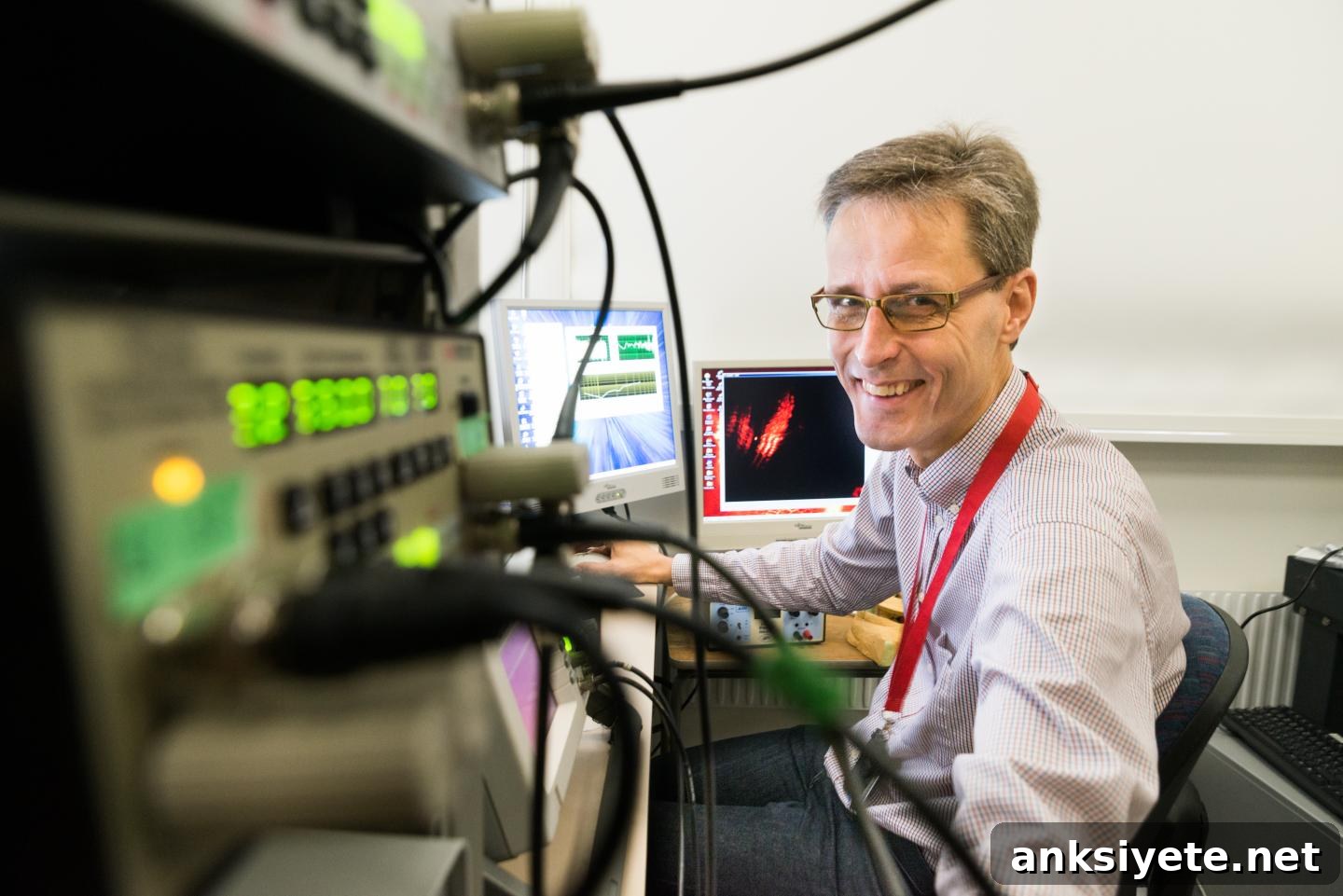
Image source and credit: Anders Fridberger, professor at Linköping University. Photo credited to Thor Balkhed/LiU.