Proof-of-concept study highlights new therapeutic use of engineered human stem cells.
Researchers at the Harvard Stem Cell Institute working through Massachusetts General Hospital have developed a promising new strategy to treat brain cancer using genetically engineered human stem cells. Led by neuroscientist Khalid Shah, MS, PhD, the team previously demonstrated the value of stem cells carrying cancer-killing viruses and now report a new approach: engineering stem cells to produce and secrete highly targeted tumor-killing toxins.
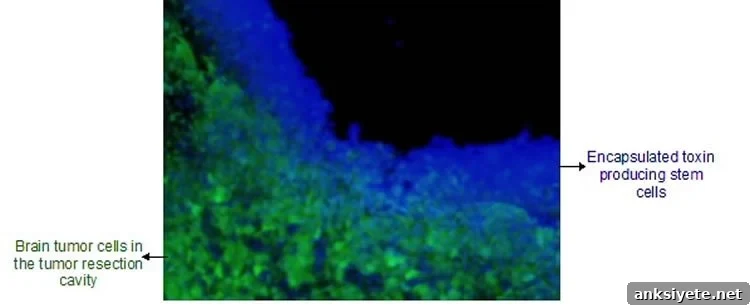
In the peer-reviewed journal STEM CELLS, Shah and colleagues describe a proof-of-concept that uses toxin-secreting stem cells placed into the brain after surgical removal of the primary tumor. The cells are delivered inside a biodegradable gel that fills the surgical cavity, allowing continuous local release of therapeutic proteins. This local, sustained-release strategy addresses a major challenge in treating brain tumors: direct delivery and stability of purified toxins in the brain. The investigators are pursuing FDA approval to advance these and related stem cell–based approaches into clinical trials.
Targeted protein toxins—sometimes called cytotoxins—have been effective against certain blood cancers for years, but they face significant obstacles in solid tumors of the brain. Those obstacles include poor access to tumor cells scattered through surrounding tissue, a short half-life of purified toxins, and the difficulty of delivering sufficient quantities without harming normal brain cells. To overcome these limitations, Shah’s team genetically modified human neural stem cells to be resistant to the toxin they secrete and to continuously produce the therapeutic molecule at the tumor site.
The engineered stem cells carry a deliberate mutation that prevents the toxin from interrupting the stem cells’ own protein synthesis machinery, making them toxin-resistant. The same cells contain genetic instructions to synthesize and secrete a modified toxin that selectively enters and disables cancer cells that display the toxin’s target molecule on their surface. Because the surrounding cancer cells lack the engineered resistance, they lose their ability to make essential proteins and die over the following days.
To test the approach in a clinically relevant setting, the investigators used a mouse model in which brain tumors are surgically resected, mimicking the standard treatment for many patients. After tumor removal, the toxin-secreting, resistant stem cells were implanted in the resection cavity in a biodegradable gel that holds the cells in place and enables sustained local release. Molecular analyses and in vivo imaging confirmed on-target inhibition of protein synthesis within residual tumor tissue. Importantly, animals receiving the engineered stem cells showed tumor cell death near the resection site and a measurable extension of survival compared with controls.
Shah emphasizes that this method solves a key delivery problem that likely contributed to the limited success of earlier clinical trials that attempted to administer purified cancer-killing toxins directly into the brain. By using living cells as delivery vehicles, the therapy provides continuous, localized production of therapeutic agents, reduces systemic exposure, and takes advantage of stem cells’ natural ability to home toward and persist near tumor tissue.
Looking ahead, the team plans to combine these toxin-secreting, resistant stem cells with other therapeutic stem cell platforms developed in Shah’s laboratory to enhance anti-tumor activity. Their goal is to improve outcomes in preclinical models of glioblastoma—the most common malignant brain tumor in adults—and to prepare a pathway toward early-phase clinical trials. Shah has indicated a plan to pursue translation into human studies within the next five years, pending regulatory review and further preclinical validation.
This work was supported by the National Institutes of Health and the James S. McDonnell Foundation.
Contact: Khalid Shah – Harvard
Source: Harvard press release
Image Source: The image is adapted from the Harvard press release
Original Research: Abstract for “Engineering toxin-resistant therapeutic stem cells to treat brain tumors” by Daniel W. Stuckey, Shawn D. Hingtgen, Nihal Karakas, Benjamin E. Rich and Khalid Shah in Stem Cells. Published online October 24, 2014 doi:10.1002/stem.1874