
TAU team connects neurons to computers to decipher the enigmatic code of neuronal circuits
Researchers at Tel Aviv University have developed a novel lab-on-a-chip platform that links living neurons to electronic systems in order to probe how neuronal circuits encode and transmit information. The device, described by doctoral student Mark Shein and his supervisors Prof. Yael Hanein and Prof. Eshel Ben-Jacob, combines engineering, nanotechnology and mathematical analysis to make previously inaccessible network activity visible and measurable.
Unlike a computer processor, which can be disassembled and understood through clear logical steps, the brain’s inner workings remain largely opaque. The TAU team’s approach creates controlled, engineered neural networks on a microelectrode array, allowing researchers to observe how groups of neurons interact, form patterns and communicate under a range of conditions. Their work was reported in the journal PLoS ONE.
Shedding light on a black box
Sensory systems such as the retina or the auditory pathway often reveal relatively simple stimulus-response patterns that can be mapped and modeled. By contrast, deeper cognitive processes — the electrical patterns associated with “thinking” and complex integration across brain regions — are more elusive. Shein explains that while stimulus-driven responses can be studied by applying defined inputs (for example, a bright flash of light) and measuring neural responses, more complex behaviors involve many interacting circuits and are effectively hidden inside a “black box.”
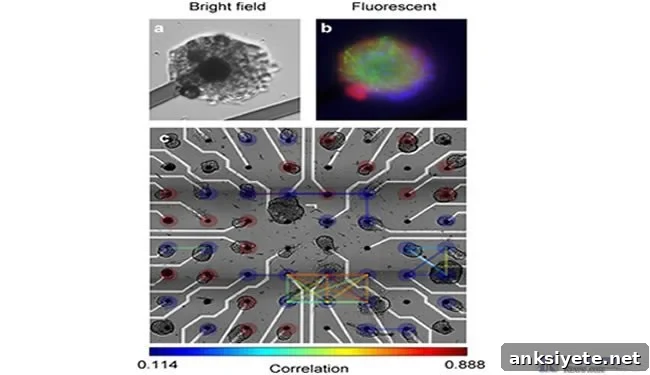
To open part of that box, the team grows networks of neurons on a specially designed chip. These circuits are organized into clusters and connected to electrodes that record activity from many sites simultaneously. This setup enables scientists to track how neuronal groups respond to stimuli, chemicals or changes in connectivity, and to search for recurring motifs or coding strategies across larger networks rather than focusing solely on single-cell behavior.
Advances in nanotechnology and multichannel recording allow the simultaneous monitoring of dozens or hundreds of neurons. This makes it possible to examine how multiple clusters coordinate, synchronize or propagate activity, and to observe emergent behaviors that do not appear at the single-neuron level.
The hierarchy of the brain
Using these engineered cultures, the researchers created neuronal assemblies of various sizes and configurations. They found complex, surprising dynamics that could not be predicted from single-cell properties alone. Electrical measurements taken at junctions where neurons converge revealed that networks often display a hierarchical organization: larger networks are composed of interlinked smaller subnetworks or clusters.
With their electrode array and cultured clusters, the team was able to distinguish functionally isolated clusters from those linked into broader networks, and to map correlations between cluster activities. These observations support the view that brain circuits are organized across multiple levels of scale, and that information processing may rely on coordinated interactions between nested subnetworks.
One theoretical suggestion from Prof. Ben-Jacob, discussed in the context of these findings, is that memory and information could be stored in a distributed, holographic-like manner: small sub-networks might hold low-resolution representations of larger network states. Experimentally, the researchers report that clusters as small as around 40 cells can act as minimal functional units, able to sustain activity and exchange signals with other clusters. Determining exactly how these compact assemblies contribute to coding, memory or computation remains an open question for ongoing research.
Beyond basic science, the platform has multiple potential applications. It can be used to test how neuronal networks respond to drugs or toxins, to explore principles that could inform artificial intelligence architectures, and to guide the development of neural prosthetics that interface artificial limbs or devices with living brain tissue.
Notes about this neuroscience research article
Source: Tel Aviv University press release
Original Research Article: Mark Shein Idelson, Eshel Ben-Jacob, Yael Hanein, “Innate Synchronous Oscillations in Freely-Organized Small Neuronal Circuits,” PLoS ONE, 2010; 5 (12): e14443. DOI: 10.1371/journal.pone.0014443
Image Source: Neuroscience News image adapted from PLoS ONE research article