
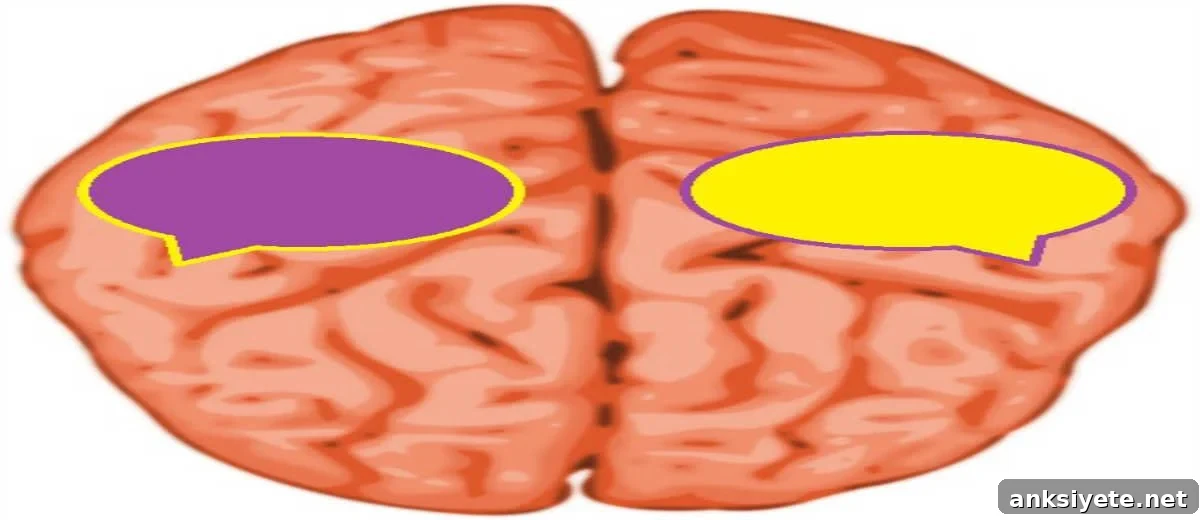
Researchers at New York University and NYU Langone Medical Center report that speech production engages both hemispheres of the brain, overturning long-held assumptions about lateralization and offering new directions for treating speech impairments after stroke or injury.
“Our findings upend what has been universally accepted in the scientific community—that we use only one side of our brains for speech,” says Bijan Pesaran, an associate professor in NYU’s Center for Neural Science and the study’s senior author. “In addition, now that we have a firmer understanding of how speech is generated, our work toward finding remedies for speech afflictions is much better informed.”
For decades, scientists have generally treated speech and language as lateralized functions: language (the construction and comprehension of sentences) is often strongly associated with one hemisphere, and speech (the physical production and auditory perception of spoken sounds) has been assumed to follow a similar pattern. Much of that understanding rested on indirect measures of brain activity, leaving open the question of whether speech production truly relies on a single hemisphere.
To answer this, the research team turned to direct neural recordings. They analyzed electrocorticography (ECoG) data collected at NYU ECoG, a center that records brain activity from patients who have temporary electrode implants placed on and within the brain for clinical monitoring. These clinical recordings provide high spatial and temporal resolution compared with noninvasive imaging approaches, allowing researchers to observe the timing and location of speech-related neural signals with exceptional detail.
“Recordings directly from the human brain are a rare opportunity,” says Thomas Thesen, director of the NYU ECoG Center and co-author of the study. “As such, they offer unparalleled spatial and temporal resolution over other imaging technologies to help us achieve a better understanding of complex and uniquely human brain functions, such as language.”
In the study, patients undergoing clinical monitoring for epilepsy completed simple speech tasks while the implanted electrodes recorded neural activity. To isolate speech motor control from higher-level language processes, participants were asked to repeat two non-words: “kig” and “pob.” Using nonsense syllables eliminates semantic and complex syntactic processing, focusing the measurement on the sensory–motor transformations involved in producing spoken sounds.
Analysis of the ECoG recordings revealed that neural activity associated with speech production appeared in cortical regions on both the left and right hemispheres. In other words, the physiological processes that transform sensory input into motor commands for speech operate bilaterally. This challenges the common assumption that speech production is strictly a unilateral function of the dominant hemisphere.
Understanding that speech-related sensory–motor processes are bilaterally organized has practical implications for rehabilitation. “Now that we have greater insights into the connection between the brain and speech, we can begin to develop new ways to aid those trying to regain the ability to speak after a stroke or injuries resulting in brain damage,” Pesaran notes. “With this greater understanding of the speech process, we can retool rehabilitation methods in ways that isolate speech recovery and that don’t involve language.”
Applying these findings could refine therapeutic strategies by targeting bilateral networks rather than focusing solely on the traditionally dominant hemisphere. Therapies that harness preserved function in either hemisphere, or that encourage cross-hemispheric compensation, may prove more effective for some patients recovering speech after injury.
Study contributors and support
The study’s other authors included Gregory Cogan (postdoctoral fellow at NYU’s Center for Neural Science), Chad Carlson (associate professor of neurology at the Medical College of Wisconsin), Werner Doyle (associate professor of neurosurgery at NYU Langone), and Orrin Devinsky (professor of neurology, neurosurgery, and psychiatry and director of the Comprehensive Epilepsy Center at NYU Langone).
Research funding came from multiple sources, including the National Institute on Deafness and Other Communication Disorders (part of the National Institutes of Health), NYSTAR, the Sloan Foundation, the McKnight Endowment Fund for Neuroscience, the Burroughs Wellcome Fund, and FACES (Finding a Cure for Epilepsy and Seizures).
Contact: James Devitt – NYU
Source: NYU press release about the study published January 15, 2014 (Nature article: “Sensory–motor transformations for speech occur bilaterally” by Gregory B. Cogan, Thomas Thesen, Chad Carlson, Werner Doyle, Orrin Devinsky and Bijan Pesaran; doi:10.1038/nature12935)
Keywords: neuroscience, speech, language, bilateral speech, ECoG, brain, stroke rehabilitation